Maryland General Assembly special elections could be on the horizon, lawmakers say
Published in Political News
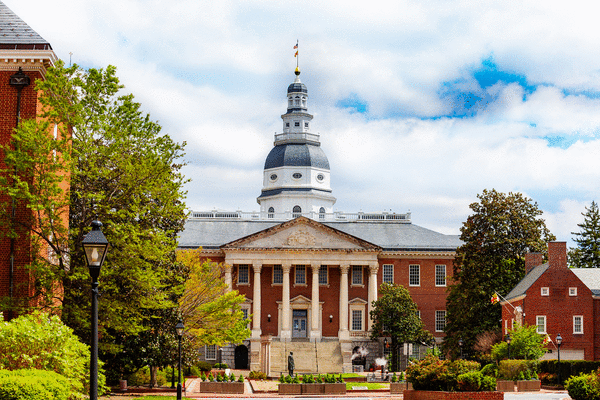
BALTIMORE — A measure that would require special elections be held at the same time as the regular statewide primary and general elections to fill Maryland General Assembly vacancies could finally get passed after 18 years since its first introduction, state lawmakers told The Baltimore Sun.
Senate Bill 5, sponsored by Montgomery County Democrat Sen. Cheryl Kagan, was approved by the full Maryland Senate Thursday and heads to the state House of Delegates, where the measure has died in committee several times. Maryland voters in districts where a lawmaker vacates their position would vote on a new representative on the presidential election ballot if the vacancy occurs at least 55 days ahead of the candidate filing deadline. Members of the state legislature are elected every four years, during midterm elections.
The Senate constitutional amendment would be placed on this year’s midterm election ballot as a referendum for voters to decide if the state should adopt the new election system. The faith in its approval is strong during the 449th legislative session, since it’s already because there’s a new House committee overseeing the bill under new leadership.
“I am very optimistic that this is the year that the special elections will prevail, and then it will go to the voters,” Kagan said. “We have better insight into our district and better connection to our community when we have been elected by the voters. We have knocked on the doors, we have shown up at community gatherings…all of that helps with preparing us to serve our constituents.”
Maryland is one of five states that only appoint vacancies in their state legislature, according to the National Conference of State Legislatures. About 14.8% of state senators were appointed, and 13.4% of members of the House of Delegates were appointed to their positions in the current assembly, according to a Baltimore Sun analysis.
Currently, whenever a seat in the state legislature becomes vacant within a lawmaker’s four-year term, the party central committee of the county and the political party of the departing lawmaker nominates their replacement. The governor then officially appoints the next representative. County central committees are formal political party organizations elected by county residents.
If the bill passes the state legislature and is approved by the voters, the governor would continue to make appointments to fill vacancies before the presidential election and until the next midterm cycle, when all members of the general assembly are up for election.
The bill has bipartisan support, with all but one senator voting for the legislation on Thursday.
Del. Kevin Hornberger, a Cecil County Republican and sponsor of a previous version of the special elections bill, said it is a “pro-democracy bill,” and that he supports the bill’s current iteration. He added that the legislation is especially important given the four-year terms members of the Maryland General Assembly have.
“What we don’t want is constituents to go without representation,” Hornberger said. “In a perfect world, as soon as someone steps down, you would have another election. But for the reasons… with the cost and logistics and extremely low turnout that happens with (separate) special elections, this is the most logical compromise.”
Jared DeMarinis, Maryland’s state administrator of elections, told the Sun that adding a state legislature special election to the presidential election would not cost the state additional funds. He added that hosting the special election during a presidential election would lead to higher voter turnout than a standalone special election.
Maryland holds separate special elections when there are vacancies in congressional seats and statewide offices. Some municipalities and counties also host separate special elections to fill vacancies.
Over the years, critics of the measure have said that the appointment process has paved the way for more diverse appointments to the state legislature.
Sen. Antonio Hayes, a Democrat, was the only vote against the Senate bill on Thursday. In an interview after the vote, Hayes said that the party central committees are already elected by people who live in the district and that the current appointment process evens the playing field for candidates in terms of resources.
“With special elections, and in many elections, it’s about who have resources,” Hayes said, referencing the struggles of running a campaign. “African Americans don’t typically have the same amount of access to the resources needed in campaigns, but the current system that we have has afforded us to have one of my most diverse legislatures in the country.”
While some still hold this reservation, past critics say the time is now to bring special elections for members of the general assembly.
Del. Jheanelle Wilkins, a previous opponent of the bill and former chair of a subcommittee on elections, told The Baltimore Sun that she will now be added as a co-sponsor to the special elections bill. Wilkins added that she has highlighted that there are many lawmakers, including herself, who were first appointed to the state legislature and made history once sworn in. She was the first Black woman to represent her district. The frequency of appointments in recent years, Wilkins said, helped to change her mind on the bill, adding that some concerns about the diversity of the chamber have “naturally been addressed.”
“It has been important to me to point out the diversity that has happened through the appointment process, and so that’s something that I’ve historically made sure that I addressed,” Wilkins said. “But over the years, we’ve been able to work on the bill…we’ve had an unprecedented number of appointments recently, and so over time and working on the bill, I’m extremely supportive of it.”
Because of committee restructures from last year, the new House Government, Labor, and Elections Committee will vote whether to send the bill to the floor, following the bill hearing on Wednesday. The chair of that committee, Baltimore City Democrat Del. Melissa Wells, said its a “good bill for the conversation about accountability and empowering our voters voices,” and that the bill is a good pathway for how to do that affordably.
While there is a House version of the bill, because the proposal is for a constitutional amendment, the passed Senate version of the bill would likely be the one, if voted out of committee.
House Speaker Joseline Peñya-Melnyk’s office did not respond to a request for comment for this story.
©2026 Baltimore Sun. Visit baltimoresun.com. Distributed by Tribune Content Agency, LLC.










































Comments