Special election winners on starting in the middle
Published in Political News
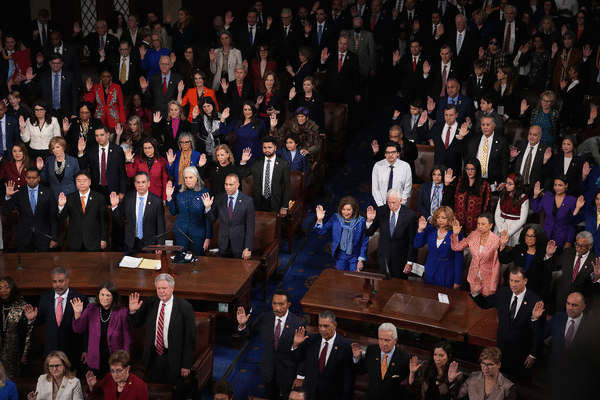
WASHINGTON — Rep. Randy Fine remembers pulling an all-nighter before his first day in the House.
“I was a congressman-elect for 22 hours,” he said.
After winning a special election in Florida’s 6th District last April, Fine left his victory party at 10 p.m., drove two hours to the airport, and arrived in Washington the next morning.
At the Capitol, he quickly met with House Sergeant at Arms staff, who handed him a member pin, a member card, the key to his new office, and a license plate for his car.
“That was it,” the Republican said. “I got sworn in that afternoon.”
He’s one of six special election winners to join the 119th Congress so far — instead of starting at the beginning, they jump in midstream. The latest is Texas Democratic Rep. Christian Menefee, who took the oath of office last week.
Menefee won a runoff on Jan. 31 to succeed former Rep. Sylvester Turner, who died last March. The House expects to welcome at least three more members in the coming months to fill its current vacancies: Georgia’s 14th District has a special election scheduled on March 10; New Jersey’s 11th District has one on April 16; and California’s 1st District will vote on Aug. 4.
In ordinary circumstances, incoming House freshmen get around two weeks of orientation and training organized by the House Administration Committee alongside support offices like that of the Chief Administrative Officer, Sergeant at Arms and Capitol Police. They learn about setting up their staff, security and House rules and regulations.
But when you win a special election, it’s a little different.
Rep. Jimmy Patronis, who was sworn in last spring on the same day as Fine, said he did as much homework as possible. The two Floridians represent solidly Republican districts, with the former replacing Matt Gaetz and the latter replacing Mike Waltz after he resigned to join the Trump administration. While both newcomers arrived on the Hill with experience in the legislative process, or at least how it’s done in the state legislature, Patronis said he relied heavily on advice from his future colleagues in Florida’s congressional delegation.
And he credits his wife with finding a handbook for members ahead of his election.
“Katie went and actually printed it out at her office, so that’s how we got a copy of it,” Patronis said. “I started reading through it. I just wanted to be prepared.”
Menefee also has been consulting his fellow Texans in the House and points to learning House procedure as his most immediate priority.
“I like to be deep in rules and be the nerd who can outsmart people because I know all the ins and outs of the rules, and that is not where I am today,” he said.
Until recently he served as Harris County attorney and oversaw 300 people in his office, including some lawyers with careers older than he was, Menefee said.
“I figured that out,” he said. “I’ll figure this out.”
Rep. Adelita Grijalva, D-Ariz., had a longer transition period between her election and swearing-in. She took the oath of office on Nov. 12, almost two months after winning a special election to fill the seat left open by her father, former Rep. Raúl M. Grijalva, who died while undergoing cancer treatment.
While Speaker Mike Johnson blamed the delay on the government shutdown happening at the time, Democrats accused him of slow-walking her official start date. Grijalva went on to provide a key signature in the push to compel the release of material related to the late sex offender Jeffrey Epstein.
Grijalva used that state of limbo to start setting up her office, interview candidates for staff positions and go to meetings with Democratic House lawmakers. But even with a longer on-ramp, she said she would have liked more formal training opportunities.
“There are a lot of things that I think people assume, because my dad was in Congress for 22 years, that somehow I was able to, by osmosis, learn it,” she said. “But I never interned on the Hill, never was a staffer. I think in the 22 years my dad was in Congress, I went maybe five times.”
House Administration majority and minority staffers onboard their respective party members who enter Congress via special election, according to aides familiar with the process. Topics range from how to use their Members’ Representational Allowance, hire staff and establish district offices.
Rep. James R. Walkinshaw, who succeeded his former boss, the late Rep. Gerald E. Connolly, was more ready to step into office than many of his peers, thanks to his 11 years as Connolly’s chief of staff. He attended the new member orientation when Connolly was elected in 2008.
But even with his experience, he thinks a more structured orientation for special election winners would help.
“I didn’t need a primer on everything, but it’s maybe a flaw in the process that you have to ask for help or guidance,” Walkinshaw said. “The first day is hard because things are happening so fast.”
Grijalva plans to attend the future orientation that will be offered to the class elected in 2026. In the meantime, she has been learning on the job.
“I think everything they offer to the freshman class, they should offer to us,” Grijalva said. “I know it’s hard and would probably be abbreviated, (but) the very first day I got my voting card, I almost missed a vote.”
“I think that we’re doing pretty well and everybody’s been super helpful, but it is one of those, like, ‘I don’t know what I’m not asking’ situations,” she added.
_____
©2026 CQ-Roll Call, Inc. Visit at rollcall.com. Distributed by Tribune Content Agency, LLC.








































Comments