Bondi to face criticism over Epstein disclosure law at House hearing
Published in Political News
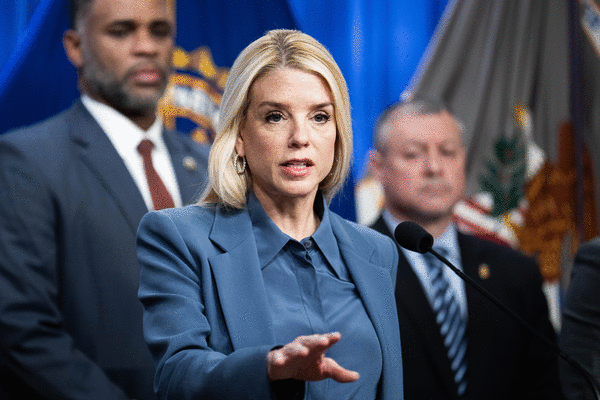
WASHINGTON — Attorney General Pamela Bondi is set to face House lawmakers at an oversight hearing Wednesday expected to focus in part on a string of controversies stemming from the Justice Department’s handling of the Jeffrey Epstein file release.
For Bondi, it will be her first appearance before the House Judiciary Committee as attorney general, with controversy swirling around the Justice Department on a wide swath of issues during President Donald Trump’s second term.
Those include the legal justifications for an incursion to arrest Venezuelan President Nicolás Maduro and military strikes on boats in the Caribbean Sea and Pacific Ocean, as well as DOJ’s role in the administration’s immigration enforcement and pursuit of criminal charges against Trump’s political rivals, former FBI Director James Comey and New York Attorney General Letitia James.
The high-profile hearing will offer members a rare chance to also press Bondi directly on the department’s compliance with a law Congress passed last year that required making Epstein documents public. Lawmakers, in passing the bill, hoped to shed light on Epstein’s network and any figures connected to the sexual exploitation of girls.
Backers of the law and Epstein survivors say the department overly redacted information that could identify people who may have been co-conspirators or enablers of his abuse, while committing egregious errors in failing to fully redact the names and identifying information of victims.
Rep. Jamie Raskin, the top Democrat on the panel, told reporters Monday that the department’s redaction decisions run contrary to the law.
“We’re going to start by posing questions directly to Attorney General Bondi about the process that produced such flawed results and that has created such mystery,” Raskin said. “The Department of Justice has been in a cover-up mode for many months and has been trying to sweep the entire thing under the rug.”
Rep. Thomas Massie, R-Ky., a member of the Judiciary committee and one of the main backers of last year’s law, known as the Epstein Files Transparency Act, reviewed unredacted versions of the files on Monday and said lawmakers discovered the government redacted the names of six men in versions of the files that were made public.
Massie said on Sunday that “there’s a whole host of questions” for Bondi. “If you notice, they don’t put her out in front anymore, they put (Deputy Attorney General) Todd Blanche out in front, because she’s been all over the map, she has no credibility on this,” Massie said during an interview on CNN.
Rep. Ro Khanna, D-Calif., another main backer of the Epstein law, said some of the documents they viewed behind closed doors remained redacted, even though the lawmakers were supposed to see unredacted versions.
That was the case because some of the documents provided to the Justice Department from the FBI and the grand jury were redacted when received, Khanna said.
Backers of the law have also hammered the Justice Department for the breadth of documents it has decided to withhold. The department identified more than 6 million pages that were potentially covered by the law but acknowledged the total production from the department was nearly 3.5 million pages.
Lawmakers are also seeking a commitment from the department to release the additional files the agency withheld, Raskin said.
Meanwhile, the department has pointed to exceptions in the Epstein files law that allow the department to withhold certain information, such as the personally identifiable information of victims, depiction of child sexual abuse material, images of physical abuse and information that would jeopardize an active federal investigation.
Survivors of Epstein’s abuse, in a joint statement after last month’s release of documents, said the Justice Department cannot assert it is done releasing the files until “every legally required document is released.”
“As we have always said, this is not about politics. We hope Democrats and Republicans will stand with survivors in continuing to demand the full release of the Epstein files,” they said in the statement.
Other questions
House lawmakers could also press Bondi on accusations that over-redactions in the documents appear to provide cover for those tied to Epstein, presenting an incomplete view of Epstein’s orbit.
And she could also face questions about why the department did not charge more individuals in connection with Epstein in the past, and what the department might do on the topic going forward.
Included in the file release is a drafted 32-count grand jury indictment that would have brought a range of criminal charges against Epstein, including counts for sex trafficking and enticement of a minor.
Other people were listed as defendants, but their names are redacted. Epstein had employed the other defendants, according to the draft indictment.
The New York Times reported the drafted indictment was prepared by prosecutors in 2007. The document states Epstein and other defendants conspired to “persuade, induce, and entice individuals who had not attained the age of 18 years to engage in prostitution.”
The draft said the purpose of the conspiracy was to “procure females under the age of 18” to travel to an Epstein-owned property in Palm Beach, Fla., so he could “engage in lewd conduct with those minor females” to satisfy his “prurient interests.”
Rep. Deborah K. Ross, D-N.C. expressed outrage that others outside of Epstein and his associate Ghislaine Maxwell had not faced federal charges.
“This is just a big cover-up,” Ross, a House Judiciary member, said in an interview. “And if there’s anything that made that clear, it was the most recent release. And we haven’t even seen the other half of the files.”
_____
©2026 CQ-Roll Call, Inc., All Rights Reserved. Visit cqrollcall.com. Distributed by Tribune Content Agency, LLC.












































Comments