Supreme Court to hear arguments on Haiti, Syria TPS; future of 355,000 people at stake
Published in Political News
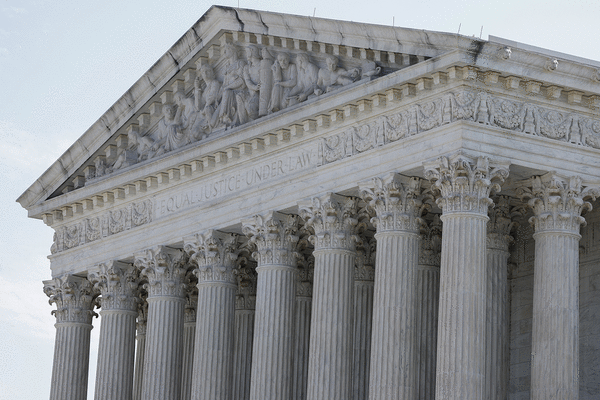
The US. Supreme Court announced Monday it will have oral arguments next month on Trump administration requests to end temporary protected status for Haiti and Syria.
In a one-page order, the high court said it would schedule an hour in April to hear arguments about whether some 356,000 people from the two countries should keep their deportation protections under TPS. It also requested both sides to submit legal briefs in the coming weeks.
So far, the Supreme Court has greenlit an emergency request to allow the Trump administration to end TPS for Venezuela, leaving over half-a-million people from the South American country in turmoil without the deportation protections.
But Monday’s order delayed making a call on the Trump administration’s request to end TPS for Haiti and Syria. It also sets up the stage for a consequential decision that shapes the future of hundreds of thousands of immigrants from several countries living in the United States under the protections.
For now, over 350,000 Haitians and Syrians — many who came here fleeing extreme violence and conflict in their home countries — are shielded from deportation under TPS while litigation is ongoing.
The development comes only days after the Trump administration asked the nation’s high court to end the protections immediately for Haiti. Solicitor General John Sauer argued that the lower courts had overstepped and infringed on executive authority.
The administration had made a similar request to end the protections for Syrians about two weeks ago when another judge upheld TPS for the Middle Eastern nation. It also asked the Supreme Court to declare that the courts don’t have jurisdiction to challenge the termination for Syrians — which would mean it has no authority to rule on terminations about any other group. In both cases, the federal government argued that it was not in the national interest to keep the TPS designations in place.
In January, U.S. District Judge Ana C. Reyes in Washington, D.C., ruled that the Department of Homeland Security had illegally ended TPS for Haiti and that the decision had been driven by racial and national animus. She also said that it would be devastating for Haitian beneficiaries of TPS to lose the protections.
In February, an appeals court upheld Reyes’ decision 2-1. The Second Circuit Court of Appeals in Manhattan separately upheld the protections granted by a district court order for Syria while litigation is ongoing. In both the Syria and Haiti cases, beneficiaries from both countries challenged the Trump administration’s decision.
“While we are relieved that our plaintiffs and thousands of other Syrians will maintain their TPS status for now, it is disappointing that the Supreme Court took the extraordinary measure of taking on our case before the lower courts have weighed in,” said Lupe Aguirre, deputy director of U.S. Litigation at International Refugee Assistance Project, in a statement.
Her group is one of the organizations representing the Syrian TPS holders challenging the Trump administration’s decision to end the program. The organization said that Wednesday’s order allowed “the government to bypass the normal course of briefing and arguments at the appeallate level.”
There are more than 350,000 Haitians and about 6,100 Syrians with TPS. The State Department has warned Americans not to travel to either country because of risk of kidnapping, crime and death.
Gangs control large swaths of Haiti, including its capital, Port-au-Prince. Millions of Haitians live in extreme poverty. More than 1.4 million people have been forced to flee their homes by late 2025, according to the United Nations. Meanwhile, sectarian violence, terrorist groups and a civil war have ravaged Syria, whose dictator, Bashar al-Assad, fled in 2024 after two plus-decades of repressive rule.
Congress created TPS in 1990 to create a deportation shield for people who cannot safely return to their home countries because of dangerous conditions. To qualify, people must be in the U.S. before a certain cut-off date as well as clear background checks and application requirements. The federal government also has the chance to periodically review the conditions in countries with TPS to determine whether they should keep or cancel the status.
While in the White House, former President Joe Biden significantly expanded temporary protected status designations. His administration created, renewed or expanded the protections for several countries, including Venezuela, Haiti, and Ukraine.
However, President Donald Trump has opted to end the protections for several countries, with top administration officials arguing that the protections were always meant to be temporary, that some conditions had somewhat improved in countries like Venezuela and Haiti, and that the TPS designations go against American interests. He also moved to terminate TPS for Haiti and other nations during his first term.
_____
(Miami Herald staff writer Jacqueline Charles contributed to this report.)
_____
©2026 Miami Herald. Visit miamiherald.com. Distributed by Tribune Content Agency, LLC.



























Comments