Trump's Iran war drive exposes limits of 'Yes, sir' Cabinet
Published in Political News
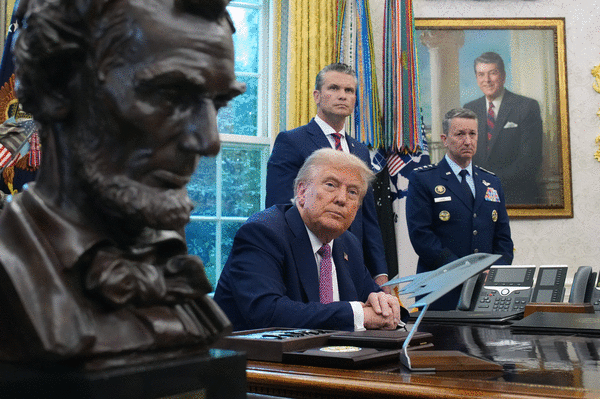
Donald Trump’s decision to wage war on Iran was partly motivated by pressure from outside allies while his own White House team stayed more muted — underscoring how in his second term, guardrails have been traded for a green light.
Those privately pressing Trump to strike Iran included Israeli Prime Minister Benjamin Netanyahu, media mogul Rupert Murdoch and some conservative commentators, according to people familiar with the matter who spoke on the condition of anonymity to discuss private conversations. The News Corp. founder communicated with Trump several times as he urged the president to take on Tehran, according to one person briefed on their interactions.
Meanwhile, some of Trump’s closest advisers were more muted about the prospect of an armed conflict, including Vice President JD Vance, Secretary of State Marco Rubio and White House Chief of Staff Susie Wiles, the people said.
Few, if any, told him directly it was an ill-conceived idea. Wiles tried to ensure the president understood his options, the people said, while Vance urged top officials to speak candidly to the president and about the possibility of war. In private meetings before the attacks, Vance asked questions about how any war would work.
Tommy Piggot, a State Department spokesperson, said it’s “an old familiar story of people not knowing what they are talking about pretending that they do. There is no division. President Trump is making the world safer, and the entire administration is lockstep in that effort.” Representatives for Murdoch didn’t immediately respond to requests for comment.
Launching the war, which just entered its fourth week, marked one of the most momentous choices of Trump’s second term. It has since thrust his administration onto the precipice of an international and domestic crisis, shaking US alliances, driving up energy costs and complicating Republicans’ chances in November’s midterm elections.
Despite those factors, Trump has dug in his heels and insisted the decision when to end the war rests with him. It illustrates just how empowered the president has been to act on his instincts and how little pushback he faces from his team — even when he abandons key campaign promises, such as ending foreign wars.
“What he wanted for his advisers in his second term was people who were more amenable just to saying, ‘Yes, sir’ when he wanted to do X or Y, as opposed to people who said, ‘Have you considered this or that or the other thing,’” said John Bolton, who served as national security adviser during the president’s first term but has since become a prominent critic.
“President Trump wants to hear the honest opinions of everyone in the room,” White House Press Secretary Karoline Leavitt. “Anyone who has actually been present for meetings with him will tell you he often solicits the opinions of all of his advisers, no matter their title or expertise, asking ‘what do you think?’ And he expects honest feedback.”
The war is the latest, yet most striking example, of how Trump has barged ahead with consequential decisions despite the reservations of some around him, such as his global tariffs that were later struck down by the Supreme Court.
‘Much more power’
Still, Trump has often hailed his team’s loyalty and contrasted it with his first-term Cabinet, which was filled with officials who often butted heads with him, and each other.
“I have much more power in my second term,” Trump said Friday at the White House.
A concern for many Republicans has been the toll the war would take on their political fortunes in midterm elections that will likely turn on voter perceptions of the economy and the cost of living.
“It does not appear our energy costs will not be going down anytime soon,” said GOP strategist Marc Short, who served in Trump’s first administration. “There will be significantly higher cost pressures for working families.”
Polls show slight majorities of Americans oppose the conflict and some prominent voices in Trump’s “Make America Great Again” movement, including Tucker Carlson and Steve Bannon, have criticized it.
Still, one Republican in frequent touch with the White House said many aides seem unfazed by the Iran war, the spike in energy prices or the way it could damage the party’s economic message. Trump has said the war is worth enduring short-term pain and insisted that the price of gasoline will fall when the conflict ends.
Conservative media personalities close to Trump, including commentator Mark Levin, and Sen. Lindsey Graham, R-S.C., are among others who advocated for war.
‘Quite enthusiastic’
Even Trump advisers who previously opposed military strikes on Iran have remained relatively silent. Director of National Intelligence Tulsi Gabbard said this week during a congressional hearing that Trump is the “only person” who can decide whether Iran continues to pose an “imminent threat.”
Vance, a U.S. Marine veteran and longtime skeptic of foreign intervention, has publicly endorsed the war, even as Trump has suggested that the two had somewhat differing views behind closed doors.
Trump earlier this month said of his number two: “He was, I would say, philosophically a little bit different than me. I think he was maybe less enthusiastic about going, but he was quite enthusiastic.”
Vance said Monday he supports the troops and agrees with the president that Iran should not have a nuclear weapon. He has declined to discuss his private counsel to the president, but has said he believes Trump will be able to successfully navigate the conflict, unlike previous presidents.
So far the only Trump official to air an opposing view is former National Counterterrorism Center Director Joe Kent, who posted on X that he was resigning because he could not support “sending the next generation off to fight and die in a war that serves no benefit to the American people.”
Vance said it was right for Kent to quit. “It’s fine to disagree, but once the president makes a decision, it’s up to everybody who serves in his administration to make it as successful as possible,” Vance said Wednesday during an event in Michigan.
In Trump’s first term, his national security officials sought to tame the president’s impulses. Often, they did not see eye to eye. Defense Secretary Jim Mattis resigned a day after the president abruptly called for the withdrawal of American forces from Syria, citing policy differences. Then-White House Chief of Staff John Kelly had frequent arguments with Trump and in one heated exchange, dissuaded the president from pulling all U.S. troops from the Korean Peninsula, NBC News reported at the time.
When he led the National Security Council, Bolton wanted to bomb Iran many times and openly told the president his views, even though Trump disagreed with him. “I’m the one who tempers him, which is OK,” Trump once said of Bolton.
Wiles’ mantra as chief of staff has been to allow Trump to act as he pleases. She only tries to control the people and processes around him, a strategy that has earned the president’s implicit trust and helped her outlast her predecessors.
Trump had four chiefs of staff, including acting chiefs, in his first four-year term. This term, Wiles has been the only person in that role.
———
(With assistance from Eric Martin.)
©2026 Bloomberg L.P. Visit bloomberg.com. Distributed by Tribune Content Agency, LLC.







































Comments