Peru's perennial presidential loser is getting her best shot yet
Published in Political News
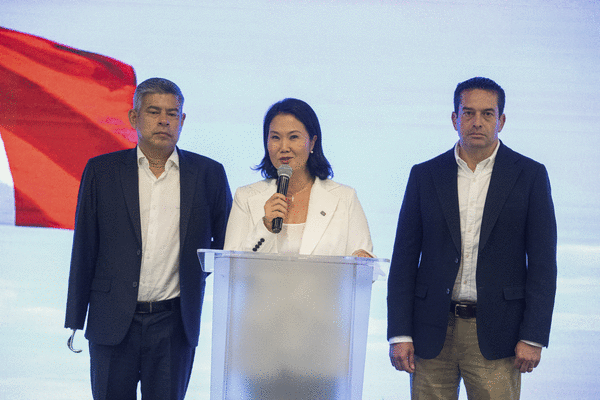
Peru’s Keiko Fujimori, the second-place finisher for three straight presidential elections, is now positioning herself for a victory that would capitalize on the power structure she’s built over two decades in the shadow of her father’s legacy.
While official results from Sunday’s vote are still being counted, Fujimori has enough of a lead that she’s likely to head to a June runoff, although her opponent has yet to be determined. She’s lost the last two votes for the presidency by only around 40,000 votes.
Fujimori, the daughter of late former President Alberto Fujimori, has reason to believe this time is different.
“I once said that even a tree could beat Keiko Fujimori,” said Patricia Zárate, who heads polling for IEP, a Peruvian think tank. “But I think we’re now in a different place.”
The 50-year-old conservative has pitched herself as a source of stability and continuity after years of impeachments and ousters, despite her role in that upheaval as a major congressional power broker.
Her pro-market positions have won support from investors who see her as a “shield” protecting the country’s 1993 constitution, a pro-business charter enacted under her father, from a potential leftist opponent, said Carlos Meléndez, a political analyst who runs the 50+Uno consultancy in the capital Lima.
Fujimori has also firmly established herself as a tough-on-crime politician at a time when voters are citing public safety as their top concern.
Victory in the June 7 runoff would make her the first woman ever elected president in Peru. It would also add her to a growing list of Latin American candidates, like Chile’s José Antonio Kast and Ecuador’s Daniel Noboa, to prosper by offering voters an iron fist on security and market-friendly economic plans, a trend that may be extended into Colombia and Brazil later this year.
A fourth defeat, by contrast, would raise doubts about whether Fujimori will ever succeed in winning the job.
First place, again
Keiko, as she’s commonly known to Peruvians, is poised to finish first in the initial round of voting, with early counts showing that she won about 17% of votes.
“The mandate of Peruvians is very clear, they want order,” she said Sunday night, after polls closed.
A representative for Fujimori didn’t respond to requests for comment.
The focus on law and order is reminiscent of the days when Alberto Fujimori, who led Peru from 1990 to 2000, crushed violent Maoist insurgents who had sought to overthrow the government. The late Fujimori also laid the foundation for the country’s economic transformation into a copper-exporting powerhouse by wrangling hyperinflation into submission.
Alberto Fujimori’s eldest daughter Keiko became his first lady at 19, following her mother’s public accusations of abuse and corruption against Alberto, and has since spent nearly her entire life in politics.
She remained in Lima after his sudden resignation by fax from Japan in 2000, and six years later won election to congress. In 2011, she first ran for president while helming the party now known as Popular Force.
Fujimori has long invoked memories of her father’s administration, and this year has sought to curate his economic and security credentials into a message that will push her over the top.
She’s pledged to cut red tape for entrepreneurs and boost Peru’s annual growth to 6% — up from its current 3% — while respecting macroeconomic rules and the central bank’s independence. On crime, she’s vowed to restore “order, peace and progress for all Peruvians.”
She plans to tighten control over borders and deport migrants she considers criminals in a nation that has taken in some 1.5 million Venezuelans in recent years. Fujimori also wants to make prisoners pay for meals while replicating the high-security mega-prison El Salvador built under President Nayib Bukele.
In past campaigns, however, the controversial flipside of her father’s legacy has weighed on her chances.
The elder Fujimori fled Lima 26 years ago amid allegations of corruption and human rights abuses. He was later extradited from Chile to Peru, where he was imprisoned and convicted for graft and the use of death squads in his campaign against guerrilla groups.
But with concerns about violent crime and migration now at the top of Peruvian minds, it’s clearly a bet that voters who once refused to back anyone with the Fujimori last name will at least consider it now.
“We need strong leadership like my father had,” Fujimori said in one of the debates. “I’ve got the guts to take on crime.”
Just over half of Peruvians say they’d never vote for her in an IEP poll released in February, more than 10 times the rejection of top rival Rafael López Aliaga, a former Lima mayor.
But a runoff that pits her against another conservative could help blunt those concerns, especially if her opponent is perceived as even further to the right than she is.
Early results suggest that could be the case. López Aliaga, who’s modeled his candidacy on the brash political style of Donald Trump and is known colloquially as “Porky,” is currently in second place, according to the official count.
“This is the best-case scenario for Fujimori, because she always went to the runoff against someone who was to her left,” Meléndez said. “This time López Aliaga is in a corner to her right and she has all the space on the other side.”
A so-called quick count from Ipsos suggests that two other candidates — center-right sociologist Jorge Nieto and leftist lawmaker Roberto Sánchez — also have a shot at making the runoff.
The latter would create an effective rematch of 2021, when Fujimori narrowly lost to former President Pedro Castillo, a little-known leftist schoolteacher. But she has spent the last five years crafting a message for that scenario, according to Meléndez.
“Keiko has been playing the anti-communism card very well, because she has realized that to fight anti-Fujimorismo you have to go against communism,” he said.
Her own hurdles
Regardless of who her new opponent turns out to be, the complicated past of her late father, who had publicly mused about running again himself before his death in 2024, won’t be the only challenge for Fujimori to overcome.
She has earned a reputation in her own right, running the Popular Force party and its highly influential legislators in congress. That’s helped her maintain her status as one of the country’s most prominent and powerful figures despite her repeated defeats.
Many Peruvians, however, blame Popular Force at least partially for the tumult that has gripped the nation’s politics.
Peru has cycled through nine presidents over the last decade. It’s had four since Fujimori lost the 2021 race to Castillo, who was impeached and imprisoned after trying to close down congress — much as her father had tried to do nearly 30 years prior.
Fujimori has also been dogged by her own corruption allegations, and was investigated for money laundering related to the financing of her 2011 and 2016 campaigns.
She briefly did a stint in a women’s prison under pre-trial detention, but maintained her innocence throughout the probes, arguing that efforts to prosecute her were a way of criminalizing politics.
Peru’s top constitutional court dismissed the case last October, ruling before a trial could take place that the laws being used to prosecute her didn’t exist at the time of the alleged crimes.
Days later, Fujimori announced that she would run for president again.
©2026 Bloomberg L.P. Visit bloomberg.com. Distributed by Tribune Content Agency, LLC.















































Comments