Editorial: Congress ought to fix the flawed Saudi nuclear deal
Published in Political News
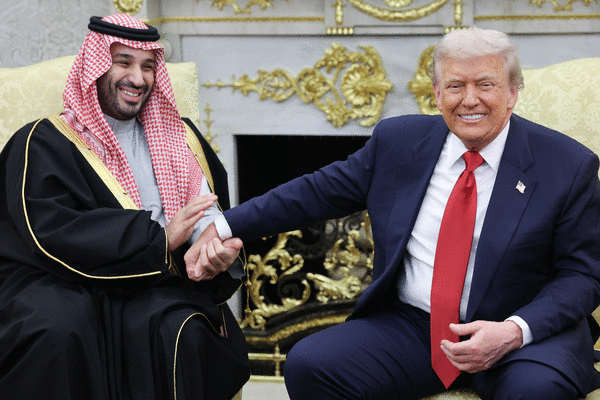
The confusion surrounding a proposed civil nuclear deal with Saudi Arabia hasn’t exactly disappeared: The White House is still claiming it depends on the country normalizing relations with Israel, even if that’s not part of the written agreement. At least Congress now has the text for review. Having seen its flaws, legislators should demand changes.
The 30-year nuclear cooperation pact would allow U.S. companies not only to build new reactors in the kingdom, but possibly also a uranium enrichment facility — needed to produce the fissile material for a bomb. The two governments would have up to two years to decide whether an indigenous enrichment program makes sense, both commercially and in terms of U.S. national interests. If so, the U.S. would introduce but restrict the sensitive technology, keeping it in a metaphorical “black box” to prevent transfer to the Saudis. Congress has 90 days in session to decide whether to oppose the deal; otherwise, it’ll go into effect automatically.
Proceeding on such terms would be risky. For decades, the U.S. and other nuclear suppliers have refused to provide customers with the technology to enrich uranium or reprocess spent fuel, precisely so they couldn’t assemble the working materials for a bomb. Saudi Crown Prince Mohammed bin Salman has already said his nation would “have to” match Iran if it develops a nuclear weapon; the mere possibility that the Saudis might do so will encourage other countries in the region to pursue one as well. Any restricted facilities will be vulnerable to leakage, if not outright seizure.
It’s unclear why the U.S. even needs to offer such a concession. Other suppliers aren’t threatening to provide the same access to enrichment technology; Russia and China compete mainly on cost. Besides, the Saudis have been pursuing access to U.S. nuclear technology for nearly two decades. They’ve had plenty of time to seek alternatives if they wished. Breaking with precedent, on the other hand, could liberate U.S. rivals to do the same. (Russia is already leading major reactor projects in Egypt and Turkey.) It would also dramatically weaken the U.S. case against allowing Iran a domestic enrichment program.
While a joint resolution opposing the agreement seems unlikely to muster a veto-proof majority, Congress should still use this chance to press for greater clarity and stronger safeguards against proliferation.
At minimum, lawmakers should thoroughly scrutinize the classified documents linked to the deal, including two secret side letters, and insist on answers to unresolved questions such as whether the Saudis would be allowed to pursue an independent enrichment program if the joint study decides against one. Congress should insist on input into that study, to ensure the arguments against allowing nuclear fuel-making are fully absorbed.
Legislators should continue to push for the Saudis to sign an Additional Protocol with the International Atomic Energy Agency, allowing for expanded international inspections. Failing that, they should press the administration to work with the IAEA on expedited procedures to investigate any suspicions that the Saudis may be pursuing a hidden enrichment or weapons program. Perhaps most important, Congress should lay out severe consequences for such cheating — including asset freezes and cutting off access to other U.S. technology.
The administration should be commended for looking for ways to boost U.S. nuclear exports. But that goal shouldn’t be pursued at any cost — and Congress should say so clearly.
_____
The Editorial Board publishes the views of the editors across a range of national and global affairs.
_____
©2026 Bloomberg L.P. Visit bloomberg.com/opinion. Distributed by Tribune Content Agency, LLC.

















































Comments