Omar's home search breaks from DOJ norms, former federal prosecutors say
Published in Political News
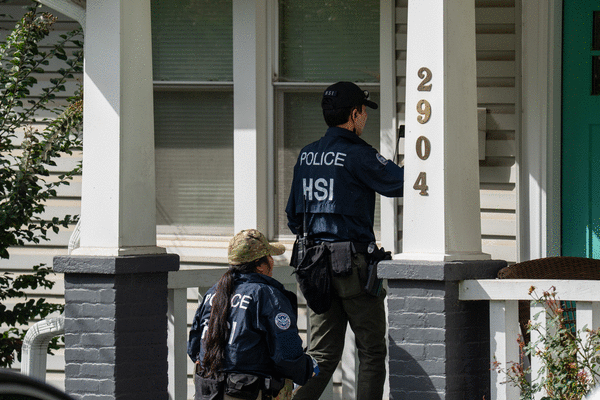
The federal raid at Rep. Ilhan Omar’s home in Washington, D.C. on Monday prompted reactions that fell along party lines: celebration from conservative figures and outrage from the Minneapolis Democrat’s supporters.
It also caused some unease among some former federal prosecutors, who say the search appears to have broken a few longstanding political and legal norms within the highest level of government.
There has long been an informal DOJ practice to not engage in headline-grabbing investigations or raids for roughly 60 days prior to an election if the matter can wait without jeopardizing a case, so as to not influence voting. Monday’s raid was 22 days before Election Day.
“In my experience, there was always a high level of sensitivity about doing things close to an election cycle,” said B. Todd Jones, who served as Minnesota’s U.S. Attorney for two terms under the Clinton and Obama administrations.
Former U.S. Attorney Joyce Vance of Alabama, an Obama appointee, raised concerns about the timing on social media.
“We are within the period before an election where DOJ doesn’t take overt steps in an investigation that might influence its outcome,” Vance wrote on X. “Another hard norm out the window.”
Federal searches of elected officials’ homes are not without historical precedent. President Donald Trump’s Mar-a-Lago estate was searched in 2022; a search of the home of former U.S. Sen. Bob Menendez led to corruption charges against him in 2023; and U.S. Rep. Henry Cuellar was also subject of a search before his 2024 indictment on bribery and foreign influence charges. Trump pardoned Cuellar and his wife in December.
But the FBI is typically the agency behind criminal investigations into sitting members of Congress, which was the case with those searches. The agents carrying out the raid at Omar’s home belonged to Homeland Security Investigations (HSI). The difference signals that the inquiry into the congresswoman could pertain to immigration matters.
“What meat is on the bone with respect to actual criminal offenses? I don’t know,” Jones said. “But she is a member of Congress and it is unusual for this to happen this close to an election, particularly with the involvement of HSI as compared to the FBI.”
Doug Kelley, a former federal prosecutor in Minnesota under the Carter and Reagan administrations, noted that the raid unfolded nearly two weeks after the Justice Department leveraged another high-profile attack against Minnesota officials. During a press conference late last month, Attorney General Todd Blanche announced that the Justice Department had filed a judicial misconduct complaint against Minnesota federal judges for speaking to the New York Times about the fallout from Operation Metro Surge. The bench has denied wrongdoing.
To Kelley, the misconduct complaint and history of barbs between Trump and Omar together make him question the veracity of the investigation.
“While there’s a possibility that there’s some evidence we don’t know about, when I look at the circumstances surrounding this search, it doesn’t pass the smell test for me,” he said.
The former federal prosecutors say the peculiarities they observe from the raid appear to be among the latest long-established practices to be broken by the Trump administration. Trump and conservative media have long targeted Omar, a Democrat, since her early days in office, largely focusing on the unproven rumor that she married her brother to steer from immigration laws — an allegation that she has denied.
Details about the investigation underpinning the raid remain unclear, but Homeland Security Secretary Markwayne Mullin last month signaled that a probe into Omar was percolating, and “something’s going to happen.”
A Justice Department spokesperson told the Star Tribune that Homeland Security Investigations officers had a “judicially authorized search warrant secured by the Department of Justice” to enter a home in the Washington, D.C. region. White House border czar Tom Homan offered little specifics during an interview with Fox Business Network other than the detail that a search warrant signed by a judge was served.
In her first comments after the raid, Omar said the search was part of an attempt to target political enemies and “weaponize federal law enforcement.”
“I will not be silenced,” she said.
Omar fled her home country of Somalia when she was 8 years old when a civil war forced her and her family to flee. She and her family spent four years in a Kenyan refugee camp before entering the United States in the 1990s. The family moved in 1997 to Minneapolis.
____
Sofia Barnett of the Minnesota Star Tribune contributed to this report.
____
©2026 The Minnesota Star Tribune. Visit at startribune.com. Distributed by Tribune Content Agency, LLC.













































Comments