Analysis: House Republicans appear to have an open-seat problem
Published in Political News
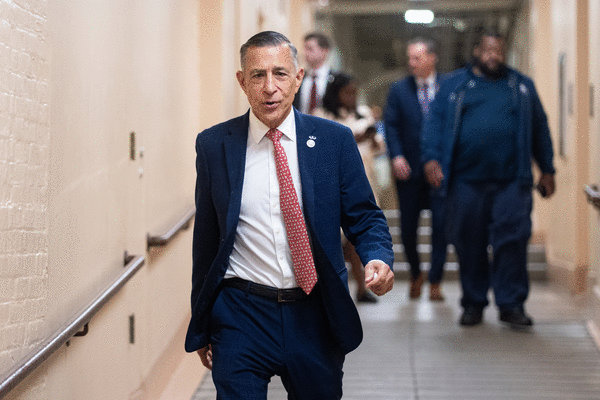
WASHINGTON — With President Donald Trump’s national job approval rating hovering near 37 percent, it’s no surprise that dozens of Republican incumbents are sweating their reelection bids. But the GOP’s struggle to hold open seats might tell the story of the midterm elections.
While Republican incumbents such as Brian Fitzpatrick of Pennsylvania’s 1st District and Mike Lawler of New York’s 17th have pre-established brands and extensive political networks to potentially withstand a political wave, GOP nominees in open seats don’t have the same profiles and are more at risk of losing, particularly when the storm gets rough.
While Democrats don’t need a blue wave to take control of the House – a net gain of just three seats would give them the majority – it’s helpful to look back at past cycles when a clear political tide benefited one party.
During Trump’s first midterm, in 2018, Democrats won 12 GOP-held open House seats (and defeated 30 incumbents), according to Vital Statistics by the Brookings Institute. And Democrats picked off nine open seats in 2006 and 12 more in 2008. Republicans won 14 Democrat-held open seats in the 2010 red wave (along with knocking off 52 incumbents) so the trend doesn’t just go in one partisan direction.
Even under a milder midterm in which Trump was more popular than he is today, Republicans would probably have struggled to hold Nebraska’s 2nd District, where GOP Rep. Don Bacon is retiring and Kamala Harris finished ahead of Trump by 5 points in 2024. It also wouldn’t have been easy for Republicans to hold California 48th District, where Rep. Darrell Issa chose not to run for reelection to a redrawn seat Harris would have carried by 3 points.
While district voters backed Trump by 3 points two years ago, Arizona’s 1st, which GOP Rep. David Schweikert vacated for an unsuccessful gubernatorial run, would have been difficult for Republicans to hold. And Michigan’s open 10th District could have still been a challenge with GOP Rep. John James running for governor. Voters here backed Trump by more than 6 points in 2024.
Under the current political conditions, however, not only are those seats at extreme risk of a Democratic takeover, but GOP open seats in deeper-red territory are vulnerable as well.
In Iowa, it’s not a surprise that GOP Reps. Mariannette Miller-Meeks and Zach Nunn are in competitive races, given the competitive nature of their respective 1st and 3rd districts. But the 2nd District, which is open due to Rep. Ashley Hinson’s Senate run, is competitive as well. Democrat Lindsay James has a significant chance of winning a seat that Trump would have carried won by 10 points.
Republicans thought they had averted a disaster in North Carolina’s 11th District by pushing embattled Rep. Chuck Edwards out of the race. But Democrat Jamie Ager now finds himself in position to win an open seat where Trump finished ahead by 9 points in 2024. It’s not just the national political environment that’s helping Ager, but the new GOP nominee, state Rep. Jennifer Balkcom, has struggled to adapt to a high-profile national race.
Trump carried Montana’s 1st District by more than 11 points, South Carolina’s 1st by 13 points and Florida’s 16th by 14 points – all three are competitive as well. The inclusion of retiring Rep. Vern Buchanan’s Sarasota-area seat is remarkable because Republicans thought the seat would be out of reach for Democrats under Florida’s new GOP-drawn map. But the current political climate is making the race a challenge.
About five years ago, Democrats drew Nevada’s 2nd District to elect a Republican (in order to help the other three seats be more Democratic). But the combination of a favorable political climate and outgoing Rep. Mark Amodei’s rift with GOP nominee David Flippo is making this a real race. Trump finished ahead of Harris by 14 points here, and yet Democrat Teresa Benitez-Thompson has a chance.
Trump won Kentucky’s 6th District by 15 points, but Republicans are at risk of losing the seat of Senate hopeful Andy Barr. Democrat Zach Dembo is running even or ahead of Republican nominee Ralph Alvarado in the Lexington-area district.
And some Republicans are concerned the party might lose New York Rep. Elise Stefanik’s 21st District. Trump won the North Country seat by a whopping 21 points, but public polling shows Democratic farmer Blake Gendebien running ahead of Republican sticker company CEO Anthony Constantino. While the climate is poor for Republicans across the country, it’s hard to imagine the races being this tight had Stefanik, Barr, and Amodei run for reelection.
The fact that these open seats are competitive is not unprecedented. Back in 2006, when there was an unpopular Republican president and an unpopular war in the Middle East that was driving up fuel prices, Republicans struggled to hold deep-red Idaho’s 1st District. President George W. Bush had finished ahead of Democrat John Kerry by 38 points in 2004, but Republican Bill Sali won the open seat by just 5 points two years later. Bush finished ahead of Kerry by 11 points in Wisconsin’s 8th District, and yet Democrat Steve Kagen won the open seat in 2006.
In the end, the 2024 election results might prove to be a mirage for Republicans – or just a temporary shift against Democrats – rather than a permanent realignment of the two parties. If Trump were on the ballot this November, he would struggle to match his margins from just two years ago.
While Democrats were hurt by their open seats in 2022, when Wisconsin’s Ron Kind and New York’s Tom Suozzi, Antonio Delgado and Kathleen Rice decided not to run, the party has benefited from a relative lack of Democrat-held open seats this cycle.
They have a few tough open seats, particularly those that were dramatically reshaped by redistricting. But Democrats are fortunate that a handful of vulnerable incumbents decided to run for reelection, even though Republican cartographers have targeted them for defeat. If Reps. Shomari Figures (Alabama’s 2nd District), Don Davis (North Carolina’s 1st), Marcy Kaptur (Ohio’s 9th), Kathy Castor (Florida’s 14th), Henry Cuellar (Texas’ 28th) and Jared Moskowitz (Florida’s 25th) had decided to call it quits in the face of challenging congressional lines, Democrats would have struggled to hold their seats, and it would have put a dent in the party’s chances for a majority.
House Democrats don’t need to win all of the GOP-held open seats to flip the chamber. But those competitive races demonstrate the nature of the cycle and help divert Republican resources to defense rather than letting the party spend on offense elsewhere.
_____
©2026 CQ-Roll Call, Inc., All Rights Reserved. Visit cqrollcall.com. Distributed by Tribune Content Agency, LLC.














































Comments