In newly independent US, Americans debated whether public executions taught a lesson or just showed off the state’s power to destroy
Published in Political News
The proposed livestream of Nidal Hasan’s execution by a U.S. military firing squad gives an old question a new audience. Hasan, an Army psychiatrist convicted by a military court of killing 13 people at Fort Hood in Texas in 2009, is scheduled to be executed on Dec. 3, 2026.
Explaining the plan to make his death public, Defense Secretary Pete Hegseth said that “people need to understand … there’s serious consequences for these types of things.”
Whether the broadcast will proceed remains uncertain. But as a historian of the early American republic, I recognize a familiar expectation behind it: that watching someone die will teach a useful lesson. Americans at the republic’s founding debated that premise — and doubted what the lesson might be.
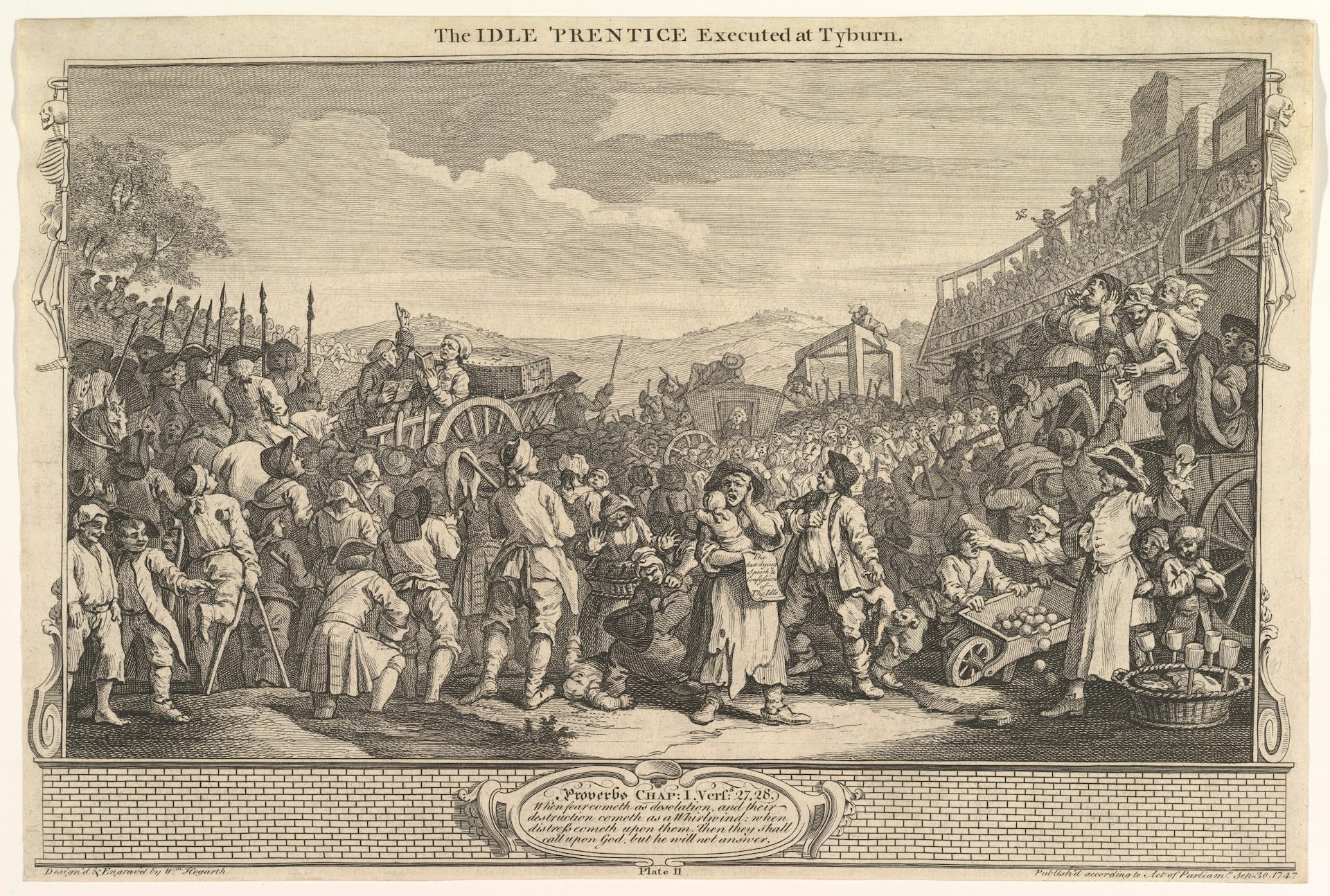
On Aug. 17, 1797, New Yorkers gathered to watch John Young hang.
An English musician and music publisher struggling with debt, Young had shot and killed Robert Barwick, a deputy sheriff taking him into custody. Barwick left a widow and nine children.
Young’s conviction by a jury brought him to a scaffold surrounded by soldiers, before an immense crowd.
Governor John Jay, a leading Federalist who placed greater faith in firm government than in popular judgment, had authorized the military presence after the sheriff reported fears of a rescue. But Jay also wanted the execution to impress its witnesses with the power of the government carrying it out.
Writing to James Kent, New York City’s chief municipal legal officer, two days before the hanging, Jay stressed that the authority of law should prevail visibly. The occasion should be “particularly solemn and impressive,” he said. The “authority of the law should be seen to bear down (on) all opposition.”
Solemnity, however, proved difficult to arrange. The military escort played lively music as the procession made its way to the scaffold. One newspaper critic thought an uninformed passerby might mistake the spectacle for “the celebration of some Festival.”
Soldiers formed a square around the gallows. The crowd remained orderly. Young addressed a few words to the minister, sang a psalm “and with great composure pulled his cap over his face,” reported one newspaper. Then, before the assembled witnesses, he was hanged.
Whatever the crowd’s reaction that day, the public execution had already become an argument about the nature of government.
The display did not impress everyone as evidence of governmental strength. Writing in the “Greenleaf’s New York Journal” two weeks after the hanging, “A CITIZEN” accused Jay of “letting down the dignity of civil authority.” Calling out troops for the execution suggested, among other things, “a wantonness on the part of the Executive.”
To this critic, the military presence advertised executive excess. The spectacle could undermine the very authority it was meant to affirm.
That point mattered in a republic still deciding how its authority should differ from that of the European monarchies that Americans portrayed as corrupt.
In the 1780s and 1790s, American reformers took particular aim at England’s “sanguinary laws” – statutes prescribing death for offenses ranging from murder to relatively minor theft.
By 1776, nearly 200 offenses carried a possible death sentence in England. These laws had accumulated piecemeal over generations, but American critics portrayed them as a single system with bloodshed at its center.
England’s punishments became a measure of what republican justice must overcome. Independence required Americans to reconsider how readily, and under what circumstances, their own governments could take a life.
The contrast was partly an exercise in national self-definition. Americans cast English severity as evidence of an old, corrupt political order and imagined their own laws as rational, proportionate and suited to free citizens.
In practice, the distinction was harder to sustain.
Nevertheless, the aspiration entered constitutional language. New Hampshire’s 1784 Constitution declared a multitude of sanguinary laws “both impolitic and unjust.” Punishment’s proper object was “to reform, not to exterminate mankind.”
Reform did not necessarily mean abolition. In 1796, New York reduced the number of crimes punishable by death but retained capital punishment for murder.
Young went to the gallows the following year. Even if Jay favored milder criminal laws, he was able to see a carefully staged execution as a necessary assertion of public authority.
Other Americans pressed further.
Benjamin Rush, the Philadelphia physician and signer of the Declaration of Independence, opposed executing even murderers. His argument went to the heart of the relationship between government and the governed.
“Capital punishments are the natural offspring of monarchical governments,” Rush wrote in 1792. “Kings consider their subjects as their property.”
For Rush, a republic that put citizens to death still acted like a monarchy, treating citizens’ lives as its own to dispose of. Calling the killing a lawful punishment did not make it less an act of revenge.
A related debate concerned the audience. Even Americans who accepted capital punishment could doubt the wisdom of making it public.
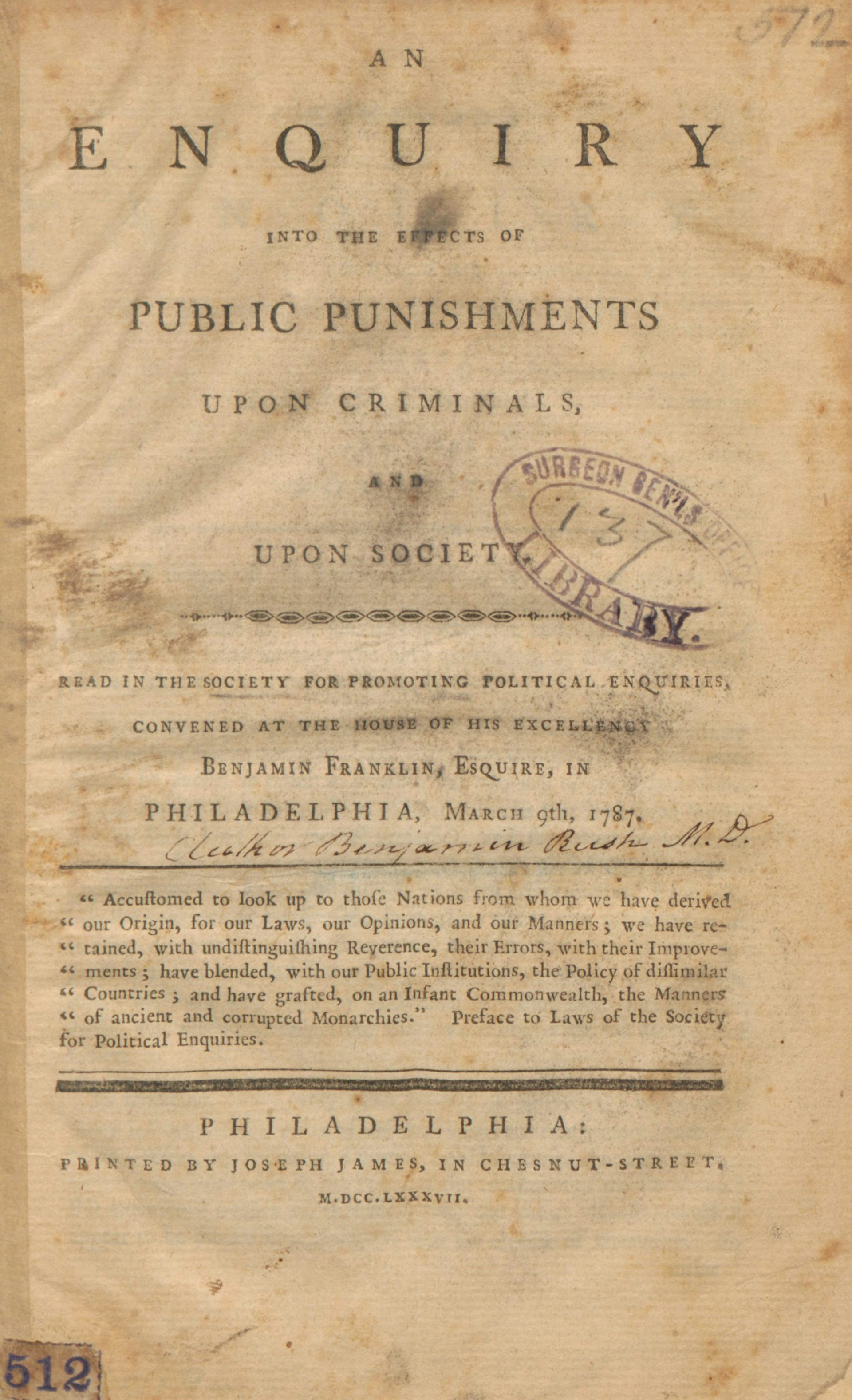
In 1787, Rush had already questioned what spectators actually learned from watching others suffer. Sympathy for the condemned could turn them against the government: “We secretly condemn the law which inflicts the punishment – hence arises a want of respect for laws in general,” he wrote in a pamphlet titled “An Enquiry into the Effects of Public Punishments upon Criminals and upon Society.”
Alternatively, repeated exposure to cruelty could harden spectators, encouraging the very violence that punishment was supposed to deter. “How often,” Rush asked, “do we find pockets picked under a gallows, and highway-robberies committed within sight of a gibbet?”
The crowd could pity the condemned, admire his composure or simply enjoy an outing. Gathering witnesses did not guarantee that they absorbed the intended lesson. The complaint about festive music at Young’s execution exposed that uncertainty: Officials could stage the spectacle, but they could not control its meaning.
Young’s execution gives the proposed broadcast of Hasan’s death a particular resonance. The crimes, jurisdictions and audiences differ, yet the ambition remains recognizable: to make one person’s punishment teach everyone else a lesson – and demonstrate the government’s strength.
Cruelty concerns more than the pain inflicted. It also lies in treating a person as fodder for exposure, humiliation and public instruction. The condemned person’s body becomes a public demonstration of whom the state protects – and whom it has the power to destroy.
But spectators may come for the theater of death itself, drawn by fascination with what human beings can do to one another. What officials present as instruction can become the marketing of guilty pleasures.
Cesare Beccaria, an Italian criminologist and economist whose 1764 essay “On Crimes and Punishments” helped shape American reform debates, argued that punishment could not undo a crime, only prevent future harm. Suffering beyond that purpose was unnecessary cruelty.
For Beccaria, an execution’s fleeting spectacle deterred less effectively than lifelong penal servitude. Beccaria’s alternative was harsh, but his principle constrained the state: The power to inflict suffering did not establish its necessity.
At Young’s scaffold, the state could end his life without controlling the meaning of his death. A broadcast would vastly enlarge the audience, but reach is no proof of usefulness, and curiosity supplies no justification.
Beccaria’s question thus remains: What future harm does this additional spectacle prevent? If it prevents none, what justifies it – and what does it reveal about the government that stages it?
This article is republished from The Conversation, a nonprofit, independent news organization bringing you facts and trustworthy analysis to help you make sense of our complex world. It was written by: Maurizio Valsania, Università di Torino
Read more:
Yes, this is who we are: America’s 250‑year history of political violence
Where George Washington would disagree with Pete Hegseth about fitness for command and what makes a warrior
George Washington’s foreign policy was built on respect for other nations and patient consideration of future burdens
Maurizio Valsania does not work for, consult, own shares in or receive funding from any company or organization that would benefit from this article, and has disclosed no relevant affiliations beyond their academic appointment.











































Comments