Iran divides Netanyahu and challenger Eisenkot before vote
Published in Political News
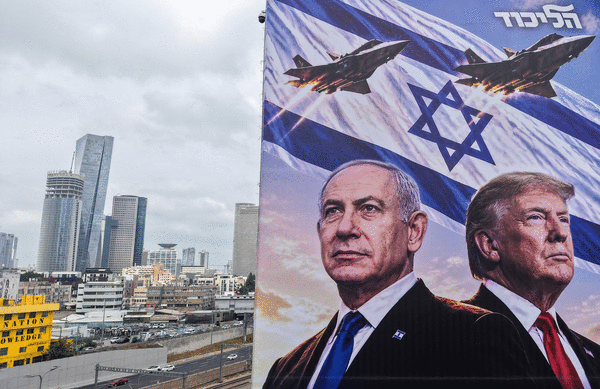
For months, Israeli opposition leader Gadi Eisenkot has pitched himself as a modest alternative to Prime Minister Benjamin Netanyahu, campaigning more on reliability than a markedly different approach to the country’s myriad security challenges.
But in the final days of the election campaign, the question of Iran – and of Israel’s future approach to it – is widening the policy gap between the two. Netanyahu is pledging to topple Tehran’s regime – with U.S. President Donald Trump’s backing – casting himself at a rally last week as the only leader capable of waging such an existential battle.
On Sunday, Netanyahu posted an AI-generated image of an Iranian nuclear bomb detonating on Tel Aviv, hours before Trump issued a second endorsement of the Israeli prime minister, saying the two leaders needed to “finish the job” in Iran.
Eisenkot is advocating narrower goals. He says Iran’s nuclear program must be stopped, militarily if necessary, but he told Army Radio this month that regime change in Tehran is “not an achievable goal.” While he’s spent his life as a hawk, he says he wants more focus on diplomacy.
The question of how Israel will approach Iran is becoming a bigger factor ahead of Tuesday’s election as Trump repeatedly hints at reviving the war that he and Netanyahu started against the Islamic Republic in February. The conflict has been in hiatus for months, with Washington attempting to apply economic pressure via a naval blockade and Tehran looking to control the Strait of Hormuz.
Trump, who endorsed Netanyahu earlier this month — albeit with little impact on the polls — would doubtless expect Israel to support a fresh offensive. U.S. Defense Secretary Pete Hegseth met with Netanyahu at an Israeli airbase this month, Bloomberg reported, although the purpose of the meeting wasn’t disclosed.
Eisenkot, 66, has a markedly different background from the articulate and telegenic Netanyahu, who spent years in the U.S. The former military chief is the son of Moroccan immigrants who settled in the working class city of Eilat, and has dedicated his life to Israel’s defense. Many were surprised last year when he launched his Yashar party (straightforward in Hebrew) and said that he planned to oust Israel’s longest serving leader.
Eisenkot has little political experience and faltering English. But he says that his overriding advantage is that he grasps the stakes in the election. Eisenkot’s son Gal and two of his nephews were killed while fighting against Hamas in Gaza – part of a long list of sacrifices he gives in lieu of a political resume.
His somber and monotonous oratory and ubiquitous all-black outfit are “all part of the camouflage,” Eisenkot said this month on Israel’s public broadcaster Kan. He added that “Netanyahu is unfit to be prime minister because he led Israel blindly into Oct. 7,” then failed to translate military achievements into diplomatic deals, referring to Hamas’ assault on Israel in October 2023 and the country’s subsequent military and foreign policy.
Much of Eisenkot’s campaign has looked to tap into the outrage that many Israelis feel toward Netanyahu, who has refused to take responsibility or even launch an inquiry into the failure to prevent the Hamas attack. Eisenkot connects the tragedy to Netanyahu’s coalition, whose expansionist, religious right-wing members often invoke God, rather than sober military logic, in describing Israel’s wars.
“Anyone who thinks that our Israel will survive another four years like the past four years lives in a dangerous delusion,” Eisenkot said at a campaign rally in Tel Aviv on Sunday night.
Eisenkot opposes the creation of a Palestinian state, but wants to supervise the return of up to 70,000 Palestinian day workers from the West Bank into Israel to ensure economic stability to counter terrorism, he said at a campaign rally last week.
In Gaza, he wants to remove Hamas from power, either by enforcing the U.S.-brokered peace agreement of October 2025 or through military force, he told supporters near the Gaza border this month. He hasn’t elaborated on how to end the ongoing refusal of Hamas to disarm, widely viewed as the chief barrier to implementing that accord.
Eisenkot’s path to victory requires him to unify the Israeli right with the centrists that make up his base, while pulling in voters for Netanyahu’s Likud party. His strategy has been mostly through small-scale events and living-room meetings rather than mass rallies.
In campaigning in the Likud heartlands, he is also “working on the psychic level” to try to sway undecided voters in towns where it was once taboo to not vote Netanyahu, said Gayil Talshir, a political scientist at Hebrew University.
Pre-election polls have consistently shown that neither Netanyahu’s nor Eisenkot’s bloc will win the required 61 seats to secure a majority needed to form a government. A Channel 12 poll on Oct. 22 projected 55 for Eisenkot and 51 for Netanyahu, while a Channel 13 survey put the outcome at 52 to 49.
A result along those lines will require the winner to bring in other parties, which for Eisenkot could mean holding talks with the Israeli Arabs, who make up 20% of the population. Two of the partners in his bloc say they’ll refuse to take part in a government that includes Arabs, however.
Eisenkot’s support for diplomacy is partly pragmatic. Israel’s army is facing severe manpower shortages after extensive operations in Lebanon, Syria, Gaza, the West Bank, Yemen, Iraq, and against Iran, missing around 15,000 personnel and some 8,000 frontline soldiers, according to army estimates.
As army chief of staff and, in the first months of the war in Gaza, a member of the emergency war Cabinet, he says he watched Netanyahu dismiss the need for strategic planning and hollow out the National Security Council.
Eisenkot’s X feed, though, has been less focused on policy statements and more on attracting voters from Netanyahu’s traditional and religious base, particularly Israelis of North African and Middle Eastern descent.
Earlier this month, after pro-Netanyahu commentator Yinon Magal described him as “a monkey with elitist Ashkenazi Jews behind him,” Eisenkot said he would not dignify the remark with a response. He instead posted footage of a campaign rally where supporters sang Israel’s national anthem and later posted videos of former Netanyahu supporters pledging to vote for him.
The pro-Netanyahu camp “is crossing every line,” said Eisenkot on a podcast Thursday, adding that the voters he’s met on the campaign trail “are tired of this culture of lies, of division, and they want to see a different kind of reality.”
©2026 Bloomberg L.P. Visit bloomberg.com. Distributed by Tribune Content Agency, LLC.




































Comments