Grandson of immigrant coal miners, Richard Ojeda will be NC's first Hispanic congressman
Published in Political News
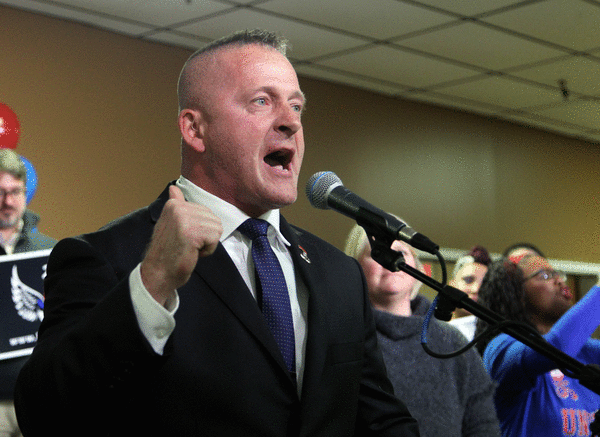
RALEIGH, N.C. — For Richard Ojeda, one of the new Democrats elected to Congress in North Carolina, it’s important that people know about his family’s immigrant background.
It’s integral to how he got where he is today and who he is.
Ojeda, 56, will become North Carolina’s first Hispanic member of Congress in January after defeating Richard Hudson, the chairman of the National Republican Congressional Committee, in the 9th District.
Hispanic Americans have served in Congress since 1822, according to the U.S. House Office of the Historian, but none has represented North Carolina.
In a victory speech on election night, Ojeda said, “Standing here tonight, I can’t help but think about two men who never could have imagined this moment.”
He was referring to his grandfathers.
On his father’s side, his grandfather came to the United States from Jalisco, Mexico, and worked in a coal mine in Logan, West Virginia. He came “looking for something better,” but “it wasn’t easy.”
He learned English in the mines, married a local woman, Ojeda’s grandmother, and didn’t become a citizen until he was 70.
On his mother’s side, his grandfather came from Romania, fought in World War II and later also worked in a coal mine in Logan. There, he met Ojeda’s other grandmother. He later died in a coal mine collapse.
“Two men from two different parts of the world, two different stories, but they shared something. They believed in the promise of America. They believed that if you worked hard, sacrificed, and gave everything that you had, maybe your children and grandchildren could have a better life than you did,” said Ojeda, according to a video of that speech online.
“Tonight, their grandson is standing right here, a kid, a kid that grew up in a holler, a retired United States Army major, an airborne sapper, all the way, and now a member of the United States Congress,” Ojeda said, tearing up.
Ojeda served 24 years in the Army, including combat deployments to Iraq and Afghanistan, and spent 15 of those years at Fort Bragg. After retiring, he moved back to West Virginia to be near his aging parents and served in the state Senate.
In a candidate questionnaire for The News & Observer, Ojeda said he supports securing the border and enforcing immigration laws but opposes “using immigration enforcement as an excuse to intimidate communities or deny people due process.”
The first Hispanic member of Congress, Joseph M. Hernández, took office in 1822. Hernández, who was born in Florida when it was a Spanish colony, was the Florida Territory’s first delegate, a nonvoting member of the House. The first with full voting rights, Louisiana Sen. Charles Bouligny, took office in 1824. After he left office in 1829, Congress had no Hispanic members for about a quarter of a century.
Randy Jones, senior adviser to Ojeda, told The N&O that his Mexican grandfather rode with Pancho Villa, a Mexican revolutionary who was instrumental in ejecting dictator Porfirio Díaz. Jones said that also led to Ojeda’s grandfather’s decision to flee to the United States, as Mexican federal troops were after him.
His father, also named Richard Ojeda, meanwhile, fought in the Korean War, studied at the Mayo Clinic and delivered babies in Logan County, West Virginia, Jones said.
Jones said a guidance counselor at the elder Ojeda’s West Virginia high school told him he was never going to do more than work in a coal mine because his last name was Hispanic.
Jones said Ojeda always tells people he had three options after graduating from high school: “dig coal, sell dope or join the Army.”
His uncles, all first- or second-generation Americans, told him not to follow them into coal mines. When he joined the Army and stepped onto Fort Bragg near Fayetteville, it was like he “was home,” Jones said.
_____
©2026 The News & Observer. Visit at newsobserver.com. Distributed at Tribune Content Agency, LLC.












Comments