Trump's White House lawyer on subpoena compliance: 'it depends'
Published in Political News
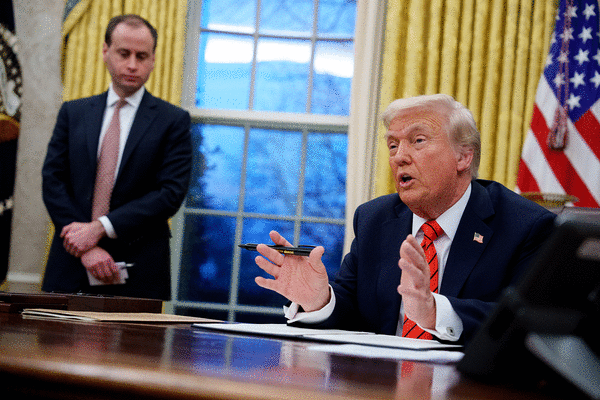
The White House won’t commit to complying with potential subpoenas from a Democratic-led Congress and believes company executives who’ve had contact with President Donald Trump may be covered by executive privilege, White House Counsel Will Scharf said.
The counsel’s office has added some 15 attorneys to its ranks, with offers to others still outstanding, in preparation for an expected onslaught of probes when the new Congress is sworn in next year, Scharf said in a Bloomberg News interview.
Scharf, who took over as the top White House lawyer in September, will help lead the administration’s response to the investigations, along with Attorney General Todd Blanche. He has warned the incoming Democratic chairman of the House Oversight Committee that some of its expected investigations may violate the law.
From his wood-paneled office in the White House’s West Wing, Scharf doubled down on that vigorous stance. Asked if people should expect the White House to comply with congressional subpoenas, Scharf said that was an “absurdly over-broad” question.
“It depends on the subpoena. It depends on the nature of the investigation,” he said. “This is also not a White House that’s going to be bullied.”
Democrats won control of Congress in the Nov. 3 midterm elections, changing the balance of power in Washington and portending a period of increased lawmaker checks on Trump, his cabinet and his family. Trump initially expressed a willingness to work with Democrats before pivoting to a sharper tone and elevating hard-liner Stephen Miller to White House chief of staff.
Asked what Congress might do that would veer into criminality, Scharf declined to share specifics.
“When you look at the way just the law works in this space, congressmen have powerful protections. They have powerful immunities,” he said. “But that doesn’t mean that there isn’t the possibility of, you know, of them moving beyond that.”
The U.S. Constitution grants members of Congress inmunity for official legislative acts. A 2020 Supreme Court decision broadly protected Congress’ subpoena powers, but proposed a more stringent test for attempts to obtain a president’s private documents.
Democrats have also indicated an intent to probe ties between companies and the White House. Trump has played host to multiple corporate executives, including many who have donated to fund his 90,000 square-foot ballroom.
Scharf said the White House had spoken with attorneys representing some companies and individuals that have done work with the administration who could be asked for testimony.
“If a private party were to be asked about personal communications with the president, we would take the position that those would fall under the presidential communications privilege,” he said. “These are all situations that we’ve thought deeply about and that we’re ready to defend.”
Scharf said his office would represent White House staff embroiled in investigations, while the Department of Justice and counsel from other agencies would represent others in the administration.
“I’ve hired a lot of lawyers since Sept. 1,” Scharf said. They include “highly experienced ethics counsel,” oversight counsel and people with experience on Capitol Hill, he said. “This office is prepared.”
Scharf, 40, worked as one of Trump’s private attorneys as part of a team that won the 2024 Supreme Court decision on presidential immunity. He also defended Trump in the E. Jean Carroll sexual abuse case.
A graduate of Princeton University and Harvard Law School, he grew up in Manhattan but made Missouri his home as an adult, launching an unsuccessful campaign for state attorney general. Scharf indicated he’s unlikely to run for office again, though he declined to rule it out entirely.
“When you lose by 26 points in a Republican primary,” he said, it “makes you think twice about whether elected politics is the right profession for you.”
Picking battles
Friends say Scharf’s legal and political background will equip him for the fights to come.
“He’ll have the good sense to understand when to pick his battles,” said Mike Fragoso, a friend from college. “He also seems to have the president’s trust, which I think is important to sell him in the correct courses of action in dealing with a hostile Congress.”
Democrats are prepared for a hostile administration response to investigations.
“I expect they’re going to resist them, right?” Democratic Representative Jason Crow said in an interview, referring to subpoenas. “Just because somebody will resist justice and ignore the law doesn’t mean that we do the same.”
Scharf, who said he starts most of his days at 5:30 a.m. and is at the White House until 8:30 or 9 p.m., has had differences with Trump’s new chief of staff, authoring memos warning against proposals to rescind due-process rights for undocumented immigrants and to use the Insurrection Act to deploy the military against protesters.
Scharf said he has had a “close and productive relationship” with Miller since the start of the administration. “I look forward to continue working with him,” Scharf said.
As staff secretary, the job he held for the first part of Trump’s second term, Scharf became an unlikely star in executive order signing sessions, starting on Inauguration Day when the president asked him to talk through, on camera, what he was putting his signature to.
“I was as surprised as anyone else,” Scharf said. “This has never been a staff secretary function before, kind of being the town crier of the Oval Office or of the White House. But it’s a role I sort of sheepishly stepped into.”
©2026 Bloomberg L.P. Visit bloomberg.com. Distributed by Tribune Content Agency, LLC.





































Comments