Biden: 'Hard to take' as Pelosi, Schumer turned on him in 2024
Published in Political News
WASHINGTON — In conversations with Democratic strategists in recent months, I heard a strikingly similar sentiment when the topic turned to Joe Biden’s forthcoming memoir. The consensus view, even among some who’d worked for the former president, was that if he did anything other than accept some responsibility for his role in Donald Trump’s return to the White House, they didn’t have much appetite to hear what he had to say about anything else.
Spoiler alert: Biden offers only a full-throated defense of his decision to seek reelection in 2024, and expresses deep disappointment over what he casts as a disloyal pressure campaign orchestrated by party leaders to force him out of the presidential race despite what he cites as his successes in the office.
But while his perspective on the climactic moment of his political career will be the most scrutinized portion of Biden’s new book, “Promise Me, America” seems primarily intended to offer the former president a platform he has otherwise not had since leaving office: to catalog what he sees as his historic achievements and offer his perspective on how he wrestled with the major issues of our time.
It’s often said that the only thing better than being president is being a former president. That has hardly been the case for Biden in the nearly 22 months since he left the White House, especially as he’s endured what his son Hunter has described as “debilitating” physical pain following a cancer diagnosis last March.
But where “Thanks, Obama” became a popular mantra nearly a decade ago for Democrats seeking to defend and celebrate the 44th president’s record in contrast with the first Trump administration, no such widespread nostalgia has emerged around Biden, as the party is loath to revisit the trauma of the summer of 2024.
The sheer length of his new book — more than 400 pages — seems an implicit acknowledgment that presenting a positive portrait of Biden’s single term in office is largely to be a solitary effort. Over 15 chapters, Biden offers sometimes mechanical descriptions of specific policies and their impact, but also new details of the sausage-making required to pass major initiatives like the Inflation Reduction Act. That legislation, he writes, was revived thanks in part to an Italian dinner hosted by Commerce Secretary Gina Raimondo to make peace between West Virginia Sen. Joe Manchin III and White House chief of staff Ron Klain.
Biden writes in sweeping terms about other accomplishments like responding to the COVID-19 crisis he inherited, calling his administration’s work “one of the most monumental achievements in public health history.” He repeatedly defends his frequent efforts to warn Americans about the need to safeguard our democracy even as critics in the press and his own party suggested he focus more on economic concerns.
Supporting Ukraine in its war against Russia gets the most extensive treatment of any single issue in the book, including a detailed account of Biden’s clandestine trip to Kyiv in February 2023. And the former Senate Foreign Relations Committee chairman takes great effort to delve into the complexity of the U.S.-China relationship and his relationship with President Xi Jinping, while asserting that Taiwan “will likely be the most important foreign policy challenge in the world over the next generation.”
Recurring throughout the book are expressions of optimism that under his administration, Washington was beginning to work again like it was supposed to, that America’s global leadership was being restored through its alliances, and that he was tackling problems that previous presidents had sidestepped. And in offering this comprehensive presentation of his record, Biden also offers his primary rationale for running again.
“We had accomplished so much — I wanted to finish the job. And yes: I believed I was the best person to do it,” he says. “I was the only person who had ever beaten Donald Trump. And I felt I was the best person to do it again.”
One of Biden’s top advisers put it to me a different way in the months leading up to his decision to seek another term. “He has been running for president for 50 years. And the idea that he would actually be president and stop running for president is almost laughably preposterous.”
The biggest question, of course, was his age, something Biden, who was 81 when he dropped out of the race, asserts he gave serious consideration.
“I knew better than anyone how old I was. I knew what I was — and wasn’t — capable of doing. I carefully monitored how I was meeting the demands of the job. And there is not a single example of me failing to handle my responsibilities,” he writes.
The June 27 debate, of course, created a very different perception, as Biden acknowledges that his flubbed comment that “we finally beat Medicare” was to become “Exhibit A that I was too old to do the job.” But he tries to argue it was no different than the poor showings of previous incumbent presidents, including President Barack Obama, in their first debates.
“The difference was that every other president was given the chance to redeem themselves in a second debate. As it turned out, that chance would not be available to me,” Biden writes.
He argues the response he was seeing from voters at his public events after the debate didn’t justify the panicked response of elected Democrats in Washington, and that public polling showed only minor slippage after the debate, until a steady drumbeat of elected Democrats publicly began calling for him to step aside.
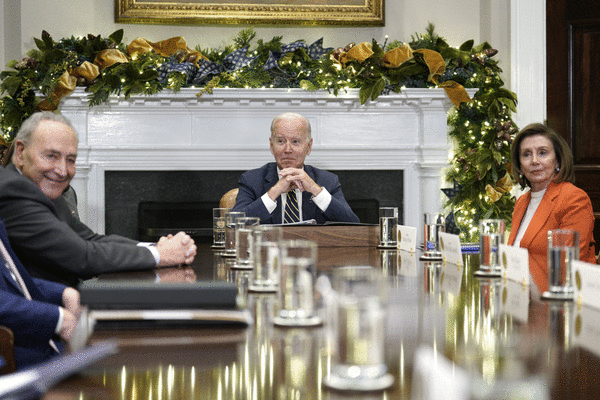
Describing separate visits from former Speaker Nancy Pelosi, D-Calif., and then-Senate Majority Leader Charles E. Schumer, D-N.Y., personally urging him to step aside, he says there was a “yawning gap between what I was seeing with Democratic voters and what I was hearing from the Democratic leadership in Washington.”
“I have to admit it was personally hard to take so many old friends turning on me,” Biden says. “I told Schumer he had a lot of gumption (I may have said it differently at the time), coming to my home and telling me to get out of the race. Loyalty matters to me. If I give you my word, I stick with you. If I say I’m with you, I’m with you to the end.”
At one point, Biden seems to reflect some resentment that some of the Democrats who would ultimately call on him to drop out of the race had themselves been too afraid to challenge him in the first place, saying: “Anyone who was scared off from running has no business being president.” While there was a constant narrative about the weakness of his candidacy, Biden acknowledges, the lack of a serious challenger was in fact a sign of his strength.
“I had it on good authority that several big names in Democratic politics had looked at running. They held meetings and took polls and talked to donors and to potential staff. If they thought I was weak or vulnerable, they would have taken their shot. But they didn’t,” he writes.
Biden’s defiant tone, and his insistence that the lack of party unity was a greater threat to his continued candidacy than his own performance, may be dismissed by Democrats who don’t want to revisit this difficult chapter. But as Schumer and other Democratic leaders are now facing their own internal challenges, “Promise Me, America” may also serve as a cautionary note for an ambitious crop of potential candidates hoping to reclaim the presidency in 2028.
©2026 CQ-Roll Call, Inc., All Rights Reserved. Visit cqrollcall.com. Distributed by Tribune Content Agency, LLC.






































Comments