What to know about mail-order mifepristone as Pa. Gov. Josh Shapiro urges Supreme Court to maintain access
Published in News & Features
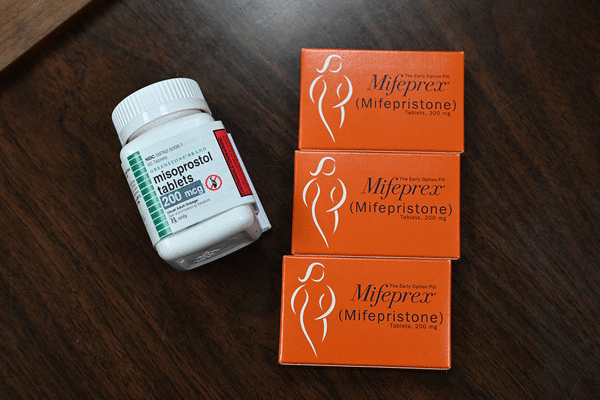
PITTSBURGH — Mifepristone, a drug used for miscarriage management and to end pregnancy, has been thrust again into the national spotlight — this time with response from Gov. Josh Shapiro.
The Pennsylvania governor signed onto a multistate amicus brief this week, urging the Supreme Court to uphold mifepristone access via mail. The court is set to rule on Monday whether the drug will be available only in-person or if it can remain accessible by mail.
Since the high court’s Dobbs decision overturned the federal right to abortion in June 2022, a growing number of Americans’ only option for abortion care is through mail order. In 2024, 1 in 4 abortions occurred via telehealth, according to an analysis by Kaiser Family Foundation.
Thirteen states, including West Virginia, have total bans on abortion, per the Guttmacher Institute, and this pill method has been a stalwart for patients in those states: Last year, a majority of the abortions in states with total bans occurred via telemedicine.
The method has gained popularity even in states without bans. Mifepristone was deemed safe and effective and approved by the Food and Drug Administration in 2000.
Here’s what to know about the recent rulings, and how they may impact access to mifepristone moving forward.
Last week’s 5th Circuit ruling
Because of rules codified during the COVID-19 pandemic, mifepristone prescriptions have been available by mail, via a telehealth provider or mail-order pharmacy, nurse practitioner or clinician, since 2021.
In October, a Louisiana court sued the Food and Drug Administration to reverse those rules and return to the previous ones — which required patients to see a doctor in-person for the drug — claiming the safety data on mifepristone was underdeveloped and the FDA should never have approved them.
On May 1, a panel of judges with the 5th Circuit Court of Appeals, which oversees Louisiana, Texas and Mississippi, sided with the plaintiffs and granted a stay on that court case, lifting the current prescribing terms.
In its opinion, the 5th Circuit stated: “Every abortion facilitated by FDA’s action cancels Louisiana’s ban on medical abortions and undermines its policy that ‘every unborn child is human being from the moment of conception and is, therefore, a legal person.’”
Deciding national medication access based on a state case could have a far-reaching impact.
“If every state can just say, ‘I don't like this medication and I want the FDA to stop, and that applies to the whole nation, that is going to throw medical care into complete chaos,” said Sarah Horvath, a Pennsylvania-based clinician and OB-GYN.
The U.S. Supreme Court’s interjection
Three days after the 5th Circuit’s decision, on May 4, the U.S. Supreme Court temporarily blocked the ruling, which reinstated the prescribing terms, leaving mifepristone available by mail.
Justice Samuel Alito said in the ruling that the court wanted a week to oversee the case and deliberate about its decision. The court is expected to decide on mifepristone’s fate on Monday, which will determine how accessible the drug is during the litigation process of Louisiana v. FDA.
This is not the first time the Supreme Court has stayed a 5th Circuit ruling. In 2023, the court had a similar approach regarding FDA v. Alliance for Hippocratic Medicine, which aimed to reverse mifepristone approval and block access based on a 2000 paper on its safety and efficacy. That case was ultimately dismissed.
Because of this precedent, it’s likely the Supreme Court will act similarly for the recent 5th Circuit ruling, but there is no guarantee, said David Cohen is a law professor and abortion expert at Drexel University College of Medicine in Philadelphia, and author of the book “After Dobbs.”
Shapiro’s role
On the same day as the Supreme Court ruling, Shapiro announced his participation in a legal document meant to encourage the court to keep mifepristone available. Led by New York Attorney General Letitia James, the brief includes numerous states, including New York, California, Delaware, New Jersey and Virginia, as well as Washington, D.C.
Any group can file an amicus brief for the court to review before making its decision, with a deadline of May 7.
In a news release about the brief, Shapiro called the 5th Circuit ruling “a direct attack on women’s health care” that prohibited women from making decisions about their own bodies. He said he joined the brief to reassert his commitment to reproductive health care access.
“Despite this court’s ruling, Pennsylvanians should know that abortion remains safe, accessible, and legal here in our Commonwealth,” he said in the release. “Mifepristone is a safe, effective medication that has been widely used for decades, but once again, anti-abortion advocates are pushing junk science and encouraging the courts to upend decades of research in their continued assault on a woman’s freedom to choose.”
Shapiro has long been a supporter of reproductive rights during his time as governor. He joined a nonpartisan group of 22 other governors to form the Reproductive Freedom Alliance, and has sued the Trump administration for its efforts to defund Planned Parenthood.
Cohen was not surprised to see Shapiro voice his support in this way.
“He has been consistently supporting abortion access and mifepristone access,” he said. “The surprise would have been if he hadn’t signed on.”
The science
There are more than 100 studies that suggest mifepristone is safe and effective. So why is the 5th Circuit saying otherwise?
“They are not really telling the truth,” said Cohen. “This is one of the most studied drugs worldwide, and has been proven safe and effective in all major studies.”
Previous FDA boards have not taken the same position on mifepristone, Cohen noted.
The move thus serves to sow confusion and stigmatization, said Horvath: “Politics are getting in the way of science.”
While staff at the local clinics Allegheny Reproductive Health Center and Planned Parenthood of Western Pennsylvania said patients have not yet expressed confusion around mifepristone access, some doctors have become overwhelmed with the onslaught of rulings.
“It’s really off-putting, and it’s sowing a lot of confusion within medicine,” Horvath said. “I just spoke with a doctor a couple days ago. This person is in a very permissive state, and they told me, ‘I feel like we should have mifepristone, we use it a lot for miscarriage management, but it just feels so complicated.’”
Mifepristone is still available by mail in Pennsylvania, where abortion is legal up to 24 weeks.
©2026 PG Publishing Co. Visit at post-gazette.com. Distributed by Tribune Content Agency, LLC.






Comments