With at least 32 wolves roaming Colorado -- but releases on pause -- reintroduction is at 'inflection point'
Published in News & Features
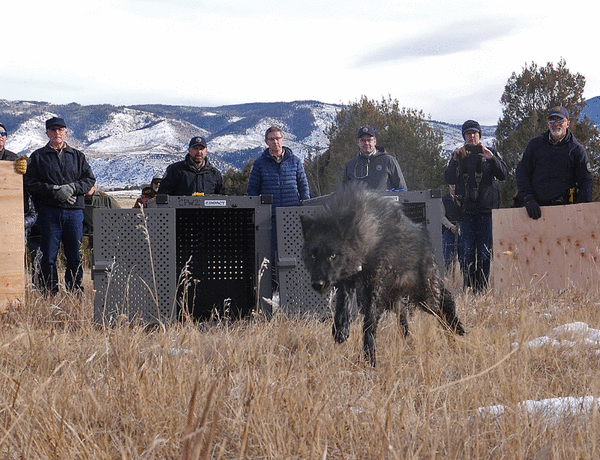
DENVER — Colorado’s voter-mandated wolf reintroduction is at a critical juncture two years after the first canines were released in the state, wildlife officials said Thursday.
At least 32 wolves are roaming Colorado after two rounds of releases and last year’s breeding season, which produced at least 14 pups, according to Brenna Cassidy, Colorado Parks and Wildlife’s wolf monitoring data coordinator. Cassidy and other CPW officials presented the annual wolf report to the agency’s commission during its meeting Thursday, including the most detailed information about the state’s wolf population to date — including the number of pups born last spring to the state’s four packs.
The survival rate for the pups was high, Cassidy said, helping mitigate the impact of the deaths of 10 adult wolves.
“We’re at an interesting and tenuous time for this population,” Cassidy said.
CPW officials planned to release between 10 and 15 wolves from Canada in January to add to the state’s population, but the agency canceled those plans after the new head of the U.S. Fish and Wildlife Service under the Trump administration warned that using wolves from another country would violate the state’s agreement with the federal agency. CPW disputed the federal agency’s new interpretation, which was a reversal of its previous approval of the use of Canadian wolves.
But the state agency pivoted and attempted to find a domestic source for the canines. The agency canceled the release for the winter when officials could not find another source.
The setback has made it difficult to predict when Colorado’s wolf population will be considered self-sustaining, said Eric Odell, CPW’s wolf conservation program manager.
Colorado voters in 2020 narrowly approved the reintroduction of the native species and mandated that CPW create a self-sustaining population. State biologists have since released 25 wolves into the state in two batches.
High reproduction and survival rates could result in a growing wolf population, Odell said. But one year of high mortality or low birth rates could set the program back.
“We’re very much at an inflection point,” he said.
Ten wolves died during the last biological year, which began April 1 and ended March 31. One of the wolves was killed by a mountain lion and six were killed by people, including one struck by a car and two killed by CPW. Three deaths remain under investigation.
CPW biologists, meanwhile, have spent thousands of hours studying the wolves’ activities and their impact on other species.
A map released Thursday as part of the annual report shows that the vast majority of tracked wolf activity since last spring occurred in a corridor in the state’s central mountains, stretching from Walden in the northern part of the state to just north of Gunnison. While the wolves spent time across most of the Western Slope, they spent significantly more time in the central corridor.
Twenty-four of the 32 known wolves were members of the state’s four packs. Those packs have established territories and stayed relatively close to their dens, though they still logged hundreds of miles of travel, Cassidy said.
The One Ear pack roams around Walden. The Three Creeks and King Mountain packs established themselves southwest of Steamboat Springs. And the Copper Creek pack lives south of Glenwood Springs.
The eight wolves that are not in packs rambled much farther and were less likely to stay in a specific area, Cassidy said. On average, wolves in packs traveled 679 miles last year, and those not in packs traveled 730 miles, she said.
CPW scientists this year completed a three-year data collection period for a study on how wolves and humans influence elk herd sizes and movement, according to the annual report. They are also studying how wolves impact moose calves and how drones can be used to haze and monitor wolves.
CPW officials also outlined to the commission their programs to reduce the risk of wolf conflict with livestock. The state now owns more than 500 devices it can loan to ranchers to scare away wolves and more than 45 miles of fladry — fabric that can be attached to fences to scare off wolves.
CPW also hired 11 range riders last summer to patrol livestock herds and keep wolves away.
Those nonlethal management methods reduced the risk of depredation but were not 100% successful, said Ethan Kohn, a wildlife damage specialist.
“Nonlethal tools are an important part of the toolbox, but they are no a complete solution,” he said.
Wolves killed or injured 42 head of livestock and one working dog during the last biological year, according to the annual report. CPW expects to pay about $1 million to ranchers for depredations and other wolf-related impacts on their herds, such as lower birth rates and reduced weight, said Ray Aberle, the deputy assistant director of outdoor recreation and lands.
The agency has the money to pay all claims, he said.
Odell, who is retiring in July after 26 years with CPW, said the wolf restoration program he helped create is growing and adapting. Implementing the controversial program was complex and difficult, he said.
“I’m proud of what we’ve built and I’m confident in where it’s headed,” he said.
_____
©2026 MediaNews Group, Inc. Visit at denverpost.com. Distributed by Tribune Content Agency, LLC.






Comments