Minnesota lawmakers vote to limit powers of homeowners associations
Published in Home and Consumer News
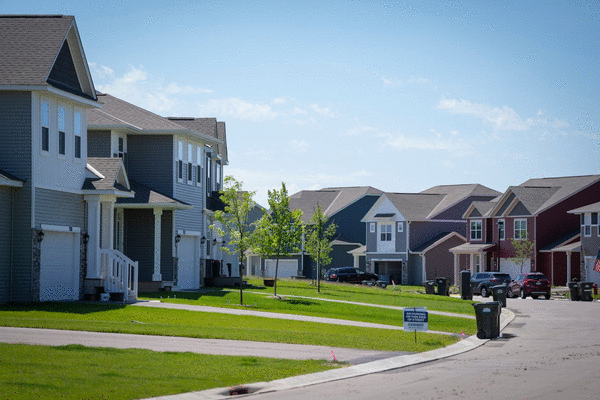
Homeowners associations across Minnesota will see their powers diminished under a far-reaching “HOA Bill of Rights” approved by state lawmakers this week.
The bipartisan measure that runs more than 50 pages is aimed at protecting homeowners by requiring more transparency from HOAs, limiting their ability to levy fines and foreclose properties, and other consumer protection provisions. It will affect the roughly 8,000 HOAs across the state and the more than 1.5 million Minnesotans who live in them.
“This really is about putting power back in the hands of Minnesotans,” said Rep. Kristin Bahner, DFL-Maple Grove. “It has been a long time coming.”
It’s also something of a legislative equivalent to finding a four-leaf clover or a parking spot at Trader Joe’s: a consequential bill with broad bipartisan support in a tightly divided Legislature that’s otherwise accomplished relatively little this year.
“There’s no partisanship in this effort,“ said Sen. Eric Lucero, R-St. Michael. ”This is for Minnesotans."
Opponents have argued that the bill would drive up legal costs for associations, which would pass those along to homeowners, and otherwise punish organizations typically run by volunteers. HOAs, they argue, have stepped in to provide vital services and infrastructure increasingly outsourced by local governments.
But supporters say they were motivated by homeowners’ stories of HOAs acting as unaccountable quasi-governments that can make arbitrary rules, like how long a car can be parked in a driveway or how long a trash bin can stay on the street, then levy fines and even initiate foreclosures over violations. Similar bills have recently passed in other states, including Florida and Georgia.
A spokesman for Gov. Tim Walz said he plans to sign the bill.
A bipartisan group of legislators has been working toward this moment for years. A 2024 law led to a report with dozens of policy recommendations that undergird the final bill, which cleared the Senate last year but stalled in the House.
This year, Bahner shepherded the bill through House committees and a final floor vote last week. Legislators made several changes friendly to property management companies along the way, like one that sets a higher bar for dissolving an HOA than the Senate bill did.
But compared to existing law, the final bill makes an easier path for homeowners who’ve tried and failed to terminate their HOAs.
Bahner characterized such changes as “additional layers of flexibility” and said the bill came out of the House more balanced and “much, much stronger.”
Among the final bill’s key provisions:
The bill’s passage marks a “pivot point” for HOAs in the state, said Mark Luis Foster, co-owner of HOA Leadership Network, a Minnesota company that educates HOA board members.
Foster’s was one of several HOA advocacy groups that argued against the bill during committee hearings this session, saying that lawmakers should focus on education, not regulation.
But in a Wednesday interview, Foster said he expects HOA boards will embrace the new rules and learn to comply.
“They’re not lawyers, and they just want to do a great job for their HOAs,” Foster said. “They just want to maintain property values. And it will be a test of the legislation as to whether what the state has passed will make those things better or worse.”
Foster said that while he supports some of the bill’s provisions, like transparency around fines, he’s worried that overall it will worsen the perennial problem HOAs have of attracting new volunteers. He also worries that last-minute amendments made in the House could be problematic.
A handful of senators also objected to the House bill in a Wednesday floor debate, saying it could run afoul of a federal debt collection law and hasn’t been publicly vetted by experts yet.
But bill sponsors dismissed those concerns, saying they are confident it’s ready to become law.
“This bill really re-centers homeowners at the core and makes sure that their interests are protected, that their rights are preserved in their largest asset, their homes,” Bahner said, “so that their biggest purchase in life doesn’t become their worst nightmare.”
©2026 The Minnesota Star Tribune. Visit at startribune.com. Distributed by Tribune Content Agency, LLC.






Comments