How Do You Manage "Too Many Cats"?
Published in Cats & Dogs News
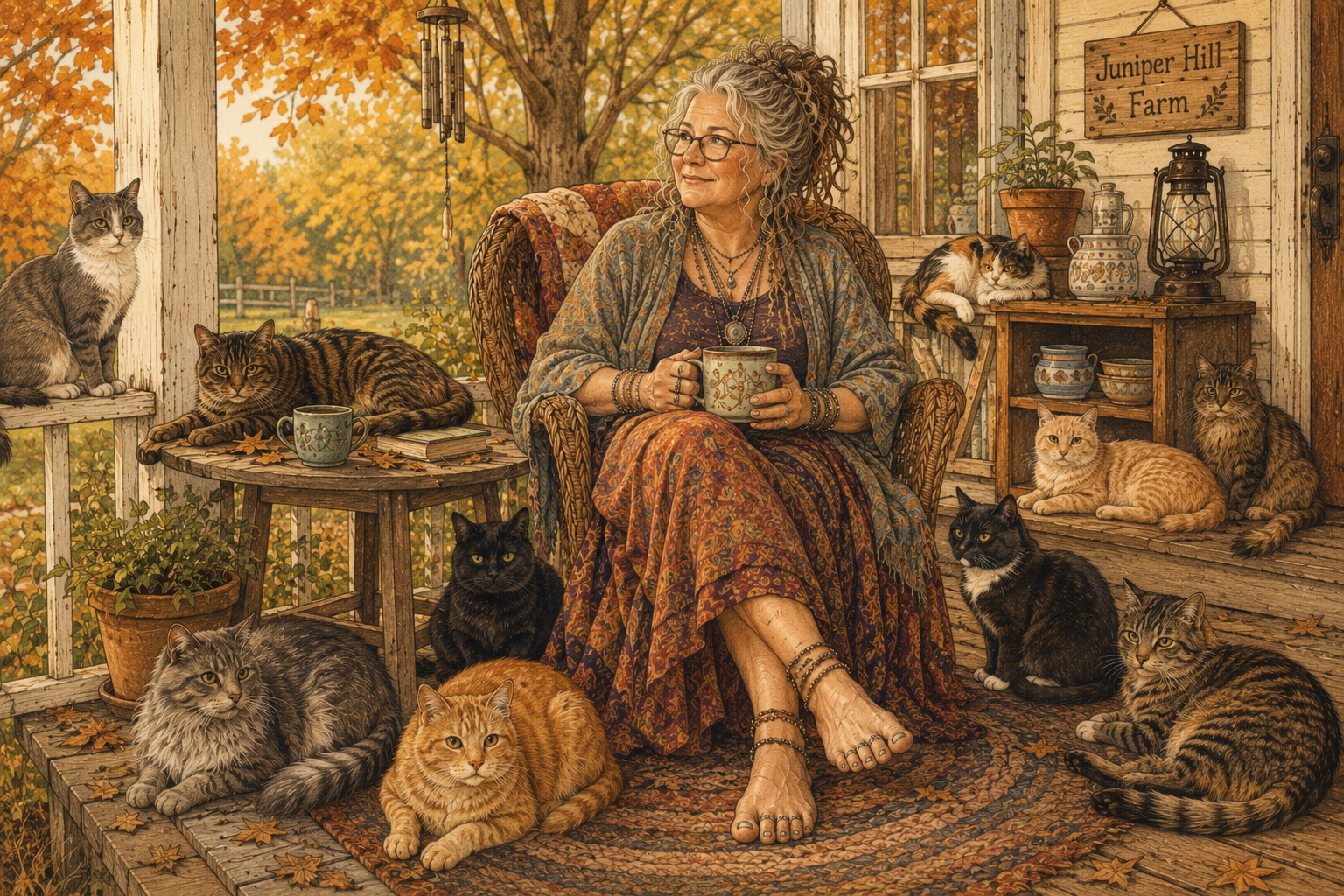
The mailbox at the end of the gravel drive reads “Juniper Hill Farm,” though the woman who lives there admits she hasn’t grown anything successfully in years except cats.
“There’s always another cat,” she said, barefoot on the wide plank porch of her antique farmhouse outside Amelia, Virginia, silver rings clinking softly against coffee mugs and feeding bowls alike. “You swear you’re done. Then one skinny little idiot shows up under the azaleas looking at you like you’re the last decent person left on Earth.”
At last count, she thinks there are 35 cats on the property, though the number appears flexible depending on weather, kitten season and “whether Ernie decides he lives here this week.”
The house itself looks less like a hoarder’s den and more like a bohemian grandmother’s museum. Quilts spill over old couches. Wind chimes clatter gently from the porch rafters. Books about herbal medicine share shelf space with veterinary ointments, cat treats and antique cookie tins filled with vaccination paperwork.
And everywhere — on chairs, railings, windowsills and staircases — are cats.
Contrary to popular stereotypes, large cat households are not always chaotic. Experts say domestic cats are more socially adaptable than their reputation suggests, especially when resources are plentiful and stable social groups form gradually.
“People still think cats are solitary animals like tiny tigers,” said the woman, who asked that only her first name be used: Marianne. “Nope. Cats are little neighborhood weirdos. They form cliques. They gossip. They absolutely have friendships.”
A massive orange tomcat walked across the porch during the interview, paused for ear scratches, then wandered away toward a rusted tractor half-swallowed by weeds.
“That one,” she said, pointing. “That’s the mayor.”
The Myth of the Solitary Cat
Researchers have increasingly documented social behavior among free-ranging domestic cats, particularly when food is available and territorial pressures are low. Female cats often cooperate in raising kittens, share sleeping areas and form long-term bonds. Cats recognize one another through scent, body language and vocalization patterns.
In mega-multi-cat homes, those social structures become surprisingly visible.
“There’s a breakfast crew, a porch crew and a nighttime cuddle union,” Marianne said matter-of-factly. “Some of them despise each other. Most of them just negotiate around each other like relatives at Thanksgiving.”
Veterinarians caution, however, that large cat populations can become unhealthy quickly without proper management. Stress, territorial conflict and disease transmission all rise dramatically when resources are insufficient.
The Humane Society and veterinary behaviorists generally recommend multiple litter boxes, feeding stations, vertical spaces and resting areas to reduce conflict. The often-cited formula for litter boxes is one per cat, plus one extra — a number that becomes mathematically alarming in Marianne’s house.
“I’m not discussing the litter situation,” she said with mock dignity. “I have legal counsel.”
Running a Business in a House Full of Cats
Marianne works from home running a small web design business, a setup she says is “ideal if you enjoy coding while somebody screams because another cat sat in their chair.”
Her office occupies what was once a formal dining room. Vintage monitors sit beside potted plants and stacks of design books. At least four cats slept through most of the workday interview, while another periodically walked across the keyboard with what Marianne described as “strong opinions about typography.”
The cats, she said, have become part of the rhythm of the house rather than interruptions to it.
“You stop fighting it,” she said. “You design around cats. You sleep around cats. You schedule Zoom calls around whether somebody is currently occupying your lap.”
She is also always barefoot — a practical decision, not merely an aesthetic one.
“If you step in something unpleasant, you know immediately,” she said with a shrug. “You don’t track it all over the house.”
Couldn’t socks accomplish the same thing?
“You can tell in socks too,” she acknowledged. “But you can’t wear socks outside and… wet socks… ick.”
Even in chilly weather, she rarely wears shoes around the property. Years of navigating the old farmhouse barefoot have apparently made her remarkably sure-footed around both cats and hazards.
“There’s an entire dance to not stepping on tails,” she said.
Managing 35 Cats Without Losing Your Mind
Despite appearances, Marianne runs her farmhouse with military precision.
Every cat is spayed or neutered. Vaccination schedules are written inside a massive floral day planner. Several local veterinarians know her by first name. Outdoor feeding stations are separated to reduce bullying behavior, and older cats have heated indoor sleeping areas during winter.
She also insists the indoor-outdoor setup matters.
“If all 35 were trapped inside this house, we’d all be dead,” she said cheerfully.
The farmhouse itself helps. The sprawling structure includes enclosed porches, an old smokehouse converted into a feeding station and enough creaking corners for cats to disappear into for hours at a time.
There are rules, too.
“No spraying indoors. No fighting on the bed. No dead snakes in the bathtub.”
Has that last one happened?
“It happened once,” she said. “That’s all it takes.”
Experts note that enrichment is crucial in large cat environments. Cats require places to climb, hide and observe. Socially bonded cats may groom or sleep together, while others prefer distance and parallel coexistence.
Marianne can identify nearly all the alliances instantly.
“Those two are lesbians,” she said, nodding toward a pair of tortoiseshells sleeping in a sunbeam. “Those three are criminals. That one thinks he’s a person.”
When Does ‘Cat Lover’ Become ‘Too Many Cats?’
The answer depends less on numbers and more on conditions.
Animal welfare experts distinguish between organized large-scale cat keeping and animal hoarding. Healthy environments maintain sanitation, veterinary care and quality of life for both animals and humans. Hoarding situations typically involve deteriorating health conditions, uncontrolled breeding and inability to provide adequate care.
Marianne bristles slightly at the comparison.
“I know exactly how many cats I have,” she said. “Crazy cat ladies who’ve crossed the line stop counting.”
She paused.
“Also, they don’t usually have spreadsheets.”
Still, she acknowledges the balancing act.
The food bill alone rivals a car payment. Medication schedules become complicated. Vacations are almost impossible. Hair appears permanently embedded into every blanket, sweater and human soul within the property line.
And yes, she occasionally questions her own judgment.
“Sometimes I stand in the kitchen at midnight while six cats scream for snacks and think, ‘You know, people without cats are probably asleep right now.’”
Then a small gray tuxedo cat climbed into her lap, pressed its face against her arm and began purring so loudly it nearly drowned out the cicadas outside.
She shrugged.
“That’s how they get you.”
========
Delia March is a Virginia-based features writer who focuses on rural life, animals and the strange domestic worlds people quietly build for themselves. This article was written, in part, utilizing AI tools.








Comments