Gautam Mukunda: The cost of gutting science is invisible yet enormous
Published in Op Eds
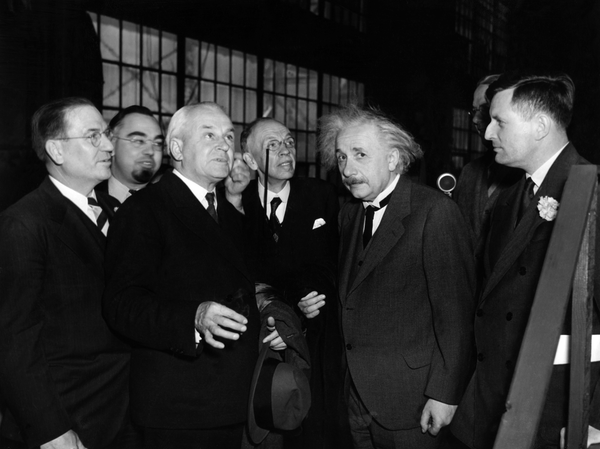
Intelligence agencies often complain that they are judged unfairly because you hear about their failures, not their successes. It’s hard to evaluate anything based on what didn’t happen — even when that’s really the important thing. The problem is just as salient for those trying to create a better future as trying to avert a worse one. When it comes to research, we can see technologies and industries that exist. We can’t see the ones that were never invented because the science that should have created them was defunded.
Consider the 22 emails that went out on a late Friday afternoon in April from the White House terminating the recipient’s appointment to the National Science Board, which has set policy for the National Science Foundation (NSF) since 1950.
No reason was given. The Trump administration’s explanation was that a 2021 Supreme Court ruling — about administrative patent judges, not advisory boards — raised constitutional questions about non-Senate-confirmed appointees. That’s no explanation. The firings come on top of huge cuts to the NSF’s budget and the loss of more than 30% of NSF staff since January 2025. They are the latest step in the administration’s evisceration of the NSF and the American science it supports.
The cost will be enormous, even if it’s invisible. A 2025 paper by Andrew Fieldhouse and Karel Mertens estimates the social return to non-defense public research and development at 140% to 210% — far higher than almost any other category of federal spending. The NSF is what produces that return.
In 1985, it began funding NSFNET, the backbone that bridged the Defense Department’s ARPANET and the public internet, greatly accelerating the commercial internet. In 2009, Berkeley researchers supported by the NSF published Above the Clouds, the seminal document of cloud computing. Even the foundations of today’s artificial intelligence boom were laid by the NSF in the 1980s and 1990s, when neural networks were a backwater dismissed by mainstream computer science.
None could have been funded first by private actors, or even universities. The payoff was too far out and speculative. The public paid for it because no one else would.
The NSF doesn’t just produce science. It produces scientists. Its Graduate Research Fellowship Program, in operation since 1952, is the longest-running federal investment in America’s STEM workforce, and the primary federal funder of graduate and postdoctoral training in the physical sciences, mathematics, computer science, engineering, and political science. One recipient of NSF support was me, for both my PhD and post-doctorate at the Massachusetts Institute of Technology.
That matters more now than ever, because our other talent pipeline is being strangled. For 70 years, the U.S. has been where scientific talent goes to flourish. It’s not the climate. The leading destination is Boston, where the weather leaves much to be desired. Nor the food. I did seven years at MIT and, ditto. It’s institutions like Harvard, MIT, Stanford and Berkeley. As they have come under assault and the U.S. has become hostile to immigrants, that pull has weakened.
Other countries have picked up what we’ve fumbled. The European Research Council’s 2026 Starting Grant call received 4,807 applications, up 22.4% over the previous year, which itself was up 13%. The European Union has committed 500 million euros ($587 million) to a Choose Europe for Science initiative aimed at attracting American researchers. France’s Choose France for Science platform drew 30,000 visitors from 157 countries in its first weeks, more than a third from the U.S.
When the U.S. doesn’t train and retain the world’s best scientists, it can cost us entire industries. Erdal Arıkan, a Turkish information theorist, completed his PhD at MIT in 1986 and returned to Turkey because the American tenure clock wouldn’t let him spend two decades on a single problem. He worked on it anyway, at Bilkent University, and in 2005 cracked a fundamental problem in code design. In 2009, a researcher at China’s Huawei read the paper. By 2016, polar codes were crucial to 5G cellular networks, which Huawei dominates. There are Arıkans working in American universities right now.
Firing the National Science Board also dismantles the agency’s protection from political interference. The board was designed in 1950 to insulate scientific judgment from politics, because when politicians dictate scientific truth, the results are usually disastrous. If the creators of the NSF needed an example, all they had to do was look to the Soviet Union, where Soviet agriculture was crippled for a generation by the government’s commitment to the nonsensical theories of the biologist Trofim Lysenko. The NSF model worked for three generations because Congress understood that without a firewall, government support of science could be counterproductive. The board was fired less than two weeks before it was scheduled to release a study on the U.S. ceding scientific ground to China.
The administration has no problem spending money. Just not on the future. Even at the Pentagon, where there seem to be no budget limits, it’s starving science. The proposed fiscal 2027 defense budget rises by 44% over the previous year, but within it, basic research falls by more than $3 billion, advanced technology development by $2 billion, and applied research by $1.9 billion.
The money is going to weapons and troops, not the next ARPANET or GPS. The Defense Department built ARPANET, but the Defense Department depends on basic research it does not perform. GPS runs on atomic clock physics developed at NIST with federal funding. Applied work is downstream of pure research, and there is no downstream after you stop up a river’s source.
The cost of crippling the NSF is the companies that won’t be founded and the jobs they won’t create. The industries dominated by other countries. All the good things that would have happened tomorrow but won’t. That’s a real loss, even if you never read about it on the front page.
Those losses can still be minimized. The venture capital industry knows the value of federal scientific research better than any other, and many of its most prominent members have the ear of the President. Congress has already rejected steep cuts to the NSF and NIH, only to watch the administration slow-walk the funding it had been ordered to spend. It can and should force the money it has allocated for scientific research to be spent. The absences are inevitable.
_____
This column reflects the personal views of the author and does not necessarily reflect the opinion of the editorial board or Bloomberg LP and its owners.
Gautam Mukunda writes about corporate management and innovation. He teaches leadership at the Yale School of Management and is the author of "Indispensable: When Leaders Really Matter."
_____
©2026 Bloomberg L.P. Visit bloomberg.com/opinion. Distributed by Tribune Content Agency, LLC.



















































Comments