Inside the fight over corporate activism and the Minnesota CEO letter
Published in Business News
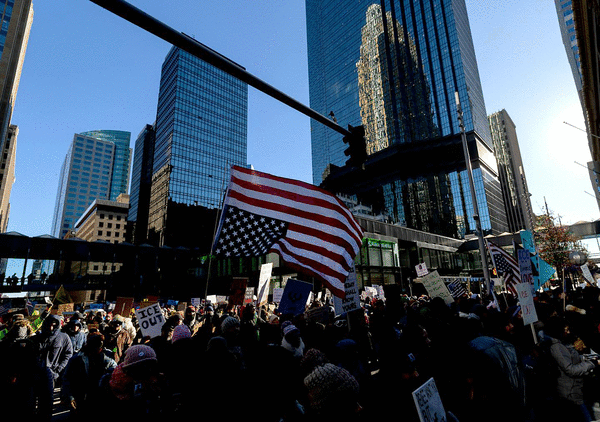
MINNEAPOLIS — The pressure on the CEOs of Minnesota’s biggest companies to publicly condemn the Trump administration’s massive deportation campaign was building for weeks.
The day before U.S. citizen Alex Pretti was killed, hundreds of Target employees crafted a letter of outrage to executives for not condemning the arrest of two of its U.S. citizen employees; local clergy were arrested at the airport while demanding Delta Air Lines speak out; and thousands of Minnesotans called off work to join a day of protest.
Pretti’s death at the hands of immigration agents “increased the urgency fundamentally” for business leaders to play an active role, said Doug Loon, CEO of the Minnesota Chamber of Commerce.
That’s when the Minnesota CEOs’ letter, workshopped by dozens of executives and their teams over the next 24 hours, came into existence. Ultimately signed by more than 80 executives, the letter became its own flashpoint among Minnesotans who hoped for a more full-throated condemnation of immigration enforcement agents’ tactics.
It called for “de-escalation” but did not mention Operation Metro Surge, Pretti or Renee Good, another Minneapolis resident and U.S. citizen killed by immigration officers weeks earlier. Loon acknowledged there were critics, but said, “The reality is, I think it accomplished its goal.”
The goal: cooperation between local and federal leaders to bring the surge, and the violence, to an end.
Minnesotans’ expectations that their hometown companies will engage in local civic life is built on recent memory and a long-running legacy. Many people decried the letter as mealy-mouthed, drawing a sharp contrast to the strong corporate response to the murder of George Floyd six years ago in Minneapolis.
Yet the world has since changed. Stephen Young, a corporate social responsibility scholar and former dean of what’s now the Mitchell Hamline School of Law, felt it was indicative of a “new order” in Minnesota’s business community, one that is wary of taking risks.
The risk for companies that make strong public statements, including taking a side during the immigration surge, is inflaming the White House and exposing their businesses to retaliation.
“When you’re having conversations that aren’t in the public eye, you can get a lot more done,” said Kurt Zellers, CEO of the Minnesota Business Partnership and former speaker of the Minnesota House of Representatives as a Republican.
A divisive letter
Weeks before the letter was published, a group of about a dozen CEOs started holding daily calls. They knew many activists were clamoring for powerful business voices to join them in expressing outrage.
But the pressure ballooned following Pretti’s killing, and a smaller initial group of CEOs recruited more executives to their cause.
The letter, signed by leaders from Target, Best Buy, UnitedHealth Group, Cargill and many more, came together like a college group project. There were “a lot of interests to accommodate,” Loon said. Initial drafts and versions evolved into “the most critical words necessary.”
And while many Minnesotans were critical of the statement, it was received more warmly nationwide, according to a survey report.
Of the 1,251 adults surveyed by Morning Consult, most of those who were aware of the letter felt positively or neutrally about it, regardless of the political party they belonged to, though fewer than 20% of respondents had heard “a lot” about it.
Bill George, a former Medtronic CEO who has taught executive leadership at Harvard Business School for two decades, has spoken out against the immigration surge. He thought the letter achieved what it set out to do.
“They then came up with this word, ‘de-escalate,’ which proved to be a brilliant word,” George said. “Although a lot of people in Minnesota thought it was soft and weak, it actually was the word that was engaged by the president of the United States and by the people around him, and that’s exactly what he did.”
Loon said the letter “affected all levels of government in a positive way.”
The companies have since turned their focus to philanthropy and recovery, raising $4 million in the first 30 hours following Pretti’s death.
For years, this is the civic role Minnesota corporate leaders have played.
‘Do-good stuff’
Minnesota companies have a long history of charitable giving and community engagement.
George Draper Dayton, whose retail empire grew from a single store in 1902 into what is now Target, set aside 5% of profits for the community, said Louis Johnston, a College of St. Benedict and St. John’s University professor who has studied Minnesota’s economic history.
In the second half of the 20th century, Dayton’s grandson urged CEOs who moved into town to make similar pledges over lunches at the swanky Minneapolis Club, Young said.
These CEOs endowed museums and had their employees serve on nonprofit boards. After race riots tore through north Minneapolis in the late 1960s, now-defunct computer company Control Data built a plant to revitalize the neighborhood.
In the 1970s, the ideas of economist Milton Friedman — who argued the “goal of a business is to maximize shareholder value” — became business school gospel, Johnston said.
As Control Data began to unspool in the following decades, people told its executives, “if you weren’t doing all this do-good stuff, the company would be doing a lot better,” Johnston added.
“I think that Minnesota companies remember that,” Johnston said.
‘We lost a mindset’
The state’s headquarters companies today have global reach and navigate geopolitical dynamics. Their philanthropy stretches far beyond the state, contending with divisive partisanship among varying customers, Johnston said. They “don’t want to antagonize” so they can do business with both political sides, he added.
The letter’s broad focus did not surprise Johnston. With shareholders in mind, companies often “waffle” in responding to social events, he added.
Yet, Johnston said, it strikes people as odd when Minnesota companies “straddle the fence” on issues because businesses here “have tended to be part of the civic fabric in a way that they aren’t necessarily in other places.”
A raucous evening protest at a Target near Minneapolis-St. Paul International Airport on Feb. 11 was a microcosm of activists’ broader call for companies to speak out.
Some of the demonstrators sat in groups between the store’s sliding doors. A few customers gave them high-fives, others heckled them and most ignored them. Within an hour, Richfield police were arresting protesters.
“Target’s voice is powerful,” Richfield protest organizer Ulla Nilsen said. “Where they lead, others follow, and we need them to lead.”
Target declined to comment for this story.
In a video recording obtained by the Minnesota Star Tribune, Target CEO Michael Fiddelke told employees on Jan. 26 that as someone raising a family in the Twin Cities, the “violence and loss of life” feel incredibly painful.
“Within Target, we are doing everything we can to manage what’s in our control, always keeping the safety of our team and guests our top priority,” Fiddelke said on the video.
America has changed
Young, of Mitchell Hamline, said a corporate focus on “risk aversion” is not unique to Minnesota companies.
“I think systemically America has changed,” the corporate social responsibility scholar said.
“We lost a mindset,” he said. “The new mindset is not conducive to risk-taking and creativity.”
When criticizing Minnesota business leaders’ muted response to ICE activity, people often contrast it to their statements and actions post-George Floyd, when financial and hiring pledges were commonplace.
Several experts said there’s a clear difference of circumstances: It’s easier to stand up to a local police force than face off with the president of the United States.
R.T. Rybak, the former mayor of Minneapolis, said “the biggest change right now is that there are overt threats from the federal government.”
CEOs “all fear retribution” when it comes to President Donald Trump, said George, who has served on boards of directors for Target and Mayo Clinic.
Trump explicitly warned Minnesotans in a Jan. 13 social media post that “the day of reckoning and retribution is coming.”
Trump recently suggested he’d keep ExxonMobil out of Venezuela after its CEO expressed skepticism about investment efforts in the country. He also recently sued JPMorgan Chase for $5 billion, accusing the bank of debanking him to further a political agenda.
Zellers, head of the business partnership, said people are looking to businesses for leadership due in part to the “lack of leadership — all around — in politics right now.”
“If it’s about making Minnesota a better place to do business and to have a great job, we’ll lean in,” Zellers said. “But where we won’t lean in is to be a part of a political fight or to be a part of a political statement from from either side.”
©2026 The Minnesota Star Tribune. Visit at startribune.com. Distributed by Tribune Content Agency, LLC.






Comments