Ford responds to federal government telling it to cut back China ties
Published in Business News
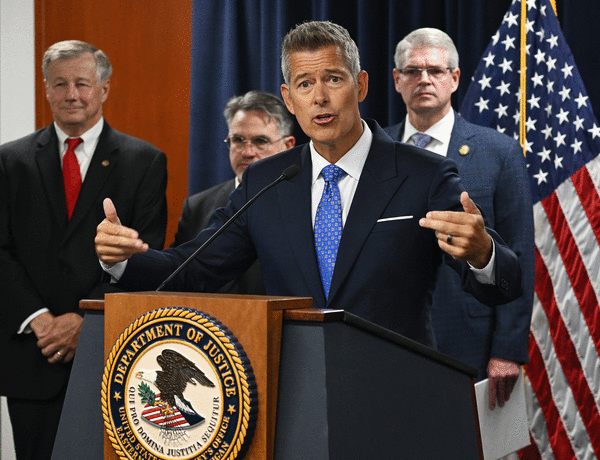
U.S. Transportation Secretary Sean Duffy sharply criticized Ford Motor Co's connections with Chinese companies — labeling those ties as "not a sustainable strategy for the United States" — in a letter sent to CEO Jim Farley on Tuesday.
"While DOT recognizes the intense competitive pressures of the global market," the Duffy letter said, "the Company's recent strategic decisions paint a troubling picture of a foundational American brand actively intertwining its future with Chinese state-backed enterprises."
Ford quickly volleyed back at the Trump administration on Tuesday afternoon, labeling Duffy's letter as a ploy to "capture headlines at the expense of a company that has done more for American manufacturing than virtually any other in the nation’s history."
Duffy pointed to several examples that concerned him: Ford's technology licensing with Contemporary Amperex Technology Co., Limited, or CATL, at its Marshall, Michigan battery plant; its joint-venture with Geely Automobile Holdings at a plant in Europe; and "delaying" the end of Lincoln Nautilus production in China until 2030.
The letter said the department has concerns over supply chain exposure, reliance on technology from "foreign adversaries," as well as maintaining U.S. manufacturing jobs.
In a lengthy statement from spokesperson Mark Truby, Ford underscored that it remains committed to the U.S. market and manufacturing and pointed out that it employs more hourly manufacturing workers, and exports more vehicles from the United States, than any other automaker. It said the partnership with CATL is limited, and pointed out that the White House praised Ford for the Marshall project just last week.
The statement also said Duffy's letter had "factual errors" — including its description of a framework to facilitate Chinese joint ventures on American soil. "Ford has not proposed a joint-venture framework as described in the letter," the automaker said.
And Duffy's concerns about delays bringing Nautilus production back stateside were "misguided," Ford said. Another Trump administration official, Commerce Secretary Howard Lutnick, had "praised that decision just last month," the company noted, and described the move as evidence that American manufacturers were bringing work back home under President Donald Trump. The Nautilus is the only model Ford builds in China for U.S. customers.
In the letter, Duffy said iconic American companies like Ford should be expected to "out-innovate competitors" from China, not team up with them.
"When a company intentionally chooses to deepen operational dependencies on strategic competitors, it fails to act as the reliable partner the American public and this DOT require," the letter said. "Attempting to navigate current circumstances in ways that could enrich those very competitors is not a sustainable strategy for the United States."
Duffy urged Ford to better align its corporate policies with the United States rather than "questionable foreign alliances." It says Farley should "reflect on these concerns." But it didn't offer any steps the department would take if Ford does not make changes.
Ford seemed surprised by the Duffy broadside: "Had Secretary Duffy reached out before issuing his letter to the press, we would have been happy to share more details about Ford’s U.S. commitment," Truby said in the statement.
Duffy's letter comes amid broader concern in Detroit and Washington over the rapid entry of Chinese automakers into Europe, Mexico, Canada and elsewhere, and what it could mean for one of America's marquee industries. In Congress, a pair of bipartisan proposals would ban the import, manufacture and sale of internet-connected vehicles, software and hardware linked to China or other adversaries.
Meanwhile, auto executives — including Farley — continue to raise concerns themselves about the competitive threat, and have urged policymakers to keep Chinese carmakers out of the United States, while at times also praising certain Chinese models for their technology and quality. On Sept. 3, the Alliance for Automotive Innovation urged Congress to ban such vehicles from the U.S. market by the end of the year.
©2026 www.detroitnews.com. Visit at detroitnews.com. Distributed by Tribune Content Agency, LLC.










Comments