Latin American-born residents 'hunkering down' before and during Midway Blitz cost economy $1.26B, report says
Published in Business News
CHICAGO — Latin American-born Cook County, Illinois, residents’ spending cratered as they stayed in their homes during Operation Midway Blitz because they were afraid of getting arrested by ICE agents, costing the local economy more than $1 billion and local governments more than $100 million in sales taxes, according to a new report on the one-year anniversary of the federal immigration crackdown’s kickoff.
While significant attention was paid during the crackdown to the business impact of immigration raids in iconic shopping and restaurant districts in the traditionally Mexican Pilsen and Little Village neighborhoods, researchers at the University of Illinois Chicago found that businesses outside those areas took a more significant — and sustained — hit, especially in suburban areas with low concentrations of Latin-American born residents.
Using weekly foot traffic from the firm Advan and U.S. Economic Census sales data, researchers compared people’s travel patterns from neighborhoods with high concentrations of Latin American-born residents before and after January 2025. That’s when President Donald Trump signed a series of proclamations and executive orders increasing detention and deportation and restricting immigration.
The business impact was swift and did not fade over time, found the study from UIC’s Great Cities Institute, which was unveiled Tuesday.
And those shoppers from neighborhoods with high Latin American-born concentrations didn’t take their business elsewhere locally. In all, the researchers estimate that led to $1.26 billion “in foregone commercial activity” at shops and restaurants over the first year of the federal immigration crackdown. The knock-on effect on local sales taxes, researchers estimate, totaled about $107 million.
“Latinos are workers, consumers, homeowners, business owners, and taxpayers,” added co-author José Miguel Acosta-Córdova, a research associate at UIC’s Institute for Research on Race and Public Policy. “Our labor and our economic activity are part of what makes the Chicago regional economy function. So when those normal patterns of movement and economic activity are disrupted, the effects do not remain confined to one neighborhood or one population.”
The $1.26 billion is only “one measurable part of a much larger economic and human toll,” Acosta-Córdova said. “The takeaway is not simply that heightened enforcement produces economic costs. It is that when the everyday mobility of Latino and immigrant communities are disrupted, those consequences extend beyond our neighborhood boundaries and into the broader economy.”
Before Trump’s immigration crackdown edicts, nearly four in ten visits made to low Latin American-born neighborhoods were by people from neighborhoods with high concentrations of Latin American-born residents. Within the first 19 weeks after the president’s January announcement, researchers said those visits “fell sharply” by 8.9% to retail stores and 9.9% to restaurants, on average. Trips within more concentrated Latin American neighborhoods stayed relatively flat.
Researchers studied whether that activity just shifted to other neighborhoods. “We found no evidence of that, and that this $1.26 billion figure is truly lost commerce,” said Great Cities Institute Associate Director Matthew Wilson, the co-author of the report, “Hunkering Down: The Hidden Economic Cost of Federal Immigration Enforcement.”
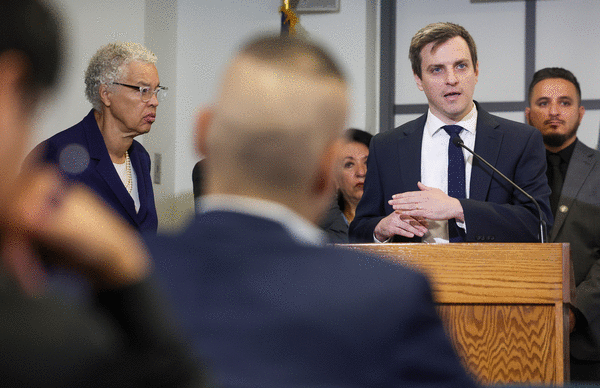
Local leaders that joined Wilson at Tuesday’s press conference emphasized repeatedly that the enforcement’s impacts extended countywide and were only one metric showing how interwoven Latin American residents and immigrants are with Cook County’s broader economy. “If there’s this idea that Latin American-born or neighborhoods with high Latin American-born shares of the population are in some way isolated, or maybe they’re insular. It’s not true,” Wilson said.
In Cook County’s suburbs in the same 19-week span, “retail decline was roughly twice as large” as it was in the city of Chicago. Latin American-born neighborhood residents have fewer places to go for routine purchases, the researchers suggested, and consistently shopped in suburban commercial corridors pre-enforcement.
The hunkering down also applied to essential trips to get groceries, medicine, gas or go to the bank, which also fell by 7.7% during the first 19 weeks after January 20.
Discretionary trips plunged as much as 20% in May 2025, around the same time Trump signed additional executive orders targeting “sanctuary” jurisdictions like Chicago and Cook County.
The drop in cross-community movement “persisted throughout nearly a year of observation,” the report found. That pattern had already stuck by the time “Midway Blitz” began 33 weeks after Trump’s first declaration about enforcement, according to researchers.
For suburban retailers, “this means the contraction is not a temporary disruption businesses can simply wait out, but a sustained shift in the geography of their customer base,” the report said.
The “directly observed 46-week loss is approximately $1.11 billion,” the analysis found. Extended out to a full year, the estimated cost rises to $1.26 billion.
“This was one of the most frightening and difficult periods in Cook County’s recent memory, and a shameful chapter in our nation’s history,” Cook County Board President Toni Preckwinkle said at a Tuesday news conference to announce the findings. “No number can capture the human suffering our residents endured, the devastating effect all of this had on our families and our communities. But today’s report puts a figure on part of that cost.”
©2026 Chicago Tribune. Visit at chicagotribune.com. Distributed by Tribune Content Agency, LLC.










Comments