Heating oil prices have risen 86% over last year. What CT officials fear as consumers ask 'Do I buy groceries'
Published in Business News
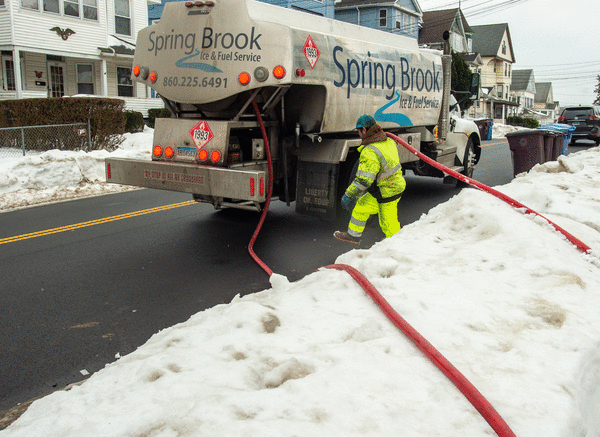
With home heating oil prices skyrocketing, officials are urging Connecticut residents to reach out for assistance before the freezing weather whips across the state this winter.
The current price of $5.91 per gallon is 86% above the average at this time last year and up 50% from June, officials said. The ongoing war in Iran has put a strain on consumer budgets as the volatile price of oil jumps up and down with the news about negotiations, stalled talks, and how many ships are getting through the narrow Strait of Hormuz that is more than 6,000 miles away from Connecticut.
With the volatility expected to continue in the short term, consumers are urged to fill out an application for assistance soon because the oil deliveries will start on Nov. 2.
“We are urging Connecticut residents to not wait until the temperatures plummet,” said Christopher McCluskey, a senior vice president at the nonprofit Community Renewal Team that serves Hartford and Middlesex counties. “Please, do not wait until your heat is completely out or your fuel has been completely spent out. Act now.”
A family of four with household income below $94,000 per year is eligible for home heating assistance, along with individuals earning less than $49,000 per year for the 2026-27 season.
Applications at the Community Renewal Team opened this year on Sept. 1, and more than 5,500 people have already applied in the central Connecticut area that covers 40 towns from Enfield to the shoreline, he said. When home heating oil averaged $3.18 per gallon last year, more than 22,000 people applied for assistance for the season.
The high cost of energy comes at the same time as food, housing, and electricity costs have stretched consumer budgets.
“Do I pay my heating bill?” McCluskey said, echoing the questions of consumers. “Do I buy groceries? Do I pay rent? Do I pay my electric bill? These are not theoretical questions. These are decisions that hardworking families across Connecticut have to consider every single day. … Our role is to meet families where they are. … We need to make sure that we ease the burden for Connecticut families who need it the most.”
In an effort to help, U.S. Sen. Richard Blumenthal called Tuesday for Congress to approve at least $7 billion for the Low-Income Home Energy Assistance Program, which is known as LIHEAP. The federal program assists low-income households in paying for fuel.
“You can cut back on a lot of luxuries, but home heating oil is not one of them,” Blumenthal said.
Perkin Simpson, chief executive officer of Generation Power CT, said the prices will be causing a major problem for affordability.
“It is an urgent and imminent matter,” Simpson said. “This is not just a temporary pain, a temporary issue. It’s going to get worse.”
Formerly known as Operation Fuel, the organization provides a maximum grant of $500 per household. Last year, the group served 6,000 households that cover about 13,000 people. At last year’s prices, the maximum grant paid for more than 100 gallons of fuel, but that will not be the case this year.
“At the end of the last winter season, we had to deny quite a few hundred people,” Simpson said. “This year, we’re looking at a similar situation if a shift does not occur” with additional funding. “We want to provide a ray of hope for these families.”
While low-income customers who use electricity and natural gas cannot be shut off during the winter by the regulated utilities, those receiving fuel deliveries are not protected.
Natural gas rates down
While oil prices are up, a ruling last month by the state’s Public Utilities Regulatory Authority calls for rate cuts for two companies selling natural gas in Connecticut. The utility regulators ordered the cuts for Southern Connecticut Gas and Connecticut Natural Gas customers, who would see rate cuts instead of the increases sought by the companies. The companies were ordered to return $120 million by Nov. 30, 2027, that was deemed as previous over-collections.
“PURA was right from the start to slash these rates,” state Attorney General William Tong said in a statement after the ruling last month. “Connecticut families cannot afford to bankroll padded profits and unsupported and unnecessary expenses.”
Tong added, “CNG was over-collecting millions of dollars from Connecticut families before they had the gall to ask for more. PURA got this one right.”
The two gas companies are subsidiaries of Avangrid, a gigantic company with operations in New York, Maine, and Massachusetts that also owns the United Illuminating electric company in Connecticut.
Cold weather already
Blumenthal warned Tuesday that winter is fast approaching, and consumers will be paying their fuel bills soon.
“Anybody who ventured out at 5:30 in the morning, as I did, knows that the temperature dropped to the low 40s where I live, and that is in the southern part of the state, so it was probably even lower around here,” said Blumenthal, who lives in Greenwich. “We are on the verge of much lower temperatures — a harsh winter for people who have to heat their homes. A winter that will likely be filled with hardship beyond any we’ve experienced in the recent past.”
He added, “The cost of home heating oil is going to be crushing — a severe and painful hardship for many families in Connecticut that simply cannot afford it.”
State legislature
Depending on the weather, the state legislature has been known to step in with extra funding if the winters are particularly brutal. In February 2024, state lawmakers voted for $17 million in emergency funding to keep residents warm during the cold weather. Lawmakers unanimously approved bipartisan legislation for $13.5 million for the Connecticut Energy Assistance Program and another $3.5 million for Operation Fuel, a nonprofit for more than 45 years before changing its name.
About 58,000 households had already exhausted their allotment when lawmakers voted, and they were required to apply again to receive additional money, officials said.
Gov. Ned Lamont immediately signed the bill on the same day it was passed by the legislature so that the money could be allotted as quickly as possible.
©2026 Hartford Courant. Visit at courant.com. Distributed by Tribune Content Agency, LLC.










Comments