Diesel prices surge just as farmers need fuel the most
Published in Business News
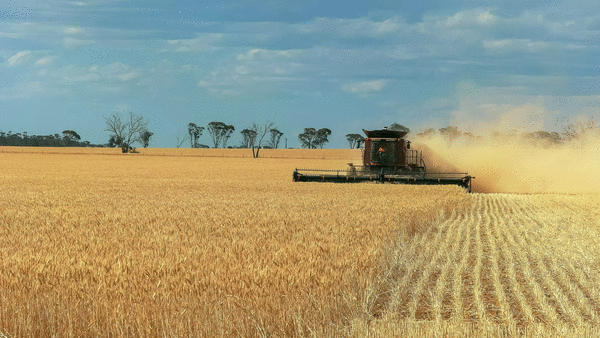
On a sprawling property near the Murray River in Australia’s southeast, Andrew Russell is gearing up to harvest one of his best grain crops in years after plentiful rain. But two wars half a world away are souring what should be a celebrated season for the nation’s farmers.
Diesel prices have soared globally as supplies tighten due to disruptions in the Strait of Hormuz stemming from the U.S.-Iran war and Ukrainian attacks on Russian refineries. In Australia, farmers are grappling with fuel costs more than 50% higher than last year as they begin harvesting what’s projected to be the country’s fourth-biggest crop on record, including wheat, barley and canola.
Russell says the country’s farmers need an above-average harvest just to cover costs, with diesel a major expense, and he worries about the growing uncertainty surrounding fuel supplies. His predicament is being repeated across major agricultural regions from South America to Europe and the U.S., raising the risk that elevated energy costs will curb production and stoke a new wave of food inflation.
“We should all be dancing on the tables,” said Russell, who runs a 1,300-hectare (3,200-acre) farm near Rutherglen, a small town in northern Victoria. But many growers only have a week’s worth of fuel-storage capacity and “harvest goes for four, five, six weeks. Gone are the days when the diesel tanker turns up every second or third day,” he said.
The industrial fuel is vital for agriculture, powering tractors, harvesters and irrigation pumps, as well as trucks that transport food to market. The squeeze has driven prices sharply higher worldwide, with diesel selling for around A$3 a liter in Australia, equivalent to about $7.90 a gallon. Average U.S. retail prices hit a record last month, creating political headaches for President Donald Trump ahead of next month’s midterm elections, while European futures have surged.
The spike in diesel comes as food prices are already climbing. A United Nations gauge extended gains in September to the highest since 2022 as extreme weather, trade disruptions and rising input costs hit farmers. The Bloomberg Agriculture Spot Index, another measure of crop prices, notched its sharpest quarterly increase in four years in the three months through September.
At the same time, several major producers are entering fuel-intensive stages of their crop cycles: Australia and Argentina start harvesting wheat this month, sowing is underway in Europe and Russia, while soybean planting is ramping up in Brazil. Disruptions to sowing or collection can weigh on yields.
Brazil is an agricultural powerhouse, ranking as the top producer of sugar and soybeans, and a key supplier to China. Farmers in the southern state of Rio Grande do Sul, which is responsible for roughly 10% of the country’s soybean crop, have warned of planting delays if diesel supplies remain tight.
“Diesel is available, but not in the volumes we were used to,” said Fernando Rechsteiner, a rice and soybean producer in Pelotas, an economic hub in Rio Grande do Sul. “You can’t just put an order one day and hope to get it quickly, you need to plan ahead,” he said, adding that the price of diesel in his area has risen roughly 40% since the beginning of the U.S.-Iran war.
The situation is leaving growers with few options. "They have to get the crop out of the field," said Beth Ford, chief executive officer of Land O'Lakes Inc., one of the U.S.'s largest farmer-owned cooperatives. "They don't have an alternative, and the question is, can they absorb that additional expense?"
Some farmers in the U.S., after already "eating into their equity the last number of years," are unable to, Ford said at a Tuesday event with the Economic Club of New York.
Fuel isn’t the only threat confronting agricultural producers. Major food-producing nations from Asia to Africa are also contending with a powerful El Niño, which has led to the weakest monsoon in India in more than a decade and exacerbated sweeping wildfires across Indonesia.
The price surge has already prompted a response from the White House. Trump threatened to ban exports before backing down after Group of Seven nations and their partners agreed to release emergency stockpiles. On Monday, the president signed an executive order to ease restrictions on the use of a tax-exempt variety of diesel in a bid to lower costs.
“It’s killing the whole nation,” said Missouri farmer Marty Richardson, who is reluctant to harvest his rain-drenched corn fields as his machines will chew up more diesel in the mud and he can’t afford to waste a drop. He recently paid $6 a gallon for the fuel and would be open to limiting U.S. exports to lower domestic prices.
Farther south, Louisiana rice and soybean farmer Julie Richard recently spent almost $20,000 on diesel to power her farm equipment, describing it as an “insane” amount of money. The fuel will probably last about two and a half weeks and doesn’t include what’s needed for trucks to haul grain from fields to mills. Richard expects elevated fuel costs to persist.
The squeeze extends beyond the farm gate. Elveden Farms Ltd., one of the UK’s biggest agricultural producers, is paying a 24% fuel surcharge to the trucking company that hauls its potatoes from its packing plant to market. Its own annual diesel bill for farm machinery has jumped 40% to £560,000 ($743,000), while electricity costs have also risen after an exceptionally dry summer.
“It’s obviously eating into our margins,” said Elveden Managing Director Andrew Blenkiron. “Budgeting is impossible. Who knows when it will end? Ultimately, it will have to increase the cost of food.”
Copa-Cogeca, the European Union’s biggest agricultural lobby group representing around 22 million farmers, warned that rising diesel, fertilizer and other input costs could hurt food supplies. There could be “noticeable production declines” if prices remain high, the group said.
Back in Australia, farmer Mic Fels has started harvesting grain on his more than 6,000-hectare farm near Esperance in Western Australia, and he isn’t waiting to see what comes next. While the fallout from the Iran war has prompted the Western Australian government to consider its own strategic diesel stockpile, he has already added 30,000 liters of diesel-storage capacity to guard against shortages.
“We’re paying close to A$3 a liter at the moment, and that really hurts,” Fels said. “We use about 4,000 liters a day when we’re harvesting. Do the math on that.”
(With assistance from Takaaki Iwabu.)
©2026 Bloomberg L.P. Visit bloomberg.com. Distributed by Tribune Content Agency, LLC.










Comments