As Dreamers are getting deported, some wonder what comes next
Published in News & Features
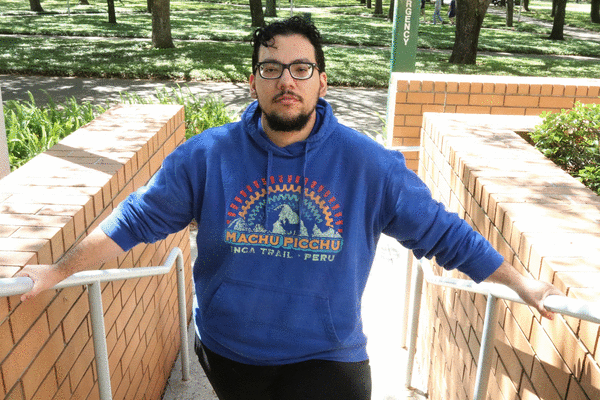
TAMPA, Fla. — Diego Dulanto and Alexander Vallejos do not know each other, but they share the same immigration status and the anxiety that comes with it.
Both are recipients of the Deferred Action for Childhood Arrivals program, or DACA, the 2012 executive action signed by former President Barack Obama that protects people brought to the United States as children from deportation.
Their concerns have grown after a report that U.S. Immigration and Customs Enforcement arrested 261 program beneficiaries and deported 86 during the first 10 months of last year.
“We are feeling petrified for those of us who have been detained and deported because we fear we might be next,” said Dulanto, 27, who lives in Hillsborough County.
“The most stressful part is the uncertainty,” said Vallejos, 26, of Orlando. “I think a lot of Dreamers feel the same.”
The new data was shared last month in a letter from the Department of Homeland Security to Sen. Dick Durbin of Illinois. The letter, signed by former Homeland Security Secretary Kristi Noem, said 241 of the 261 recipients arrested had “criminal histories.” It did not provide details about the nature of those crimes or the circumstances of the deportations.
Last month, a Mexican mother who had lived in the United States for 27 years was detained in Sacramento, California, during a green card interview and deported 24 hours later to Mexico. She was a program recipient. Now, she’s suing the federal government and lawmakers are demanding her return.
More than 20,000 recipients live in Florida; nationwide, about 515,000. The program provides recipients, known as Dreamers, with a Social Security number. They can legally work and renew their status every two years. The program doesn’t offer a path to citizenship and requires recipients to follow rules to keep their status.
The program has been under scrutiny by President Donald Trump’s administration since his first term. Last year, there were new attempts to stop it and limit its benefits.
Recipients have seen delays in renewal processing nationwide, and first-time applications are not being processed because of court rulings. They also can no longer get lower-cost health insurance through the Affordable Care Act Marketplace after the Trump administration overturned a Biden-era rule.
In Florida, the state ended in-state tuition for some immigrant students, including program recipients.
“Thankfully, I don’t have to renew anything until next year,” said Dulanto. However, he said his older brother, also a recipient, recently renewed his status and was required to appear in person for biometric screenings at a local customs office.
“Everyone in my family was terrified something was gonna happen to him,” Dulanto said. “We spent all day alert, just waiting for a text from him that he was done. Nothing happened, thankfully, but we were incredibly anxious.”
Dulanto has participated in demonstrations across the state to seek support for a permanent status. After arriving from Peru as a child, he earned a bachelor’s degree in psychology from the University of South Florida in 2022. He pursued a master’s in public health, but was unable to finish amid funding cuts and restrictions due to his status, he said. A semester away from finishing, he could not afford the $9,000 needed to complete it.
After years of pushing for reforms, Dulanto said little has changed.
“Dreamers are getting the bare minimum of what we’ve asked for over the past decade. It is not right, it is not just,” he said.
In response to questions from the Times, U.S. Citizenship and Immigration Services spokesperson Matthew J. Tragesser said in a statement that more screening can lengthen processing times.
“DACA does not confer any form of legal status in this country,” Tragesser said. “Illegal aliens claiming to be recipients of DACA are not automatically protected from deportation. Any illegal alien who is a DACA recipient may be subject to arrest and deportation for a number of reasons — including if they committed a crime.”
According to U.S. Citizenship and Immigration Services, recipients can lose their protection if they are convicted of a felony offense, significant misdemeanors such as domestic violence or driving under the influence, or three or more other misdemeanors. They also may lose their status if they pose a threat to national security or public safety.
Maria Gabriela “Gaby” Pacheco, president and chief executive of TheDream.US, a scholarship program for immigrant youth, said recipients have trusted the government for 14 years, have renewed their status and passed background checks. She questioned the arrests of Dreamers and how the program is being interpreted.
Thomas Kennedy, a policy analyst and consultant at the Florida Immigration Coalition, said the concern in Florida for local Dreamers is the cooperation between law enforcement and federal immigration authorities through formal agreements.
“Obviously, this puts them at greater risk when coming into any contact with authorities,” Kennedy said.
Immigration lawyer Jose Manuel Godinez Samperio of Bradenton said the deportation of Dreamers is the result of Congress’ failure to act. Samperio is a former program recipient, brought from Mexico when he was 9. In 2013, he was the first immigrant without permanent legal status allowed to practice law in the state. A decade later, Florida lawmakers repealed that pathway.
“Deferred Action, at the end of the day, is not actual immigration status,” said Godinez. “Congress urgently needs to pass immigration reform to open avenues for Dreamers to apply for legal permanent residence.”
For Vallejos, the fear of being detained and deported became real. He was arrested for a probation issue related to a 2024 DUI case in Seminole County. ICE took him into custody in February 2025.
Vallejos spent two months in immigration detention at the Krome North Service Processing Center in Miami-Dade County, the Broward Transitional Center in Pompano Beach and the Florence Service Processing Center in Arizona. He was released from detention in April, and his status was renewed in September. His immigration case is pending, he said, with a court hearing expected in 2028.
Vallejos is studying computer science at the University of Central Florida and plans to graduate in December. He wanted to do that last summer, but the end of in-state tuition forced him to delay his plans.
Like Dulanto, he took part in advocacy efforts calling for a permanent solution for program recipients. Deportation is something he cannot imagine.
“My whole life is genuinely here,” he said.
Vallejos came from Argentina with his parents when he was 2. His family and friends are in the U.S. He’s not fluent in Spanish.
“It’s scary to think everything could just go away that quickly,” Vallejos said.
_____
©2026 Tampa Bay Times. Visit tampabay.com. Distributed by Tribune Content Agency, LLC.






Comments