Can popular, friend-shaped koalas pull off genetic comeback?
Published in News & Features
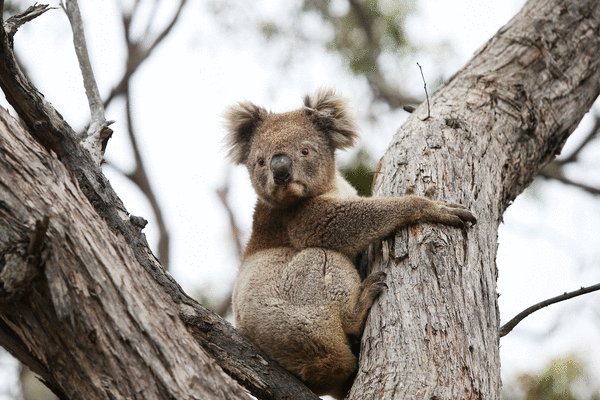
Cute but cantankerous, koalas are making a surprising recovery from a genetic bottleneck, with their once most-threatened populations now displaying a surprising diversity.
“It still looks like they’re in bad shape, but if you dig further, we’re actually finding that there’s recovery from the bottleneck,” study co-author Collin Ahrens, an evolutionary biologist at the independent research company Cesar Australia, told Scientific American.
Geneticists theorize that once populations dip below the bottleneck level, inbreeding and fatal mutations lead to an inevitable extinction, according to the University of California, Berkeley’s Understanding Evolution website. The theory doesn’t rule out rebounds, but the koala now ranks among a few species observed escaping a genetic bottleneck, in this case caused by overhunting that peaked 100 years ago.
Australian researchers sampled DNA from 418 koalas in 27 populations across three states to measure their genetic diversity. They found a surprise in Victoria, where koala populations have grown so much that the government is trying to limit their numbers. In 1920, scientists estimated only 500 to 1,000 koalas remained in Victoria, whereas today nearly half a million live in the state. That growth is remarkable because koalas sleep 20 hours a day, reporter April Santana wrote for the Columbia Post and Courier. They spend most of the remaining time chewing nutritionally poor eucalyptus leaves for sustenance.
That population growth allows opportunities for helpful mutations to take hold and proliferate, and for the limited genes in the population to regroup in different ways across new generations. Not only did they find higher genetic diversity than other populations once thought to be more stable, but they found new, rare variants and fewer harmful mutations.
“Recombination reshuffles the genetic variation,” Ahrens told Scientific American. “That’s really important and something that’s been really difficult to measure.”
They published their research in the journal Science on March 5.
Beloved around the world with their big eyes and round heads resembling human babies, koalas boost Australian tourism and even inspired an ubiquitous brand of Koala Kare baby-changing stations.
“I found that ‘ anthropomorphism ‘ — attributing human qualities to a non-human animal — has helped shift attitudes towards the koala away from the scientific and economic to a more romantic, emotional view,” researcher Kevin Markwell of Southern Cross University writes on The Conversation website. In particular, koalas share physical characteristics with human babies, which further endears them to us.”
That almost did not save them from destruction.
The Australian Koala Foundation estimates that fur traders killed 8 million koalas between 1888 and 1927, when their fur was prized for being soft and waterproof. By the time Australia banned the trade, less than 90,000 remained.
Ultimately, it was an executive order by U.S. President Herbert Hoover that spared the koala by banning fur imports. As a younger man, Hoover had spent time in Australia, which likely influenced his decision, the AKF website states.
The researchers noted that similar bottleneck escapes have been documented in northern elephant seals and the Chatham Island black robins, though without a similar increase in genetic diversity. A similar parallel exists in invasive species, which tend to rapidly proliferate from small numbers once they find a new environment to their liking.
Their research has implications beyond koalas, they wrote, with many species currently threatened by climate change and human activity.
_____
©2026 The Baltimore Sun. Visit at baltimoresun.com. Distributed by Tribune Content Agency, LLC.






Comments