Key Haiti suspect, 17 Colombians in Moïse's killing extradited to Miami ahead of trial
Published in News & Features
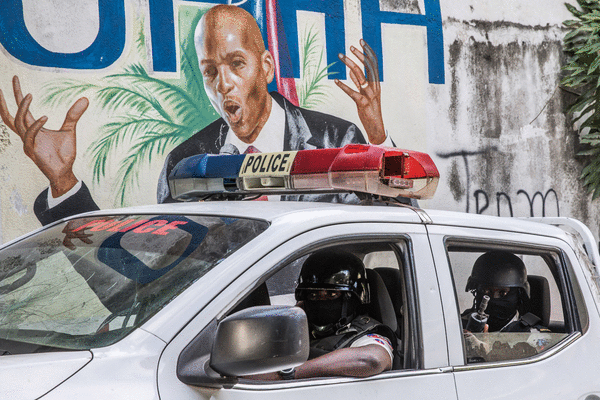
A key suspect in the July 7, 2021, assassination of Haitian president Jovenel Moïse was flown out of Haiti on Sunday by U.S. authorities, along with a group of 17 jailed Colombian commandos accused of taking part in the brutal killing.
A U.S. military aircraft arrived on the tarmac at Port-au-Prince’s international airport shortly before 11 a.m., and several people familiar with the operation told the Miami Herald that it was there to pick up Joseph Félix Badio, a former government functionary indicted in Haiti in connection with the assassination, as well as the Colombian former soldiers accused of taking part in the killing.
Initially, there was much confusion whether Badio was among those being extradited. Though he had left the prison along with the Colombians on Sunday, Haitian authorities were resistant to handing him over, given that he is a major part of their own slow-moving inquiry. But soon, his name appeared on a flight manifest that was obtained by the Herald, along with the Colombians. All were dressed in blue jumpsuits as they were seen boarding the large gray military aircraft.
In a post on X, Jason A. Reding Quiñones, the U.S. attorney for the Southern District of Florida, confirmed the extradition, saying “18 transported in military plane from Haiti to face American justice in the Southern District of Florida.”
“Today marks the next major phase in our pursuit of accountability for the assassination of President Jovenel Moïse,” he said. “Our work did not end with the men who planned and carried out this assassination. We will follow the evidence wherever it leads, to those who financed, facilitated it, supported it, or committed crimes to make it possible. Five years later, we are still bringing defendants before American courts, and we are not finished.”
So far 30 individuals have been indicted, Quiñones noted, for their involvement in the killing, which led to a political vacuum that further plunged Haiti into gang-fueled chaos.
Due to the sensitivity of the case, officials declined to comment. In South Florida, lawyers involved in the sprawling federal prosecution said they were unaware of the transfer. They noted, however, that the high-profile case in Miami federal court was recently placed under seal, an indication that new charges or defendants have been added.
The extradition of Badio and the Colombians to the U.S. by the Justice Department comes days before the final major suspect in U.S. custody, Christian Emmanuel Sanon, a South Florida resident who wanted to replace Moïse as president, is scheduled to go on trial. Before Sunday, Sanon was the last major defendant already in U.S. custody awaiting trial on the case.
Sanon was indicted with several others, including four South Florida men who were convicted earlier this year on conspiracy charges stemming from the plot to kidnap or kill the president. His trial was delayed because of health issues.
During the trial of the four men — including the owners of a Doral-area security firm that hired the Colombian commandos to go to Haiti — Badio’s name was repeatedly raised in testimony and evidence presented by both the defense and prosecutors. Text messages presented at trial showed him playing a pivotal role as the plot evolved from plans to kidnap Moïse and remove him from power into an assassination.
Several individuals who pleaded guilty in the case and were at a mountaintop house on the night the former Colombian soldiers stormed the president’s private residence testified about Badio’s presence. One witness said Badio was responsible for giving the signal to the group to leave the house they were staying at and head down the mountain toward Moïse’s residence.
Badio also allegedly armed the Colombians, told them that Moïse kept a suitcase containing cash in his second-floor bedroom and directed them to its location, as well as two firearms in the house. Moïse did not use the high-powered rifles during the attack, in which he was shot a dozen times.
Haitian police arrested Badio in October 2023 when he was spotted inside a Pétion-ville supermarket after he had spent more than two years in hiding. He has maintained his innocence and indicated he has information about the assassination.
A U.S. permanent resident, Badio had a home in New York. During the earlier federal trial, it was noted that the mortgage on his house was paid off after the killing.
The timing of the extradition raises questions about how the proceedings will unfold in the coming week. While Badio was featured prominently in the first trial, it’s questionable whether all the Colombians, who were hired to protect Sanon, were aware of the plot to kill Moïse, 53.
News of the unexpected transfer stunned relatives of the Colombian former soldiers, who had been preparing for their cases to move forward in Haiti and were given no advance indication that they could instead be sent to the United States, family members contacted by the Herald said.
Milena Carmona, whose husband, retired Lt. James Carmona, is among the Colombians jailed in connection with Moïse’s assassination, said she had just shared the news with a group of relatives when mothers, wives and other family members began asking what was happening.
“We didn’t know. We didn’t know,” Carmona said. “We were supposed to be waiting for hearings” in Haiti. She said she had been preparing a response to a request from the Inter-American Commission on Human Rights when she learned about the transfer.
The prospect of facing a criminal case in the United States has created a new worry for families who say they have struggled for years to pay legal expenses in Haiti. Relatives said they have limited resources and had resorted to organizing bazaars, games and raffles to raise money toward the Colombians’ legal costs. They now fear they will be unable to afford private criminal defense attorneys in the United States.
“For us, obviously, it will be very difficult — very, very difficult — because our resources are absolutely scarce,” Carmona said. “What we used to do was bazaars and games and raffles and everything to be able to cover at least some of the costs. Now imagine a criminal lawyer. That is much more expensive. We have no way to pay for it.”
The transfer also left relatives with mixed feelings after years of frustration over the slow-moving proceedings in Haiti. Family members had repeatedly sought intervention from the Colombian government over the detainees’ situation, but they said Sunday’s development was not the resolution they had been seeking. “I don’t see any options,” Carmona said of the prospect of proceedings in the United States. “I’m trying to organize my thoughts. I don’t know what to think.”
_____
©2026 Miami Herald. Visit miamiherald.com. Distributed by Tribune Content Agency, LLC.




Comments