Alex Saab's longtime partner to face Miami trial after Venezuela hands him over
Published in News & Features
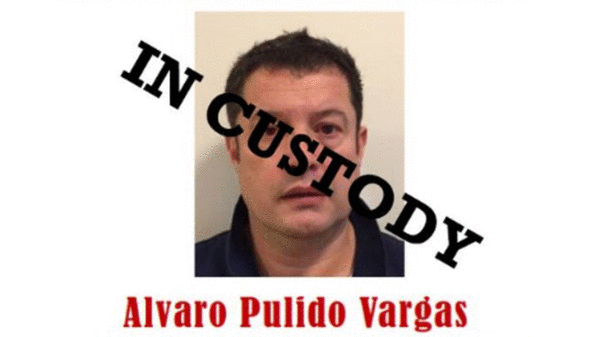
MIAMI — Colombian businessman Alvaro Pulido, accused of helping orchestrate massive corruption and money-laundering schemes involving billions of dollars in Venezuelan government contracts, is expected to make his first appearance in Miami federal court Tuesday after reportedly being handed over to U.S. authorities by the government of acting Venezuelan President Delcy Rodríguez.
Pulido, 62, a longtime business partner of Alex Saab, had been held in a Venezuelan prison since 2023. On Sunday, he was brought to Florida after agents from the U.S. Drug Enforcement Administration reportedly removed him from custody, according to Colombia’s El Tiempo newspaper, which cited federal sources.
The newspaper reported that the operation took place with the consent of Rodríguez’s government, which had previously transferred Saab, another former associate of ousted strongman Nicolás Maduro, to U.S. custody in May.
U.S. authorities confirmed Sunday that Pulido was in federal custody following an investigation involving the DEA, FBI and Homeland Security Investigations. But they have not disclosed how he was transferred from Venezuela or whether the operation involved a formal extradition, deportation or another arrangement.
His arrival raises questions about growing cooperation between Washington and Rodríguez’s interim government, particularly because Pulido was still facing criminal proceedings in Venezuela when he was transferred.
It also comes less than a month after Saab pleaded guilty in Miami to participating in a money-laundering conspiracy and agreed to cooperate with federal prosecutors, potentially making him a key witness against his former business partner.
Pulido faces charges in two separate federal indictments filed in Miami in 2019 and 2021, involving a total of 13 money-laundering counts, each carrying a maximum sentence of 20 years in prison. Prosecutors accuse him of participating in schemes to divert hundreds of millions of dollars from Venezuelan government programs intended to provide housing, food and other necessities to the country’s impoverished population.
The State Department had previously offered a reward of up to $10 million for information leading to his arrest or conviction.
At Tuesday’s expected appearance, a federal magistrate judge will advise Pulido of the charges against him, address his legal representation and consider preliminary issues involving his detention.
Handover raises questions
Pulido’s transfer is particularly unusual because he was still facing criminal proceedings in Venezuela when he was taken into U.S. custody.
He had been held at El Rodeo I prison, outside Caracas, since 2023 in connection with the PDVSA-Cripto corruption investigation, which involved allegations of irregular oil sales and losses exceeding $1.5 billion.
As recently as June, Pulido pleaded not guilty in those proceedings, which also involve former Venezuelan Oil Minister Tareck El Aissami.
According to Colombia’s El Tiempo newspaper, DEA agents removed Pulido from a Venezuelan prison with the approval of Rodríguez’s government and transported him to Florida.
Neither Washington nor Caracas has publicly explained the legal mechanism used to transfer him or what happened to the Venezuelan charges. Venezuelan authorities have not publicly commented on the operation.
The circumstances resemble those surrounding Saab’s return to U.S. custody in May, when Rodríguez’s government reportedly treated his removal as a deportation of a Colombian national.
The two transfers suggest increasing cooperation between Venezuelan authorities and U.S. law enforcement agencies following Maduro’s removal from power in January. However, there is no publicly established evidence that Pulido’s handover was part of a broader agreement involving sanctions relief, oil exports, diplomatic concessions or other benefits for Caracas.
Whether Saab’s cooperation with prosecutors directly influenced the decision to transfer Pulido also remains unclear.
Corruption schemes
The first indictment, filed in Miami in 2019, accuses Pulido and Saab of participating in a money laundering conspiracy involving a Venezuelan government contract to build low-income housing.
According to prosecutors, the businessmen obtained the contract in 2011, during the presidency of Hugo Chávez, and subsequently bribed Venezuelan customs officials, National Guard officers and government employees responsible for approving foreign currency transactions.
The payments allowed them to obtain approvals for fraudulent documentation claiming that construction materials had been imported into Venezuela, even though the materials never arrived, according to the indictment.
Prosecutors say approximately $350 million was transferred from Venezuelan accounts controlled by the businessmen through U.S. financial institutions before being moved to overseas accounts.
The second indictment, returned in 2021, centers on Venezuela’s Local Committees for Supply and Production program, commonly known by its Spanish acronym CLAP, which distributed subsidized food boxes to millions of Venezuelans during the country’s economic collapse.
Prosecutors say that a company secretly controlled by Pulido obtained a 2016 government contract to supply 10 million food boxes at $34 each, generating approximately $340 million in revenue.
The boxes allegedly cost substantially less to produce, allowing the conspirators to use the inflated prices to finance bribes and divert government funds.
Among the recipients were José Gregorio Vielma-Mora, then governor of Venezuela’s western Táchira state, and an intermediary, who prosecutors say received approximately $17.3 million.
The government is seeking forfeiture of approximately $1.6 billion in connection with that case. The indictment also names Pulido’s son, Emmanuel Enrique Rubio González, and two other alleged associates.
Saab cooperation
Pulido’s arrival in Miami could give prosecutors an opportunity to pursue allegations that have remained unresolved for years, particularly now that Saab has agreed to cooperate with the government.
On Sept. 15, Saab pleaded guilty to one count of conspiracy to commit money laundering before U.S. District Judge Kathleen M. Williams.
As part of his plea agreement, he agreed to forfeit $195 million and cooperate with federal prosecutors, including by testifying in future criminal trials.
In a statement of facts accompanying his guilty plea, Saab identified Pulido as his partner in directing the operation.
“Saab and Pulido, along with high level Venezuelan officials, were the primary organizers and leaders of the illegal scheme,” the document states.
According to Saab’s statement, the businessmen used shell companies established in Hong Kong, the United Arab Emirates and Turkey to obtain at least six CLAP contracts. A Swiss financial advisory firm allegedly helped establish bank accounts in Bulgaria and Liechtenstein “for the sole purpose of laundering funds.”
Beginning around 2019, according to Saab’s admissions, the conspirators began receiving payments in Venezuelan oil, gold and other natural resources instead of cash.
When Saab was arrested in Cape Verde in June 2020, Pulido assumed control of the operation, the statement says, adding: “The criminal scheme continued with Pulido assuming SAAB’s leadership role.”
Saab’s account says Pulido subsequently arranged shipments of Venezuelan oil aboard tankers and diverted portions of the proceeds.
Those admissions could become important evidence in Pulido’s prosecution, although the allegations concerning him have not been tested in court.
Venezuela government contracts
Pulido, born in Bogotá in 1963, has a history that predates his emergence as one of the businessmen accused of profiting from Venezuela’s government contracting system.
According to Colombian police accounts cited by El Tiempo, Pulido coordinated the shipment of approximately two tons of cocaine and 17 kilograms of heroin to Europe in 1999.
He was arrested in Bogotá in 2000 in connection with the drug trafficking organization known as the El Dorado Cartel and was sentenced to 15 years in prison in Italy, according to Colombian news reports.
Authorities also identified him as Germán Enrique Rubio Salas, one of several identities he allegedly used while traveling internationally. El Tiempo reported that he had used five false identities over a two-year period to travel to countries including Brazil, Germany and the United Kingdom.
Pulido moved to Venezuela in 2006, where he developed a business partnership with Saab that eventually brought both men into the orbit of senior Venezuelan government officials.
Their activities also drew scrutiny elsewhere in Latin America. In 2013, Ecuador’s then-attorney general, Galo Chiriboga, announced a money laundering investigation involving Fondo Global de Construcción, a company established in Ecuador in which Pulido was a shareholder. An Ecuadorian judge dismissed the case in 2015.
The DEA began investigating Pulido and Saab in 2017. Two years later, the U.S. Treasury Department imposed sanctions on both businessmen, while federal prosecutors in Miami filed money laundering charges involving their Venezuelan construction contracts.
In April 2023, Pulido was arrested in Venezuela during the PDVSA-Cripto corruption investigation, which exposed allegations of massive irregularities involving the country’s state oil company and cryptocurrency transactions.
Political upheaval
The prosecutions have unfolded against the backdrop of dramatic changes in relations between Washington and Caracas.
Saab was extradited from Cape Verde to Miami in October 2021, but President Joe Biden granted him clemency in December 2023 as part of a prisoner exchange that secured the release of Americans held in Venezuela.
Maduro welcomed Saab back to Caracas and later appointed him to a government ministry.
His fortunes changed after Maduro was ousted from power in January. Acting President Delcy Rodríguez removed Saab from his government position, and he was returned to the United States in May, eventually leading to his September guilty plea.
_____
©2026 Miami Herald. Visit miamiherald.com. Distributed by Tribune Content Agency, LLC.




Comments