LA Sheriff Robert Luna institutes new policy aimed at eliminating prohibited deputy cliques and gangs
Published in News & Features
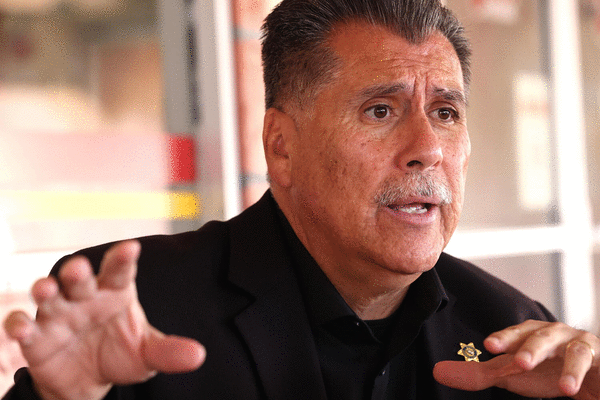
LOS ANGELES — The Los Angeles County Sheriff’s Department has enacted a new policy aimed at rooting out prohibited deputy cliques and gangs in its ranks, in an action announced two days after Sheriff Robert Luna was reelected to a second term this week.
“There is no place in our Department for cliques that undermine our guidelines, compromise accountability, or erode public trust,” according to a statement from Luna, who has repeatedly promised to eliminate rogue organizations within the department.
The new policy states that department members “shall not participate in, or solicit others to participate in, or join a prohibited clique.” In addition, it requires department employees to participate in investigations of the groups “as a condition of employment.”
A “prohibited clique” is defined by the new policy as“ an exclusionary subgroup of Department members who engage in activities that adversely affect the employment of Department members or the rights of others in violation of Department or County policy for the benefit of the clique or its members.”
The online version of the Sheriff’s Department’s Manual of Policy and Procedures has already been updated to include its new policy on the cliques.
Robert Bonner, the influential former chair of the Sheriff Civilian Oversight Commission who oversaw hearings and probes of alleged deputy gangs in that role, applauded the new policy.
“This is the policy that, if it is implemented, will actually eradicate deputy gangs in the sheriff’s department,” he said in an interview. “This was the policy that was desperately needed.”
The new policy is not the first on the issue of deputy sub-groups that the sheriff has instituted. In September 2024, Luna announced a policy that banned membership in deputy gangs and hate groups, required deputies and other department employees to participate in investigations of them, and stated that those who violated the policy could be subject to discipline including termination.
The department said the new policy announced Wednesday “builds upon” the one announced two years ago and extends beyond deputy gangs and hate groups to include “any unauthorized clique.”
At his election night party at a Mexican restaurant in Carson on Tuesday, minutes after he learned that the race had been called in his favor and he was headed to a second term, Luna told the Times that he was “still working on meet and confer with labor on the clique policy, so there’s still a lot of work to do. There’s still a lot of work to do on the deputy gang issue.”
But the next day, “the Department and the labor unions came to an agreement during the meet and confer process and all concerns were resolved,” the sheriff’s department said in an email on Friday. “The policy was finalized yesterday afternoon.”
For decades, deputies have formed cliques and sub-groups at sheriff’s stations across L.A. County, particularly in lower-income areas and neighborhoods whose residents are predominantly Latino or Black. Some of the most notorious cliques – which have names like the Executioners, the Vikings and the Banditos – are referred to as gangs because they have been accused of engaging in gang-like behavior such as initiation rites and displaying tattoos and symbols indicating membership.
More problematic is the long history of alleged involvement of deputy gangs in violence, intimidation and other potentially criminal behavior. The groups date back half a century, to the days of the Little Devils, whose mostly white members had matching tattoos and engaged in aggressive policing of mostly Latino communities in East Los Angeles. In more recent years, deputy sub-groups typically have been less outwardly visible, but critics and watchdogs say they remain a serious issue within the sheriff’s department.
In 2021, a report by Loyola Marymount University documented the existence of 18 such groups over the previous half-century. And there have been a series of incidents in recent years in which alleged members of deputy gangs were accused of engaging in violence.
As recently as January 2024, the Times reported on an alleged deputy gang that had not previously been publicly identified. The purported existence of the Industry Indians was revealed during the investigation into an alcohol-fueled altercation in 2022 in which deputies allegedly flashed a gun and punched a teenager in the face.
In the aftermath of the incident, a sergeant and a deputy who were present that evening outside a bowling alley in Montclair told investigators they had tattoos that department officials had connected to a deputy gang based at the City of Industry sheriff’s station called the Industry Indians, the Times reported.
The impacts of deputy gangs and cliques are felt beyond the people who say they’ve been victims of their violence. Over the years, L.A. County has paid out tens of millions of dollars in legal settlements stemming from cases involving deputies accused of belonging to secret societies.
Next week, the L.A. County Board of Supervisors plans to take up a motion that would compel the sheriff’s department to identify deputy gangs and provide information about its investigations into them.
Luna has repeatedly told the Times in interviews since he took office in 2022 that he is committed to ridding the department’s ranks of deputy gangs. Early in his first term, he oversaw the creation of the Office of Constitutional Policing with a mandate that included working on the issue.
In May, Luna told the Times that if elected to a second term, he was “going to be a very proactive or active participant in trying to eradicate” deputy gangs and cliques.
“I completely turned around the perspective from management,” he said at the time. “And even my critics who say, ‘Well, it just got buried deeper’ – man, you pop out your head and there’s any gang-like behavior, you’re going to get hammered, and everybody knows that now.”
It’s unclear just how effective the sheriff’s efforts to eliminate the groups have been to date. But Bonner is optimistic.
If Luna is able to effectively implement and enforce the new policy, Bonner said, “we’ll look back a few years from now and say, ‘There aren’t any deputy gangs anymore.’”
©2026 Los Angeles Times. Visit at latimes.com. Distributed by Tribune Content Agency, LLC.





Comments