ULA rolls Vulcan to launch pad, on tap to help Amazon play catchup to SpaceX
Published in News & Features
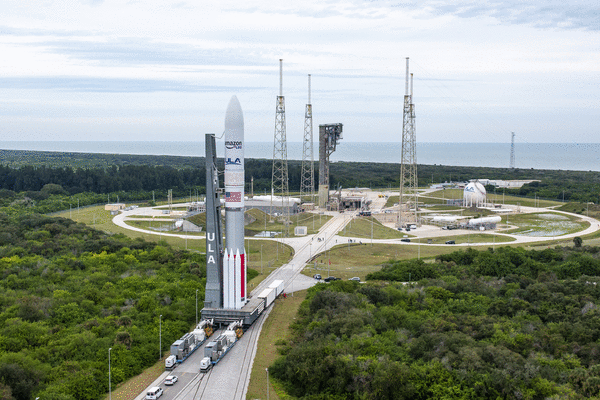
United Launch Alliance is set for the return of its Vulcan rocket Friday after nine months of delays on a mission that looks to reinvigorate Amazon’s game of catchup to SpaceX’s lucrative Starlink satellite program.
Flying for only the fifth time, the replacement for ULA’s Atlas V and Delta IV family of rockets, is targeting liftoff from Cape Canaveral Space Force Station’s Space Launch Complex 41 at 12:54 p.m. during a 29-minute launch window.
The company rolled the rocket to the pad on Thursday morning.
On board, the Vulcan has 40 Amazon Leo satellites marking the first of 38 missions Amazon bought up on Vulcan to help proliferate more than 3,200 satellites over the next few years. To date, Amazon has managed to get only 398 satellites off the ground through a combination of launches on ULA’s dwindling supply of Atlas V rockets and SpaceX Falcon 9 missions from Cape Canaveral while also flying on Arianespace’s Ariane 6 rockets from South America.
SpaceX, meanwhile, surpassed this year 13,000 satellites launched since the first operational ones were deployed in 2019, according to statistics maintained by astronomer Jonathan McDowell.
Blue Origin was also supposed to have begun Amazon Leo launches this year with its New Glenn rocket, but an explosion at Canaveral’s Launch Complex 36 damaged the pad and New Glenn won’t fly again until 2027.
Vulcan, though, was supposed to have had its first Amazon launch this past summer with ULA planning to juggle Vulcan and Atlas V missions throughout the year.
But Vulcan has been on hold since its previous launch on Feb. 12. What was its first national security mission, Vulcan’s trip to space had a problem with one of its solid rocket boosters, which are supplied by Northrop Grumman. The nozzle on one of the boosters burned off during ascent. The problem was similar to one seen on Vulcan’s second launch in 2024, and one the company has said it had solved.
So is the nozzle issue fixed? Not with certainty, and this flight, which will be the first to use the most powerful configuration of Vulcan, will use six of the boosters. Combined with Vulcan’s first stage engines, they will produce more than 3.8 million pounds of thrust at liftoff.
The company stated it expects more reliability, and that it understands how the burn-through occurred on the last flight. But it had not nailed down the culprit, but rather “identified several potential contributors which have been mitigated through design and process improvements to the nozzle.”
Amazon certainly is hoping for a successful return for Vulcan as it has oodles of satellites ready to fly. In September, the company completed the manufacture of its 1,000th Amazon Leo satellite.
ULA also has a backlog of more than two dozen national security launches for Vulcan, but the Space Force has yet to announce when it will trust its payloads back on Vulcan. After the February incident, the government said it would not fly on Vulcan again until it figured out the nozzle issue.
And with New Glenn off the board, all national security missions have flowed instead to SpaceX flying on Falcon 9 and Falcon Heavy rockets. SpaceX, though, has announced it intends to wind down its Falcon launch manifest, which limits the government’s options after 2028.
If ULA does get Vulcan up and running without issue, the company had been prepared to fly as many as 24 launches a year from Florida while it also continues to prepare for launches from California.
While Vulcan was grounded, ULA exhausted all but six of its Atlas V rockets this year, with all of those remaining set aside for Boeing’s Starliner missions.
If Vulcan flies, it will be ULA’s sixth launch of the year, and the Space Coast’s 61st, with all but eight coming from SpaceX. Blue Origin managed one launch before the pad explosion and the other flight was NASA’s Space Launch System rocket on the Artemis II mission.
The launch rate on the Space Coast fell off from 2025’s record 109 orbital flights because of changing priorities from SpaceX. Elon Musk’s company has only flown Falcon Heavy missions from its pad at Kennedy Space Center as it works to complete the Starship and Super Heavy launch tower at KSC’s Launch Complex 39-A.
It also stopped flying Starlink missions on Falcon 9 rockets from Florida, leaving those duties to its California operation.
There is still a chance Starship may have its first Florida launch before the end of the year, but for now, SpaceX has only one more launch on 2026’s manifest, a resupply mission at the end of the month to the International Space Station flying Northrop Grumman’s Cygnus spacecraft.
Another Falcon Heavy launch looks to have pushed to no earlier than early January, flying Voyager Technologies’ Griffin lunar lander to the moon.
--------------
©2026 Orlando Sentinel. Visit at orlandosentinel.com. Distributed by Tribune Content Agency, LLC.






Comments