Commentary: 'The Pitt' dramatizes the very real burnout that threatens medical care workers and patients
Published in Health & Fitness
In between patients at my oncology clinic, I couldn’t catch my breath. I asked my nurse to check my oxygen level and pulse. My chest felt heavy, as if something were pressing on it.
I sat in the same examination chair my patients use, watching the monitor and running through possible diagnoses. But I knew what this was.
A panic attack.
My mother had just called. While she felt fine, her routine CT scan showed fluid around her lung. I didn’t need anyone to explain what it meant. I’m an oncologist. Pleural effusion, in this context, is definitive: It meant her cancer had spread.
She didn’t know yet. I did.
Over the next two years, as she lived with Stage IV lung cancer, I moved between my roles as daughter and doctor, managing my own patients and quietly absorbing her suffering. The message from my oncology division was clear: Keep working. There was no space to feel.
That expectation is not incidental. It is structural. The system holds because the people inside it are asked to absorb more than they should.
That’s why a scene in the HBO medical drama “The Pitt” stopped me.
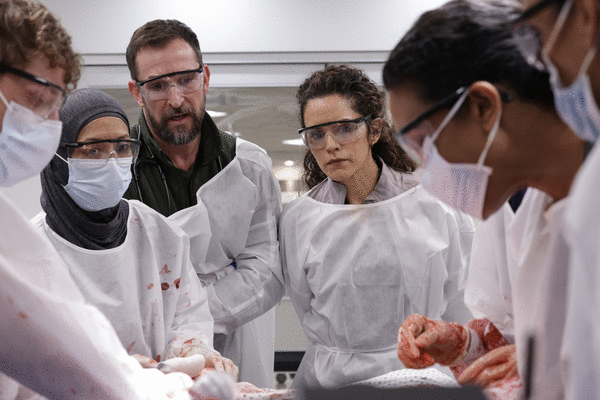
Dr. Samira Mohan is dealing with a chaotic emergency department while fielding calls from her mother. The pace is relentless. Her body gives way to chest pain, sweating and a sense of impending doom. She is triaged as a patient. But it isn’t a heart attack.
When she returns to her duties, Dr. Robby, the attending physician, dismisses it as “mommy issues.”
It was one of the first times I felt seen, and it came from a TV show.
“The Pitt” reflects the failures of our health care system — overcrowded emergency rooms, too few doctors and too many patients. It shows an uninsured patient who is suffering from diabetic ketoacidosis, a condition in which blood sugar spirals out of control, but who leaves before his treatment is complete because he cannot afford to stay. It shows a son who drives for more than an hour so his critically ill father can get dialysis after they discover their local hospital has closed.
But what the show captures with unusual insight is something more fundamental. “The Pitt” reveals not just what the system lacks, but the self-sacrifice required of the medical team in order for health care to stay afloat. Medicine does not just demand our competence as professionals. It demands that we ignore ourselves and our needs, even when the personal cost is high.
In a recent episode of “The Pitt,” a student doctor who leaves promptly at the end of her shift instead of working over tells a senior resident that 60% of emergency physicians report burnout. Hers is a quiet act of refusal. Because in medicine, the expectation is that we should stay through exhaustion, personal crisis and the slow erosion of self we are trained to ignore.
Every part of medicine functions this way. The emergency department is just where the strain is most visible. In the operating room, care depends on layers of people — nurses, anesthesiologists, surgical technicians, assistants — contributing a different piece of the whole. Oncology clinics run on the same coordination, as do inpatient teams.
It is less like a hierarchy than an orchestra, each person entering at the right moment. There is little margin for error. When one note is missed, whether from fatigue, overload or distraction, the entire performance begins to unravel.
“The Pitt” is filmed the same way, the camera moving continuously from one person to the next, as if there is no pause in the system.
Burnout is not simply an individual condition. It is the predictable result of a system that operates without a buffer.
Health care redistributes strain. When one physician is exhausted, others compensate. When a nurse is stretched too thin, someone else absorbs the delay. To patients, the system appears relatively intact because the people in it bend to keep it that way. But when enough people are depleted at the same time, what appears to be an isolated error is often the predictable result of a system pushed past its capacity.
“The Pitt” lays bare these pressures. In the first season, a charge nurse takes a break outside from a relentless shift. A disgruntled patient follows her and punches her in the face, knocking her to the ground. She returns to work.
In the second season, a patient under the influence wraps his arm around a young nurse’s neck and chokes her until the charge nurse intervenes. Though shaken, the novice nurse insists on finishing her shift. There is no pause long enough to process what happened and no space for recovery.
I have done this myself. Years ago, I had a nonviable pregnancy and chose a surgical termination — not because it was an emergency but because it fit around my clinic schedule. I saw nine patients that morning before driving to my gynecologist’s office for the procedure.
I returned to work the next day without time to mourn. It was practical. I did not feel I could risk miscarrying at work because of the pain, the bleeding and the disruption it would cause me and my patients.
This is what medicine teaches: Endure hardship and organize your life around the expectation that patient care is paramount. While we call resilience a strength, it is often a requirement that does damage over time. The system depends on people carrying on without time to recover or reflect.
At the Art Institute of Chicago, there is a painting I often return to: pointillist Georges Seurat’s “A Sunday Afternoon on the Island of La Grande Jatte.” It depicts a calm afternoon along the Seine River in Paris. But step toward it, and the image dissolves into tens of thousands of points, which you can see only up close.
“The Pitt” is that way, too. From a distance, the system seems coherent. Up close, it becomes clear that the system depends on individuals taking on more than they should, persisting when they should be allowed to stop and breathe.
Art preserves a moment by showing a historical portrayal of how people lived. It does not have to define the future.
We should hope that one day, physicians in training will watch “The Pitt” and find the burnout unrecognizable — not because medicine has changed but because what we ask of practitioners finally has.
____
Dr. Jennifer Obel is a retired oncologist who writes about the intersection of medicine, ethics and public policy.
___
©2026 Chicago Tribune. Visit at chicagotribune.com. Distributed by Tribune Content Agency, LLC.





Comments