Engineers developing edible 'robot' capsule to diagnose, treat diseases
Published in Science & Technology News
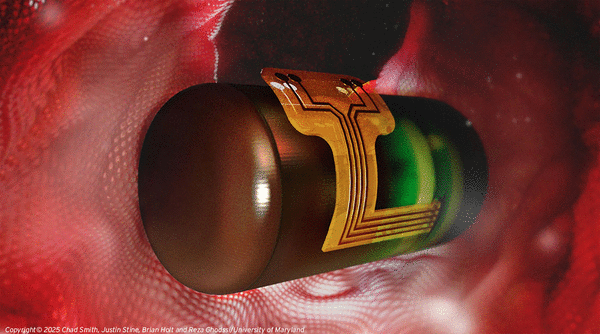
BALTIMORE — What if you could swallow a tiny robot that could diagnose, monitor and treat health issues in your gut without scheduling an uncomfortable or time-consuming outpatient procedure?
Researchers at the University of Maryland’s A. James Clark School of Engineering are developing a smart capsule to revolutionize how doctors practice medicine in the intestinal tract.
“These capsules have the potential to change lives for the better — even save lives. Our team’s work to develop smart pills that can sense, communicate in, and interact with complex biological environments will redefine the way we diagnose and treat ailments,” Reza Ghodssi, professor and MATRIX Lab executive director of research and Innovation, wrote on the university’s website.
The technology is still in development, but Ghodssi imagines a day when the smart pill, about the size of a multivitamin, can check tissue health, identify potential cancers and send data to a doctor. It could even inject medicines into the intestinal wall, or take a tiny biopsy sample before passing harmlessly out of your body, Godssi wrote in the article “Tomorrow’s Smart Pills will Deliver Drugs and take Biopsies” in the publication IEEE Spectrum.
Today, smart pills equipped with a video camera, lights and a transmitter are a routine tool in intestinal health, he wrote. They can also measure acidity, temperature and gas concentrations.
The version under development can track biomarkers, including hydrogen sulfide gas, neurotransmitters like serotonin and dopamine, and other signals that shed light on gut health and disease progression. Delivering medicines exactly where they are needed could improve effectiveness and minimize side effects, Ghodssi wrote. The technology would go beyond passive monitoring, as the autonomous capsules would sense conditions, make decisions and trigger appropriate actions.
Research teams around the country are working on similar technologies, he wrote, especially to solve the problem of providing a safe and compact power supply.
A Binghamton University team in New York is exploring microbial fuel cells to generate electricity from probiotic bacteria in the gut. At MIT, researchers have used pig stomach fluid to power a battery. And at UMD, they are exploring methods to harvest energy throughout the capsule’s digestive system journey.
Further testing will seek to prove that Ghodssi’s capsules are safe, reliable and offer benefits beyond existing technology.
©2026 The Baltimore Sun. Visit at baltimoresun.com. Distributed by Tribune Content Agency, LLC.






Comments