Xi-Trump-Putin meeting gets world worrying about a great power stitch-up
Published in Political News
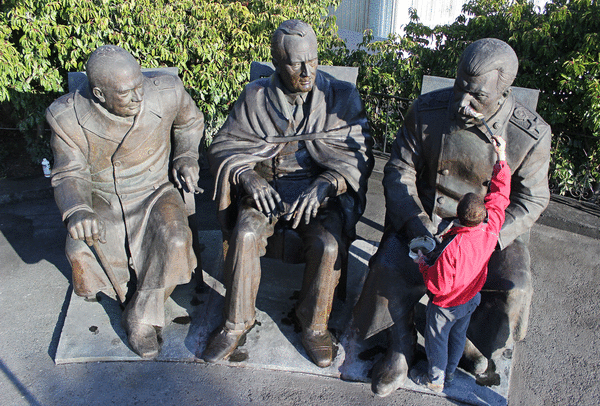
At Yalta in 1945, the leaders of three dominant military powers gathered to craft a plan that would bring stability to the world – or conspired to carve it up among themselves.
Both readings of that famous World War II meeting are still alive and well, eight decades later. And both play into parallels getting drawn ahead of this week’s summit in Shenzhen, where Chinese President Xi Jinping is due to host his U.S. and Russian counterparts, Donald Trump and Vladimir Putin.
The circumstances are completely different. Franklin Roosevelt, Joseph Stalin and Winston Churchill met with their armies nearing victory in history’s most destructive conflict. They made arrangements that endured – to set up the United Nations, and partition Nazi Germany. They also sat for an iconic photograph, which came to symbolize great powers bargaining over the fate of small ones.
The leaders, set to meet in Shenzhen on Thursday afternoon during the annual Asia-Pacific Economic Cooperation assembly, aren’t wartime allies and have no obvious shared project. All three have their own reasons to welcome the spotlight, and a photo-op that will make its own statement about where power resides in the 21st century.
There’s a case that dialogue among them can diminish the risk of regional wars — like the ones Putin and Trump started in Ukraine and Iran — spiraling into something worse. But few analysts expect this week’s summit to yield much in the way of action to end those conflicts, or to revive arms-control arrangements that have largely eroded this century.
“The trilateral summit will provide an era-defining photo shoot but is unlikely in itself to shape the future of global geopolitics,” said Neil Thomas, a fellow at the Asia Society Policy Institute’s Center for China Analysis. “Yalta failed to stop the Soviet takeover of Eastern Europe and Shenzhen is not going to end Russia’s war on Ukraine.”
‘The future world’
Moscow, which launched a full-scale invasion of its neighbor nearly five years ago, has worked hardest to project the idea of a new Yalta. (The port city where the World War II meeting took place is in Crimea, which was annexed by Russia in 2014.) A scene from this month’s National Unity Day celebrations captured the way Putin increasingly presents the war in Ukraine as part of a much larger reshaping of the world order.
Touring an exhibition with a group of students in his wake, the president stopped before a sculpture of Stalin, Roosevelt and Churchill at Yalta — and took over narration duties from the guides. The three state leaders “met to discuss how to arrange the world, the future world in Europe,” he told the children.
It’s the symbolism of Shenzhen that counts most, allowing Putin to claim membership of a new Big Three, according to people close to the Kremlin, who said major agreements on security or arms control are unlikely.
Trump said Monday he would discuss the Ukraine war, but it isn’t expected to be the focus in Shenzhen. The U.S. is hosting talks elsewhere between the warring parties, while China has been reluctant to get involved. Still, the prospect that it might even get raised – with Kyiv and its main backers absent – is prompting unease in European capitals.
As for Trump, who likes spectacle at all times, he could use a major one right now – to distract from the sweeping losses his Republicans suffered in midterm elections. The U.S. president has said the trilateral would be “not so much for Ukraine,” while hinting he could talk to Putin and Xi about ending the Middle East war.
Trump’s interest in the summit stems from “his flexible approach to global geopolitics, and fascination with great power machinations — but more than anything seems to reflect a desperation for help in getting out of the Iran quagmire,” said Kurt Tong, a former U.S. ambassador to APEC. “This gamble seems unlikely to pay off.”
The calculus is different for China, which is wary of the Yalta framing. The state-run Global Times pushed back explicitly against the comparison on Monday, saying it’s a misreading. China officially condemns the idea of major powers running the world, a message that’s helped court developing countries – even though Beijing hasn’t been shy of throwing its own weight around in the South China Sea and elsewhere.
For Xi, it’s a chance to show how China – whose leaders weren’t invited to Yalta, even though they were part of the same wartime alliance – is now at the center of global affairs.
“Hosting such a meeting could demonstrate its ability to bring major powers into dialogue, at a time when strategic mistrust is making international cooperation increasingly difficult,” said Sun Chenghao, a fellow at Tsinghua University’s Center for International Security and Strategy in Beijing.
‘Heavy on atmospherics’
Trump has said he wants to talk about de-nuclearization in Shenzhen, though progress will be tough. China, whose arsenal remains far smaller than the U.S. or Russia, has little incentive to accept equivalent constraints, while Moscow wants any deal to account for wider nuclear capabilities in the West.
Even a vague or limited agreement on avoiding escalation, keeping channels open or managing crises could reduce the risk of conflicts spinning out of control. Risks around AI have been touted as another possible topic where the three leaders could agree on something.
There’ll be little time for any of this in Shenzhen, where talks aren’t expected to last more than a few hours, compared with the eight days of intense meetings at Yalta. What’s more, it’s harder for big countries to get their way nowadays. Power is more dispersed than it was back then, when the U.S. dominated a global economy devastated by war — and was the only country with nuclear weapons technology that’s proliferated since.
Still, it’s not just in Brussels and Kyiv that the world’s “middle powers” – a cohort championed by Canada’s Mark Carney, who says they should band together to avoid getting bullied — are voicing anxiety about Shenzhen.
Japan’s government has conveyed concerns to Washington about the summit, which risks creating the impression that Tokyo’s main ally is drawing closer to China and Russia, according to a report last week by the Mainichi Shimbun.
In South Korea, the Korea Times newspaper ran an op-ed about the “specter of another Yalta,” though it argued the comparison is overblown. In Taiwan, the pro-unification Want Daily warned of a shift toward great-power bargaining that could leave the island’s future subject to negotiations beyond its control.
Such anxieties likely won’t fade whatever happens in Shenzhen. There’s more big-power diplomacy to come, potentially including another Trump-Xi meeting next month in the U.S., where the Chinese leader has already traveled once this year.
In the end, this week’s summit may “play the same role as Xi’s visit to America: heavy on atmospherics but ambiguous on practical deliverables,” said Joseph Torigian, professor at the School of International Service at American University. With little prospect that the three leaders can resolve wars or make big breakthroughs on other topics, he said, “maybe they will just all have tea together.”
_____
©2026 Bloomberg L.P. Visit bloomberg.com. Distributed by Tribune Content Agency, LLC.










Comments