After years of disaster-level landslides, Southern California's Rancho Palos Verdes will finally get some federal aid. Is it enough?
Published in News & Features
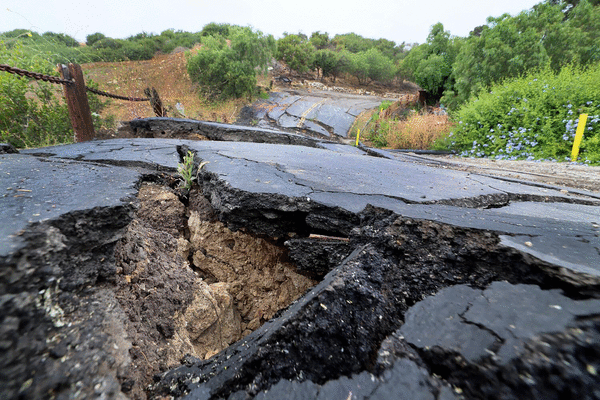
LOS ANGELES — Almost three years after landslides in Rancho Palos Verdes began accelerating and expanding, prompting an ongoing local emergency, federal officials have secured the area some long-requested federal aid.
U.S. Sen. Adam Schiff and Rep. Ted Lieu announced Thursday that officials in Rancho Palos Verdes are set to receive almost $2.3 million for two landslide mitigation projects.
These are the first federal funds directed to the landslide area since the city declared a local emergency in October 2023, when land movement began reaching unprecedented levels, tearing up roads, splitting homes and upending utilities. Dozens have been forced to relocate, though most residents are doing all they can to stay — even if it means living without utility-powered electricity.
Local officials are hopeful the money can help prevent future upticks in land movement and, ideally, formalize a new pathway for additional federal funding to address the city's ongoing hazards and worsening budget crisis.
"It's a long time coming," said Gordon Leon, chair of the Abalone Cove Landslide Abatement District, which is a resident-funded, volunteer-run assessment district that works to mitigate the landslide. "I'm certainly hopeful that we can continue this."
But he also acknowledged that it's far from enough to address the needs of his community; they had initially requested more than $20 million to tackle one mitigation project. This $2.3 million is supposed to go toward two different projects.
"We're going to have to see how we can tighten our belts and make the most out of [the funds] in terms of impact," Leon said.
The first half $1.145 million of the federal money will be directed to the Abalone Cove Landslide Abatement District to improve drainage at the toe of the Abalone Cove landslide, which primarily affects the Portuguese Bend community.
The other half will go to the nearby Klondike Canyon Landslide Abatement District to install additional "de-watering" wells to help pump out groundwater that causes the land movement, primarily serving residents of the Seaview and Portuguese Bend Beach Club neighborhoods.
Still, any outside support or focus on the city's years-long emergency is a big deal, said Ara Mihranian, Rancho Palos Verdes city manager.
"It's huge," Mihranian said. "This is an opportunity to lessen that burden on the residents."
The congressmen who helped secure the new funding said they are hopeful that both projects will help stabilize the land and, ideally, help prevent future emergencies and hazards.
"I'm grateful we were able to deliver long-overdue federal resources to the [Palos Verdes] Peninsula communities confronting the devastating impacts of ongoing land movement," Lieu said in a statement. "When you visit Rancho Palos Verdes, the devastation caused by land movement is hard to miss. ... I will keep fighting to ensure these communities get the support they need."
Schiff called the new funds "an important step toward addressing dangerous landslides in the Palos Verdes peninsula."
"Landslides pose a continuing threat to the lives and homes of Southern Californians, and we need to tackle this problem head-on," Schiff said in a statement.
Because this money was allocated directly to the resident-funded landslide abatement districts, the city won't directly benefit from this allotment. Mihranian said Rancho Palos Verdes officials will continue advocating for additional federal and state aid to help the small city respond to what has become an increasingly expensive emergency.
Since 2022, when land movement started to pick up, the city has spent about $61 million on landslide mitigation, which Mihranian said has decimated its capital improvement budget.
"Things are getting better in terms of the land movement, but financially, the city is now starting to realize we are running out of money," Mihranian said.
Movement in recent months has slowed, and even stopped in some areas, but some sections of the Portuguese Bend neighborhood are still shifting 1 to 2 inches a week, according to the latest reports from the city. At its peak, some areas were moving more than a foot a week, causing catastrophic damage.
Dozens of residents remain without power because utilities deemed the area too dangerous, and several roads remain closed.
In late 2024, the Federal Emergency Management Administration did agree to fund a $42-million buyout program for about 20 homes ruined by the land movement, but that money remains held up in a long approval process, Mihranian said. He hopes that will start reaching homeowners, most of whom are now paying for alternative housing on top of their old mortgage, sometime this year.
©2026 Los Angeles Times. Visit at latimes.com. Distributed by Tribune Content Agency, LLC.






Comments