Buzzkill? THC drinks are exploding -- but will they last?
Published in Variety Menu
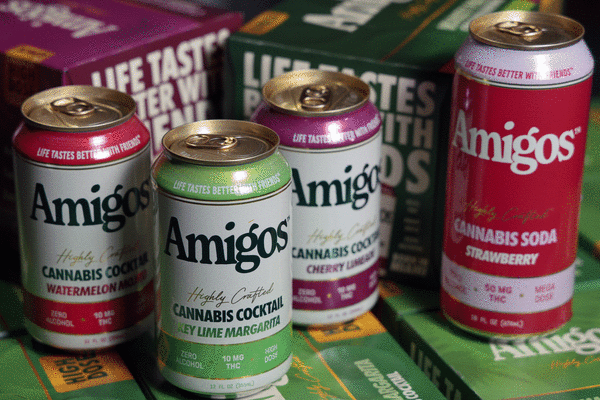
FORT LAUDERDALE, Fla. -- Beverages rattle along the production lines at Funky Buddha Brewery in Oakland Park, Florida, except these cans are brimming not with with craft beer but with THC-infused soda.
There’s pineapple, strawberry, watermelon mojito and Key lime margarita flavors — all laced with the compound that gets cannabis users high — with doses ranging from 5 to 50 mg per can.
The company on this canning line, Amigos, is part of a cottage industry of local THC beverage makers now springing up across South Florida touting cannabis-infused seltzers, mocktails and sodas.
Just as they hit the mainstream and saturate major markets, however, a new existential threat looms: Slipped into last November’s bill that ended the federal government shutdown was a provision, brought by Sen. Mitch McConnell, to limit intoxicating snacks and drinks made from hemp, including cannabidiol (aka CBD, which may contain THC), aiming to close a loophole in the 2018 Farm Bill.
That rule, set to take effect this November, could deal a fatal blow to the THC drinks industry, hospitality experts say — especially in Florida, which allows them to be sold in bars, breweries, restaurants and supermarkets.
“It’s a good recipe to kill the THC beverage industry,” said Imran Ahmad, a food scientist and professor at Florida International University. “And it will effectively make most of the THC drinks in stores and on shelves illegal.”
Birth of the boom
The boom in THC beverages is all in response to one big change in drinking habits — consumers wanting buzz without the booze.
As breweries shut down, craft-beer sales slump and younger drinkers abstain from alcohol longer than just during Dry January, sales of hemp drinks with trace amounts of tetrahydrocannabinol (or THC), are surging. Which is why using Funky Buddha’s 115,000-square-foot warehouse for co-packing hemp-derived THC drinks is a lucrative side hustle, the brewery’s co-founder, KC Sentz, told the South Florida Sun Sentinel.
“We can do 240 cans a minute, so [the THC drinks] help pay the bills,” said Sentz, who last November also released a line of Funky Buddha THC seltzer Social Tonics in blueberry-pomegranate, passionfruit-lime and blackberry-lemon flavors.
Sentz doesn’t mind that he’s canning his own competition. “If it helps us when beer sales are down, why not?” he said. “If we don’t produce it, someone else will, and we wanted to control our own destiny.”
These are high times for the year-old Amigos, co-founder David Shiffman said, adding that the brand’s 10-mg THC cocktails landed on shelves at retailer Total Wine & More in early April and have made “millions in revenue in our first 12 months and far exceeded expectations.”
Globally, THC beverage sales stood at $1 billion in 2025 and are projected to cross $3.6 billion by 2030, according to the Future Market Insights research firm.
Where did all these THC beverages come from?
When the federal Farm Bill was passed in 2018, it helped THC beverages flourish because it legalized hemp, which is part of the cannabis plant, up to 0.3% THC by dry weight. Anything over 0.3% THC is considered marijuana and is illegal in Florida unless registered for medical use.
Currently, 28 states including Florida allow THC-laced beverages to be sold by retailers, according to Oregon-based consultancy Whitney Economics, while other states limit them to licensed dispensaries.
Most THC drinks in South Florida are made with hemp, and big retailers including Total Wine, Target, Circle K and Sprouts sell them to 21-and-older consumers alongside bars and restaurants.
Declining alcohol habits have sent new players rushing into the THC drinks industry, said Joe Durkin, co-founder of the AltBev Expo trade show in West Palm Beach.
For example, there’s the 3-year-old, West Palm Beach-headquartered Brēz, which is selling “cannabis and mushroom-infused social tonics” in local markets, bars, restaurants and through DoorDash. It surpassed $60 million in revenue last August, founder-CEO Aaron Nosbisch said on social media.
In November, Fort Lauderdale-based Splash Beverage Group became a majority partner of BAAD Ventures, the owner of 10-mg Nimbus THC seltzers.
Other local brands include Mama’s, a Fort Lauderdale-based, THC-infused seltzer company, and Palm Beach County-based Subculture Beverages, which makes 10-mg THC-infused cold-brew coffees sold at owner Rodney Mayo’s restaurants (Respectable Street, Howley’s).
“What I’m hearing is everybody’s down 20% in alcohol sales,” said Durkin, who’s also co-organizer of Boca Raton’s Sunset Tequila Festival. “The restaurants and bars, they’re seeing people want an alt-beverage like a THC mocktail, so they have to adapt and capture those revenues or die.”
Since recently opening Bar Betty, the speakeasy above Sunness Supper Club in Fort Lauderdale, owner Michael Stanley said he’s sold more THC drinks “than I would’ve ever imagined.”
“Some people come for dinner and just aren’t drinking afterward, but they’ll drink the mocktails,” Stanley said, including the Black Betty, a nonalcoholic guava puree and lime juice mocktail with 5 mg of THC. “There’s no alcohol, but people just want to feel good and mellow, and this does it.”
The new bill
Letting THC drinks — or hemp-derived items like CBD gummies — proliferate wasn’t what McConnell had wanted when he first co-authored the 2018 Farm Bill, he said during a Congressional hearing in November. So, he closed what he called a “loophole” by adding a federal ban on hemp THC in his measure to end the federal government shutdown, which the Senate approved on Nov. 10.
“It will keep these dangerous products out of the hands of children, while preserving the hemp industry for farmers,” McConnell said at the hearing. “Industrial hemp and CBD will remain legal for industrial applications.”
The new provision caps the total THC in any hemp-derived product at 0.4 mg — much lower than drinks from Amigos, Funky Buddha and other South Florida-born competitors with heavier doses of 10 to 50 mg per can.
“If the current bill stays the same, we’re at risk of losing all the products we currently sell,” said Patrick Masucci, co-owner of Amigos. “Everything would become illegal on shelves. This bill will kill the growth of THC drinks, our growth, the tax dollars generated, everything.”
That’s because the new limit is far too low to feel anything a THC drink advertises — euphoric, buzzed, anxious or at the very least relaxed, Durkin said. THC and its cousin, CBD, produce different effects on different people even at low doses, “but generally at 5 mg you’ll at least feel something.”
FIU’s Ahmad agreed that THC drinks only produce a “euphoric high” in most people at between 2.5 and 5 mg.
At 0.4 milligrams per can, drinkers would need to consume six or more cans of THC drinks in the same sitting just to feel “a little bit” intoxicated, he said.
“The THC boom we’re seeing now will go away,” Ahmad said. “It won’t kill all the beverages overnight, but if it’s federally banned, they’ll be taken off menus and grocery shelves.”
THC is ‘filling a niche’
Snuffing out the momentum of THC drinks now “takes options out of the hands of what people want,” said Aaron Chase, president of Green Light Distribution in Orlando, which ships Amigos beverages and Funky Buddha’s Social Tonic in Florida.
And what people want is less alcohol, according to THC drink makers, bars and distributors.
The stats appear to agree: Craft-beer sales fell 3.6% in 2025 over the previous year, according to the national Brewers Association. Spirits sales were down 2.2% over the same period, according to the Distilled Spirits Council of the United States. And Gallup research last July found that adults younger than 35 who drink alcohol declined from 72% in 2001-2003 to 50% in 2025.
Florida distributors say the embracing of THC drinks is also coming from elder millennials and couples switching for health reasons. The 10 THC beverage brands Green Light took on within the past year now account for 10% of its revenue, “maybe 15 by the end of this year,” Chase said.
“People are looking for alternatives to get a social buzz without the adverse effects of a hangover,” Chase added. “The alcohol consumer is shifting to THC, and it’s filling a niche.”
Fighting back
Amigos, for its part, is fighting back against the new THC limit. The company’s three owners support pro-hemp groups including the Hemp Beverage Alliance, which worked with lawmakers on a mid-January bill to delay the THC limit two more years, until late 2028.
“We’re investing a lot of money in lobbying efforts to stay alive,” said Masucci, Amigo’s co-owner. “At worst-case scenario, we’re forced into licensed dispensaries, and that makes it harder for consumers to get access. But you can forget about on-premise [restaurants and stores].”
This year, a bipartisan group of lawmakers created the The Hemp Safety Enforcement Act to shift regulation of hemp-derived THC products from Congress to individual states. The legislation would be attached to the Farm Bill and let states opt out of the federal THC limits.
“Washington shouldn’t wipe out those efforts or destroy jobs and access to products that help our veterans, our elderly, and families across the country,” said Sen. Rand Paul (R-Ky.), one of the act’s co-sponsors, during an April 14 town hall.
For a brand billing itself as “Funky Buddha,” expanding from craft beer into head-buzzy THC beverages made perfect sense, Sentz said. Now he hopes his Social Tonics survive with “a proper framework for legislation” instead of a federal THC limit.
If lobbying efforts and new bills fall flat between now and November, “I’d be frustrated,” Sentz said. “Beer is definitely still our baby, but THC is a big part of our future.”
©2026 South Florida Sun Sentinel. Visit at sun-sentinel.com. Distributed by Tribune Content Agency, LLC.





Comments