Trump's latest 10% tariffs declared unlawful by US trade court
Published in Political News
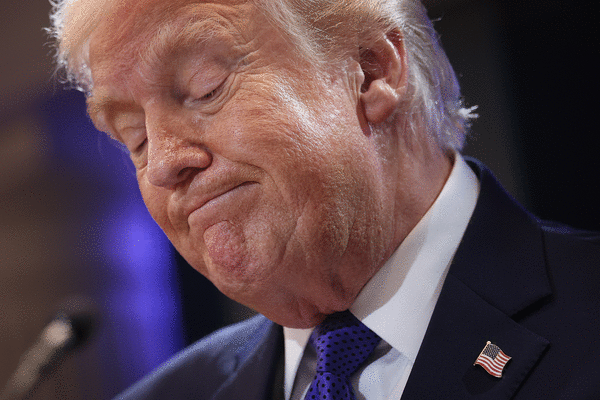
President Donald Trump’s 10% global tariffs were declared unlawful by a federal trade court in a fresh blow to the administration’s economic agenda, several months after the U.S. Supreme Court vacated earlier levies he’d imposed.
A divided three-judge panel at the U.S. Court of International Trade in Manhattan on Thursday granted a request by a group of small businesses and two dozen mostly Democrat-led states to vacate the tariffs. Trump imposed the 10% duties in February under Section 122 of the Trade Act of 1974, which had never previously been invoked.
The court for now only immediately blocked the administration from enforcing the tariffs against the two companies that sued and Washington state, making clear that it was not issuing a so-called “universal injunction.” The panel found that the other states that sued lacked standing because they aren’t direct importers, instead arguing that they were harmed by having to pay higher prices for goods when businesses passed on tariff costs.
It wasn’t immediately clear what the ruling would mean for now for other importers that had been paying the contested levies.
The majority of the panel rejected the administration’s stance that “balance-of-payments deficits” — a key criteria for imposing the Section 122 tariffs — was “a malleable phrase.” They concluded that Trump’s proclamation imposing the levies failed to identify that such deficits existed within the meaning of the 1974 law, instead using “trade and current account deficits to stand in the place.”
The decision is the latest setback for the president’s effort to levy tariffs without input from Congress. Earlier duties — overturned by the Supreme Court on Feb. 20 — were issued under a different law, the International Emergency Economic Powers Act, or IEEPA. In that case, the justices ruled Trump had exceeded his authority, kicking off a legal scramble by importers for almost $170 billion in refunds.
The U.S. Justice Department could challenge the trade court’s latest ruling by taking the case to the U.S. Court of Appeals for the Federal Circuit, which ruled against the Trump administration during the last tariff fight.
Section 122 allows presidents to impose duties in situations where the U.S. faces what the law defines as “fundamental international payments problems.” Even before Trump issued the tariffs, economists and policy experts debated whether the president would be able to build a solid legal framework using the statute.
In a proclamation declaring the use of Section 122, Trump said that tariffs were justified because the U.S. runs a “large and serious” trade deficit. He also pointed to the negative net flows of income from investments Americans have overseas and other things that showed the U.S. balance of payments relationship with the rest of the world was deteriorating.
Under the law, presidents have the ability to impose tariffs on goods imported into the U.S. on a short-term basis to address concerns about how money is flowing in and out of the country. Those concerns include “large and serious United States balance-of-payments deficits” and an “imminent and significant depreciation of the dollar.”
Unlike other legal options Trump might pursue to impose tariffs, Section 122 can be invoked without waiting for a federal agency to conduct an investigation to determine whether the levies are justifiable. But they can still be challenged in court.
The small businesses and states that sued argued that Section 122 became outdated when the U.S. ditched the gold standard decades ago. They say Trump improperly conflated “balance-of-payments deficits” with U.S. trade deficits in order to justify using the law.
They also allege that Trump’s order announcing the Section 122 tariffs was “riddled with omissions and mischaracterizations” around the meaning of a balance-of-payments deficit. The trade deficit cited by Trump is just one part of calculating the country’s balance of payments position, the states say.
Under Section 122, the president can order import duties of as much as 15%. The executive action can last 150 days, at which point Congress would have to extend it. Trump has said he would aim to increase the rate to 15% from 10%.
The states argue that Trump’s new tariffs violate other requirements in Section 122, including that such duties not be discriminatory in their application. The states argue that Trump’s new tariffs improperly exempt some goods from Canada, Mexico, Costa Rica, the Dominican Republic, El Salvador, Guatemala, Honduras and Nicaragua.
According to the complaint, the Trump administration conceded during the prior litigation over his IEEPA tariffs that trade deficits “are conceptually distinct from balance of payments deficits.”
The clash over Section 122 emerged just as the legal fight over refunds from Trump’s IEEPA tariffs began to heat up. A different judge in the Court of International Trade, U.S. Judge Richard Eaton, is overseeing the massive refund effort and ordered Customs and Border Protection to give him regular updates on a largely automated process the government will use to issue most refunds.
The cases are Oregon v. Trump, 26-cv-1472, and Burlap and Barrel Inc. v. Trump, 26-cv-1606, U.S. Court of International Trade. (Manhattan).
©2026 Bloomberg L.P. Visit bloomberg.com. Distributed by Tribune Content Agency, LLC.













































Comments