Bryson Graham embraces change and is eager to dig in on Bulls rebuild: 'We're going to get out the mud'
Published in Basketball
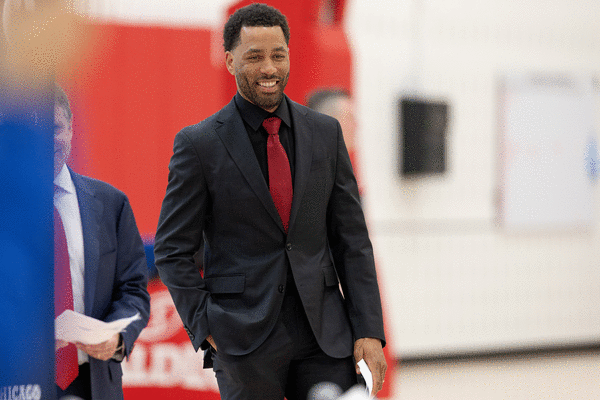
CHICAGO — Bryson Graham isn’t afraid to admit that this is a dream come true.
When the new top basketball executive for the Chicago Bulls received the job offer over the phone from President and CEO Michael Reinsdorf, Graham broke down in tears.
It wasn’t out of surprise. Graham couldn’t be surprised by a moment he worked this hard and planned this long to reach. But as a kid who grew up idolizing Michael Jordan in the ’90s, Graham still felt this moment meant something more — to himself, to his family and to basketball as a whole.
In his introductory news conference Wednesday at the Advocate Center, Graham joked that starting out as a top executive is akin to becoming a first-time parent. But he also voiced confidence in his ability to provide a clear vision and stout leadership as the Bulls attempt to reinvent themselves after years of mediocrity.
“We’re going to pull our sleeves up and we’re going to get to work and we’re going to get out the mud,” Graham said.
Graham has yet to turn 40 but already has logged 16 years in NBA front offices. The executive started as an operations intern with the New Orleans Pelicans (then Hornets) in 2010. Over the next 15 years, he worked his way up every rung of the ladder in New Orleans, from video coordinator to player development liaison to, eventually, assistant general manager. The Atlanta Hawks swooped in to hire Graham as their senior vice president of basketball operations in 2025, announcing his arrival as a new top executive in the NBA.
For fans, Graham might seem like something of an unknown. He does not have his own Wikipedia entry and spent only one season in the spotlight with the Hawks. But behind the scenes, Graham is far from anonymous. Executives throughout the league have held Graham in high esteem for years. According to a source, the Pelicans blocked him from interviewing for other jobs seven times before he finally slipped away during a front-office restructure. His hire in Atlanta was hailed as a savvy move. The Bulls’ decision to snatch him up after only one year with the Hawks is seen as similarly shrewd.
These impressions aren’t always accurate — and the Bulls certainly have been duped before. Six years ago, Artūras Karnišovas was similarly well-regarded by his peers as a potential upcoming star in the landscape of NBA front offices. That potential was never delivered upon. But Graham does fit an archetype of front-office construction that has boded well for other organizations, particularly in his willingness to invest in a more modern approach to roster building.
Selecting Graham signals a clear prioritization from the Bulls, who need to catch up with the rest of the league in their approach to the identification and utilization of talent. The Bulls lag significantly behind their peers in the investment toward an analytics department, which shrank to one of the smallest in the league during the final year of Karnišovas’ reign. Their draft selections have been hit-or-miss. Their player development strategy has often felt erratic.
Reinsdorf feels Graham is the correct solution to these problems. Throughout Wednesday’s news conference, Reinsdorf emphasized the new executive’s ability to communicate and adapt as crucial tenets of the team’s decision in the hiring process. But Reinsdorf also repeatedly came back to one skill — Graham’s ability to identify and develop players.
“The guy gets it,” Reinsdorf said. “He is an unbelievable judge of talent. I think he understands today’s players. I think he’s disciplined in his approach to talent evaluation.”
Neither Graham nor Reinsdorf could offer specifics in relation to the team’s timeline for a coaching hire to replace Billy Donovan; plans to revamp the roster this summer; or outlook on the NBA draft. This lack of concrete answers was somewhat to be expected — it was the executive’s second day at the Advocate Center, and strategy takes time to develop.
However, Graham was able to offer glimpses at the fundamentals of his team-building philosophy. He emphasized a need to invest in player development and analytics. He described his ideal player archetype with the acronym SLAP — “size, length, athleticism and physicality” And he noted that he was open to hiring a younger coach without championship experience as long as that candidate checks other boxes.
Flexibility was a key focal point for Graham, who inherited a team with a pair of first-round picks and two second-round picks in this year’s draft in addition to a bevy of futures and more than $58 million in cap space for the 2026-27 season. The Bulls know this will be a slow process. Graham acknowledged that the Bulls will not be contenders next season. That means the team will need to use creativity to build the foundation of a winning team, which could include methods such as taking on dead money to acquire draft picks.
Matas Buzelis was present for the news conference, loudly clapping from the back row of available seats as he watched his new boss speak in between workouts at the Advocate Center. Under the former regime, the forward was considered one of the future centerpieces of the organization. But with Graham in place, the entire roster will undergo reevaluation.
Graham acknowledged this dynamic delicately, stating he doesn’t believe any players on the roster is untouchable — a statement that would include Buzelis.
“You’re going to listen on every player,” Graham, 39, said. “I’m not taking anything away or trying to strike fear in the guys on the roster. That’s just the nature of this business. I’m not going to sit here and say that no one on this roster is untouchable. That doesn’t mean that we’re trading guys. We’re going to come in. We’re going to look at this holistically. And then we’re going to proceed.”
Before he can reconstruct the roster, Graham will need to assemble his staff. Although he is new to Chicago, Graham has a strong connection with current members of the front office, such as director of player personnel Brian Hagen and assistant general manager JJ Polk, both of whom worked alongside him for years in New Orleans. These preexisting relationships — and long-built trust — will be crucial for an executive who needs to hit the ground running.
The Bulls will find out their draft position in Sunday’s lottery, then immediately dive into the draft combine. Simultaneously, Graham needs to begin making his hires — particularly at head coach, whom he will need to align with his own vision for the future of the franchise.
Hiring will serve as the first test for Graham, who will receive immediate agency from ownership to build out a front office and coaching staff that fit his vision. When Graham began to explain that he would approach the coaching hire collaboratively with Reinsdorf, the president cut him off genially with a hand on his shoulder.
“You’re picking him,” Reinsdorf said jokingly to Graham. “I picked you. You get to pick the coach.”
This autonomy reflects a consistent “hands-off” theme in Reinsdorf’s handling of the Bulls. Still, resources and investment will be a key factor in Graham’s ability to navigate a rebuild on his own terms. Reinsdorf said he is willing to go into the luxury tax if the Bulls are contending. And in the meantime, he said Graham will have a green light to increase the team’s staffing as he sees fit.
This is crucial for Graham, who understands that his first round of hires will be vital to establishing the long-term identity of his tenure with the team.
“If I’m the smartest person in the room, we’re going to fail,” Graham said. “I’m going to make sure that we add the right group of people and we’re going to pull in the right direction and we’re going to win games. It’s not about me. It’s about the Chicago Bulls as a whole.”
____
©2026 Chicago Tribune. Visit chicagotribune.com. Distributed by Tribune Content Agency, LLC.






Comments