Mexican ambassador to the US pledges during San Diego visit to work on Tijuana River pollution crisis
Published in News & Features
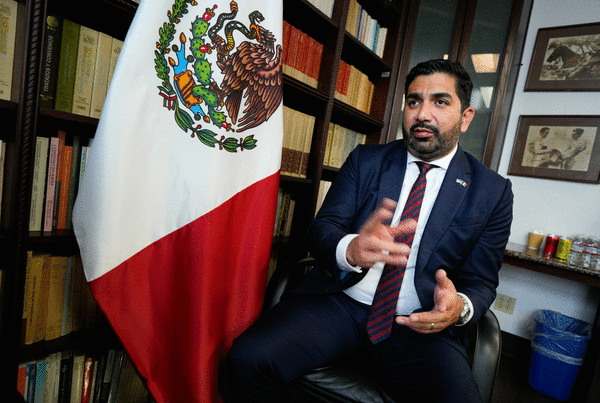
SAN DIEGO — Since becoming the Mexican ambassador to the U.S., Roberto Lazzeri has been confronted with many pressing cross-border issues, ranging from trade deals and border security to immigration.
But he said there’s one in particular that comes up constantly in his many meetings in Washington — the Tijuana River Valley’s pollution crisis.
The Mexican ambassador visited San Diego for the first time last week since taking the job in June. During his stay, he met with leadership from U.S. Customs and Border Protection, U.S. Border Patrol and the International Boundary and Water Commission, among others.
Lazzeri, an economist appointed ambassador amid trade negotiations between Mexico and the U.S., said he has been aware of the region’s longstanding cross-border pollution issue since his time at Mexico’s Ministry of Finance and Public Credit, where he served as chief of staff from 2022 to 2025.
Solving the crisis, he said, is among the top priorities of the binational agenda.
“We are working to secure the resources needed for all the required infrastructure,” Lazzeri said in an interview last week at the Mexican Consulate in San Diego. “It’s a complex issue, but given the level of cooperation and coordination we have with our counterparts and our understanding of where we stand and what we need to do to move forward, I am confident that we will succeed.”
Border communities have demanded action, not just plans, from both countries as sewage, trash and other pollutants continue to flow into the U.S. Tijuana is facing challenges due to its growing population of nearly 2 million, and its aging sewage infrastructure has not kept up.
The Mexican ambassador to the U.S. said that Mexico is conducting a study to identify the most effective solutions.
Nearly a year ago, Mexico and the U.S. signed an agreement that included infrastructure projects on the Tijuana side, such as the construction of a sediment basin in Smuggler’s Gulch and a new wastewater treatment plant known as Tecolote-La Gloria, located about 5 miles south of the border, to address the discharge of untreated wastewater into the ocean.
Mexico overhauled the San Antonio de los Buenos wastewater plant in Tijuana, aiming to reduce the discharge of sewage impacting border communities. Over a year later, Lazzeri said he hopes the study will determine whether to expand the plant’s treatment capacity or construct additional infrastructure. Although he did not provide a specific timeline, he said the study will provide a clearer picture of what to do next.
“We will know we have succeeded when the beaches reopen, and pollution levels are down,” he said. “But know that authorities on both sides of the border are truly committed to resolving this issue.”
He said there is active collaboration between authorities from both countries, particularly ahead of the rainy season. Preparations for a potentially intense El Niño have reached south of the border, with increased pressure to clean the Tijuana River channel given the significant amount of trash and vegetation coming from Mexico.
During his visit, the Mexican ambassador toured the South Bay International Wastewater Treatment Plant in San Diego, which treats sewage from Tijuana, with representatives of the Mexican IBWC. Commissioner Chad McIntosh of the U.S. IBWC led the tour of the plant and surrounding area and, according to a U.S. IBWC spokesperson, the conversation focused on the San Diego-Tijuana sanitation issue.
“The Ambassador indicated his interest and support for solving the Tijuana River pollution crisis,” said Frank Fisher, public affairs chief for the U.S. IBWC.
Some elected leaders and environmental advocates in San Diego County have called for a stronger commitment, urging the inclusion of solutions, accountability measures and protections to address cross-border pollution in a renewed trade deal — which is currently subject to an annual review process.
“A trade agreement is where commitments carry real weight. Our congressional delegation has done a good job of representing this view,” state Assemblymember David Alvarez, whose district represents border communities, said in a statement Friday. “That is why the original USMCA had $300 million for border wastewater infrastructure. Any renewed agreement must build on that with binding environmental standards and real accountability. Our community deserves nothing less.”
Lazzeri acknowledged that he had heard about the call to include the matter in trade conversations, but he believes that “we don’t need it in the treaty to address it,” as he said, it is already a priority.
Security and immigration
The U.S. Embassy in Mexico said last week that the Trump administration has elevated security cooperation with Mexico to “unprecedented levels, resulting in decisive actions and historic results.”
The Mexican ambassador to the U.S. agreed, pointing out a cooperation model involving shared information and coordination. But he emphasized that arrest operations are conducted by Mexican security forces. “They know the area and the local population. They also know how to handle high-profile arrests,” he said.
President Donald Trump has voiced his desire to take U.S. military action against drug cartels in Mexico, a move that Mexico has repeatedly opposed.
According to the U.S. Embassy in Mexico, under the current administration, Mexico has used the official extradition process to send 96 suspects to the U.S. and transferred 92 more to U.S. custody, many in connection with cartel crimes.
Immigration is also a major focus of the shared agenda.
Amid the increased immigration enforcement operations throughout San Diego, Lazzeri said that Mexico’s primary concern is ensuring the well-being and protection of human rights.
Data from the Deportation Data Project shows that most of the individuals arrested by U.S. Immigration and Customs Enforcement in San Diego since the start of the current administration are Mexican nationals.
Lazzeri said that nationwide, Mexican authorities work to ensure that detainees in the U.S. receive medical care and, in cases where Mexican nationals have died in custody, to demand that justice is served and that a proper investigation by U.S. officials is conducted. He said Mexican consulates in the U.S can help with resources and legal services to immigrants.
©2026 The San Diego Union-Tribune. Visit sandiegouniontribune.com. Distributed by Tribune Content Agency, LLC.






Comments