ICE detainees in 3 states can seek to be freed on bond, federal appeals court rules
Published in News & Features
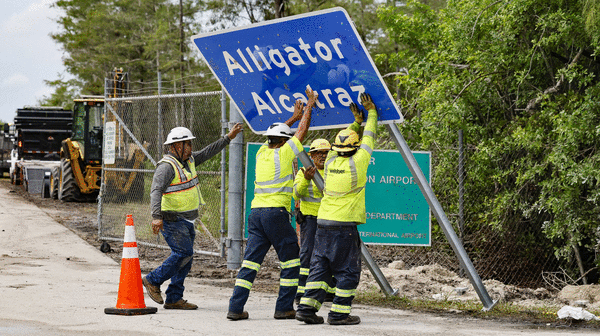
Immigration and Customs Enforcement immigrants detained in Florida, Alabama and Georgia will now be able to ask a judge to be released on bond, after a federal appeals court ruled in their favor in a major reversal of Trump administration policies.
In a 2-1 decision issued Wednesday, the 11th U.S. Circuit Court of Appeals in Atlanta ruled that the Trump administration’s blanket policy that undocumented immigrants picked up inside the U.S. are “applicants for admission” — making them ineligible for bond unless they can show without any doubt they will be entitled to admission — is unlawful. It applied to people who were not admitted at a port of entry like the border or an airport, but who were in the U.S., many already for several years.
The decision is significant for ICE detainees in Florida, Alabama and Georgia, which have several facilities that hold immigrants in custody, many of whom will now be entitled to bond hearings, though being granted freedom on bond is not necessarily guaranteed. Facilities in South Florida holding ICE detainees include the Krome Detention Center in Miami-Dade County, Alligator Alcatraz in the Everglades, the Broward Transitional Center in Pompano Beach and the Federal Detention Center in Miami.
Eligibility for bond in immigration cases generally applies to people who are not subject to mandatory detention for reasons such as criminal convictions, being a public safety threat or being a flight risk. Immigrants who couldn’t apply for bond under President Donald Trump will now be able to petition a judge for their release in Florida, Alabama, and Georgia. The decision goes into effect immediately, lawyers said, and is binding law for the states in the appeals court’s jurisdiction.
In the 2-1 appeals court opinion, the judges said the Trump administration was interpreting “seeking admission” in ways that Congress had not defined. “The government would have us believe that Congress has effected a mass detention campaign of every unadmitted alien in the country,” the judges wrote. “Seeking relief from removal is not the same thing as seeking admission.” One of the men who originally sued is seeking a procedure called cancellation of removal, a pathway that allows people to get their deportation proceedings stopped and get green cards.
The average daily population of ICE detentions in the Sunshine State was over 5,000 as of early April, according to researchers at TRAC Immigration. The detainees were either picked up in Florida or brought from other states.
“Trump did this because a person’s willingness to fight their case in detention significantly diminishes if they don’t get out on bond and are able to reunite with family and are able to keep paying rent and feeding their kids. It’s another way of putting pressure for voluntary departures,” said Kenia Garcia, an immigration attorney who represented the plaintiffs. The American Civil Liberties Union argued the case in front of the appeals court.
There are three statutes the government can use to detain someone under immigration law. For decades, immigrants found inside the U.S. who had not been inspected or admitted could ask a judge for bond in their immigration proceedings. But since Trump returned to office, the Department of Homeland Security has argued that he undocumented immigrants who are in the U.S. and entered unlawfully should generally be held without the possibility of bond. The agency has been holding people in custody under a mandatory detention statute that gives people fewer due-process rights regardless of how long they have been in the U.S.
“At some point under Trump, DHS changed the way in which they were interpreting the statute. They said that those people, whether they had been here already for 20 years or 30 years or 5 years, were being placed in a position as if they were knocking on the doors of the United States and were then considered applicants seeking admission at that point. And that gave DHS the conclusion that they are not eligible for bond and subject to mandatory detention,” said Vivianna Tijerino, an immigration attorney who also represented the plaintiffs in the case.
Other courts have ruled in the administration’s favor. The 11th Circuit ruling described these decisions as “well reasoned yet distinctly contrary conclusions.”
Over the past year, immigrants have been forced to resort to habeas corpus petitions — requests to federal judges for release claiming unlawful detention — just to seek bond hearings from immigration courts. But those cases can be lengthy and procedurally complex, and also face low success rates.
At the heart of the appeal were the cases of two Mexican men held in multiple facilities in South Florida, including Alligator Alcatraz, Krome, and the federal detention center in Miami. Both had lived in the United States several years and were detained during traffic stops. They had been granted the opportunity for bond hearings through habeas corpus cases and released, which the Trump administration then appealed.
Named as defendants were the warden for the Federal Detention Center; ICE Miami’s Field Office Director; the Director of the Krome Detention Center ; and ICE’s Director, the Secretary of Homeland Security, and the U.S. Attorney General.
In a statement to the Miami Herald, the Department of Homeland Security said on Thursday that it “strongly disagrees with the Eleventh Circuit panel and is confident in its legal position regarding mandatory detention.”
The administration’s position “was the nail in the coffin for Biden’s catch and release policies,” the DHS statement said. “ That is why the left and their activist proxies on the judiciary are resisting it so vigorously. President Trump and [DHS Secretary Markwayne Mullin are now enforcing the law as it was actually written to keep America safe.”
Experts believe the administration will appeal to the Supreme Court as it has done in other immigration cases where courts don’t rule in their favor, especially since other federal appeals courts have ruled differently.
Lawyers, community members and immigration advocates in Florida celebrated the decision. The attorneys said it will make it possible for families to stay together, immigrants to keep their families afloat and contribute to society while their cases are heard, and for the long-established interpretations of federal law to continue.
“We are extremely excited about this decision. We are excited that our clients and other noncitizens are going to get the opportunity they would have been afforded in other administrations, which is simply a bond hearing,” Tijerino said. “I feel like excitement doesn’t even cover it.”
©2026 Miami Herald. Visit at miamiherald.com. Distributed by Tribune Content Agency, LLC.






Comments