Minnesota House approves anti-fraud watchdog with 'vast' power
Published in News & Features
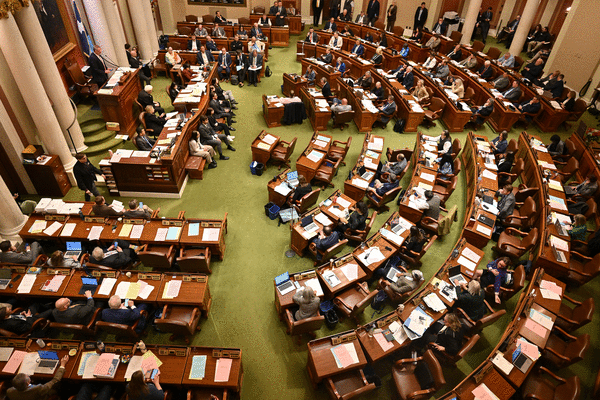
ST. PAUL, Minn. — The Minnesota House on Thursday passed a bill to create a new independent state government watchdog office with “vast, unprecedented power” to fight waste, fraud and abuse.
Under the proposal, which Gov. Tim Walz could soon sign into law, Minnesota would establish an office of inspector general, a centralized office with authority to investigate taxpayer-funded programs across all government agencies and to make arrests.
House action comes almost exactly one year after the Democratic-Farmer-Labor majority Minnesota Senate passed its own version of the bill with broad bipartisan support. It’s one of many legislative proposals that have emerged in recent years as significant fraud in state government programs came to light.
The House, which is tied between the DFL and Republicans, passed the bill in a 127-5 vote. The Senate is expected to concur with the version the House passed on Thursday.
Walz, a DFLer, has said he would sign the bill into law. If he does, the office must be established and operating by September 2027.
The office will cost about $12 million a year to run and will have 40 full-time positions.
Negotiations this session
Ahead of the vote, bill sponsor Rep. Matt Norris, DFL-Blaine, said it was important for the Legislature to take its time in creating such a powerful first-of-its-kind authority in state government. DFL and Republican representatives spent much of the 2026 session negotiating a final version of the inspector general bill.
“Public dollars should be going to help parents pay for child care, provide support for people with disabilities and elders to age with dignity. Not to line the pockets of fraudsters,” he said. “While the issue of fraud is an urgent one, the vast, unprecedented power of this office is the very reason why it was important for us to move in a thoughtful, diligent manner in crafting this legislation.”
Minnesota fraud has been described as “industrial scale” by former Assistant U.S. Attorney Joe Thompson, who speculated total losses in Medicaid programs alone could top $9 billion since 2018. So far, prosecutors have proven hundreds of millions of dollars in fraud.
In a recent report, Walz’s director of Program Integrity, Tim O’Malley, blamed fraud problems on a culture in state agencies “more based on compassion than compliance.”
Rep. Patti Anderson, R-Dellwood, who served as state auditor from 2003 to 2007, helped craft the final bill. In a speech ahead of its passage, she described state government two decades ago as being “clean” compared to the present day.
“The things that we have seen happen would have never been tolerated, whether it was a Democrat or a Republican administration,” Anderson said. “I hope this … is the beginning of the light at the end of the tunnel.”
Insulated from political pressure
Supporters have said they hope a centralized office, insulated from political pressure and with its own enforcement division, will help protect the state from future fraud. In recent years, the U.S. attorney has been the primary driver of accountability, prosecuting cases that cost the state hundreds of millions of federal dollars.
While the state’s Department of Education and the Department of Human Services each has its own inspector general, neither has law-enforcement powers. The nonpartisan, independent Office of the Legislative Auditor conducts investigations and makes recommendations, but cannot make arrests.
House DFL lawmakers initially wouldn’t support an inspector general bill sponsored by Sen. Heather Gustafson, DFL-Vadnais Heights — which passed 60-7 in that chamber last year with both DFL and GOP support. Norris and DFL colleagues said they felt the original appointment process was unconstitutional because it excluded the governor.
They also questioned whether the office’s enforcement capabilities were redundant, as the state Bureau of Criminal Apprehension had its own anti-fraud section.
Norris at one point introduced a version of the bill that would have allowed the governor to directly appoint the inspector general rather than pick one from a field of candidates selected by a bipartisan commission of state lawmakers.
Compromise on appointment, enforcement
House members eventually reached a compromise on the appointment process: the governor can appoint the inspector general, but the pick would be subject to confirmation by a three-fifths supermajority in the Senate.
The bill also retains its enforcement division capable of making arrests, despite initial DFL reservations. While most DFL lawmakers backed the bill on Thursday, they attempted to introduce an amendment to remove the enforcement division, which failed on party lines.
A bipartisan group of Legislators — two DFLers and two Republicans from the House and Senate — would recommend inspector general candidates to the governor. Once confirmed, the inspector general serves a five-year term that would not line up with the governor’s four-year term, adding another layer of independence.
The inspector general bill is just one of several anti-fraud proposals in the Legislature this year. Another bill boosting funding for an anti-Medicaid fraud unit at the Minnesota Attorney General’s Office is also moving toward final passage and the governor’s desk.
_____
©2026 MediaNews Group, Inc. Visit at twincities.com. Distributed by Tribune Content Agency, LLC.



Comments