Commentary: Reining in wasteful federal spending: A vital step to reducing energy costs
Published in Op Eds
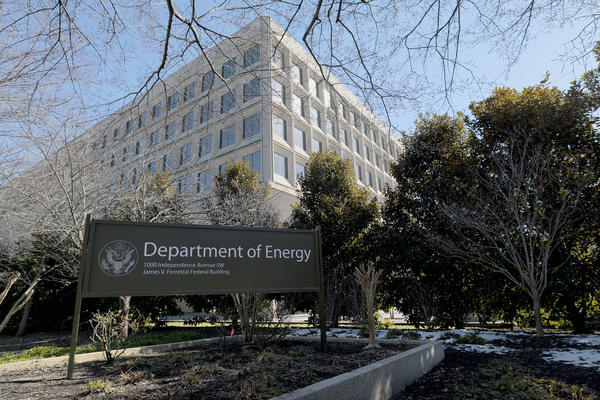
The Department of Energy (DOE) has increasingly become a vehicle for federal spending to shape energy markets and subsidize favored technologies. The result has been higher energy costs, growing deficits, and a sprawling bureaucracy that often fails to deliver useful services.
That is why last year’s effort to rein in DOE spending was necessary to stop a forced transition to “green” energy and to save taxpayer dollars. The president’s budget request for fiscal year 2027 builds on that progress in ways Congress should support.
The total FY27 request for the DOE is $53.9 billion, almost 10% more than was enacted last year. This includes a 12% increase for the National Nuclear Security Administration (NNSA) that is partially offset by an 11% decrease in all non-NNSA programs.
The NNSA is responsible for maintaining the nation’s nuclear deterrent systems and supporting defense-related nuclear technologies. Non-NNSA programs, by contrast, deal with energy deployment, subsidies and policy.
The reductions in non-NNSA programs primarily comes through reducing funding for DEI based grants and subsidies for “green” energy sources. And that’s good, because these grants and subsidies have not served the American public and do not help generate reliable and affordable energy.
In recent years, massive legislative packages like the Infrastructure Investment and Jobs Act and Inflation Reduction Act injected tens of billions of dollars into the DOE, authorizing dozens of new programs aimed at subsidizing wind and solar and setting up an energy system based on “green” energy sources.
Given America’s vast energy resources, like coal, oil and natural gas, forcing an energy transition to less reliable wind and solar at the expense of the taxpayer is not good policy.
But the problem with these funding streams doesn’t stop there.
Rather than focusing narrowly on the already dubious goal of infrastructure for “green” energy, some grants were directed toward planning exercises, social advocacy initiatives, and efforts to advance diversity, equity, and inclusion policy goals.
In one case, the DOE awarded $1.5 million to GRID Alternatives to promote “equitable access” to EV charging, with funds supporting discounted charging programs and outreach tied to environmental justice goals.
Oversight failures have compounded the problem, raising questions about waste and fraud in these programs. A Government Accountability Office review found that the DOE has struggled to track billions of dollars tied to clean-energy demonstration projects.
This is not what taxpayers were promised. It also isn’t what the DOE was created to do.
The DOE was created amid an oil crisis to ensure abundant American energy. Funneling taxpayer dollars to DEI initiatives is not in line with that purpose. Neither is propping up one energy source at the expense of another.
Against this backdrop, last year’s budget request and Congress’ decision to trim DOE spending and begin eliminating or scaling back some of these programs moved the department in the right direction.
The president’s FY27 budget continues that course.
Investments in nuclear security and advanced research serve Americans much more than subsidies aimed at accelerating deployment of specific energy sources that crowd out private investment.
The president’s FY27 budget reflects this by prioritizing national security and ensuring the reliability of the energy grid. It restructures funding to limit subsidizing mature industries, financing large-scale deployment projects, and using taxpayer dollars to engineer social or economic outcomes.
To be sure, the current budget is not perfect. The creation of new offices and increase in spending relative to last year’s levels warrant scrutiny, but the broader direction is sound.
Ultimately, the goal should be to eliminate all federal subsidies, loan guarantees, and other policies used to manipulate energy markets.
Nonetheless, after years of expansion, the DOE is refocusing on its core mission. Spending is being shifted toward areas that directly support national security and innovation. And perhaps most importantly, there is a growing recognition that government cannot, and should not, plan our nation’s energy future.
Good energy policy is essential to economic growth and American prosperity. But that outcome does not arise from higher spending or greater federal control over energy resources. It comes from free enterprise and a clear understanding of the proper role of government.
Congress has a choice. It can revert to the status quo of expanding programs and unchecked spending. Or it can build on the progress already made and pass a budget that trims waste and ensures that DOE funding is focused on areas that benefit Americans and not special interest groups.
Congress should build on the president’s budget request and ensure the Department of Energy serves the American people, not Washington’s spending priorities.
____
Sarah Wagoner is a Policy Analyst in Environmental and Energy Policy at the Heritage Foundation.
_____
©2026 Tribune Content Agency, LLC.





















































Comments