Commentary: California law limiting bail is clear. Will judges keep ignoring it?
Published in Op Eds
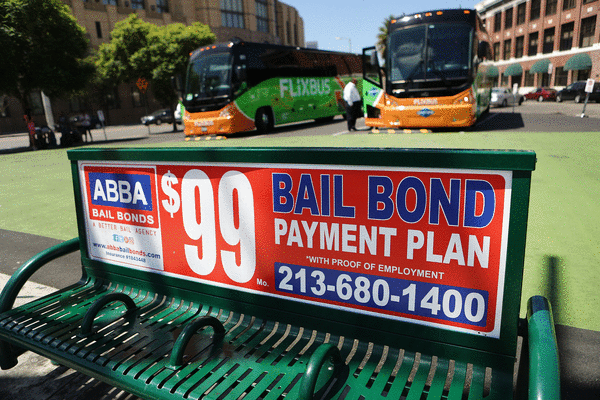
Gerald Kowalczyk tried to buy a hamburger with credit cards he found on the floor. Then, while presumed innocent, he spent months in a California jail — not because a judge determined he was dangerous, not because he threatened anyone, but because the court set bail at $75,000 for a man who couldn’t afford it, then simply denied bail altogether, in defiance of the law. Last week, the California Supreme Court unanimously said no more. The court held that pretrial liberty is the norm; incarceration before conviction for any crime is the rare, carefully limited exception. If courts choose to condition freedom on a monetary payment it “must” be “an amount that is reasonable.”
For years, California courts ran an unconstitutional shadow detention system. The mechanics were straightforward: Set bail at an amount the defendant cannot pay and the result is the same as ordering detention outright. As the court explained in its Kowalczyk ruling, pretrial detention requires strong evidence of a serious charge and“clear and convincing evidence establishing a substantial likelihood that the defendant’s release would result in great bodily harm to others.” Instead, as Justice Joshua P. Groban explains in concurrence, courts have used money bail to detain poor people accused of nonviolent offenses with “devastating repercussions for their employment, education, housing, access to public benefits, immigration status, and family stability.”
This wasn’t a bug. It was the system.
Last week’s ruling closes that loophole — unambiguously and unanimously. Courts can no longer use unaffordable bail as a backdoor detention order. Where detention isn’t authorized, bail must be set at an attainable amount, based on the defendant’s actual circumstances. The ruling builds directly on the Humphrey precedent from 2021, a California Supreme Court decision that first held wealth-based detention unconstitutional and a case I helped bring.
I know how hard these victories are to win. I also know how easily they can be ignored.
Even after Humphrey was decided, across Santa Clara, San Mateo and Alameda counties, judges asked about a defendant’s financial circumstances exactly once out of nearly 250 observed cases. In more than 95% of hearings, judges cited no legal standard at all when ordering detention. More than 90% of people jailed pretrial were charged with offenses that didn’t even qualify for detention under the California Constitution: shoplifting, driving without a license, vandalism. These findings came from Silicon Valley De-Bug, a community organization whose members spent years watching what happens in arraignment courtrooms.
The system didn’t follow the rules set out in Humphrey. We must ensure the system makes good on the unanimous ruling in Kowalczyk.
Start with public defense. California is one of just two states that contributes no funding to trial-level public defense, leaving the 58 counties with no state standards or oversight. The result is a patchwork of wildly unequal and inadequate representation. Last week’s ruling requires courts to make individualized findings about flight risk, public safety, alternative release conditions and ability to pay — which means defense attorneys must be present at or before arraignment, prepared to make ability-to-pay arguments, demand findings and challenge unaffordable bail on the record. In counties where public defenders carry caseloads of 100 or more, that is not happening. It cannot happen without resources.
Then there is the question of alternatives. The ruling requires judges to consider conditions of release — drug treatment, check-ins, social services referrals, in serious cases ankle monitoring — before resorting to money bail or detention. But these options exist only where counties have invested in pretrial services outside of law enforcement, programs such as San Francisco’s Pretrial Diversion Project. Most haven’t. A constitutional right to alternatives is hollow without alternatives for judges to choose from.
Finally, the Judicial Council, which makes policy for California courts, should establish monitoring standards, reporting requirements and training protocols that ensure courts no longer impose unnecessary or unconstitutional pretrial incarceration.
Kenneth Humphrey spent 250 days in jail for $5 and a bottle of cologne. Gerald Kowalczyk spent months inside for a hamburger. Behind each of them are tens of thousands of Californians who spent similar time behind bars unjustly, who lost jobs and homes and custody of their children, because the system treated their poverty as grounds for imprisonment.
The Supreme Court has now said clearly what our Constitution has since 1849: Pretrial liberty is the norm. Pretrial detention is the carefully limited exception. There is a good reason for the presumption of innocence: 1 in 3 California arrests does not lead to any conviction, and upending people’s lives by jailing them pretrial is so destabilizing it actually increases future crime.
Let’s ensure this presumption of innocence means something in practice if you, or your loved one, need it.
____
Chesa Boudin is the former district attorney of San Francisco and the executive director of the Criminal Law & Justice Center at UC Berkeley School of Law.
©2026 Los Angeles Times. Visit at latimes.com. Distributed by Tribune Content Agency, LLC.































Comments