Pro-Trump group tests Chicago officials' patience with public testimony, triggers legal tangles
Published in News & Features



CHICAGO — Cook County Commissioner Tara Stamps declared after a recent meeting that she’d had enough.
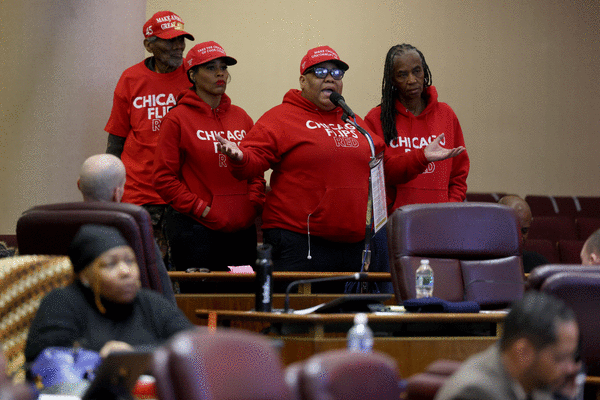
Jessica Jackson, a member of the group Chicago Flips Red, had taken to the podium that March morning during public comment in front of the county’s Finance Committee. Jackson didn’t address any agenda items, instead hitting what for her is a common refrain: that the county had spent too much on immigrants at the expense of other quality of life improvements.
Hours later, Stamps sent a brief email to fellow Commissioner John Daley and two other colleagues, plus Laura Lechowicz Felicione, the general counsel for Board President Toni Preckwinkle.
“I am fed up with how we allow the rampant disrespect to go on in our board meetings! These people are unstable, disrespectful, and completely out of order,” she wrote, according to an email obtained through a Tribune open records request. “We are complicit in being disrespected on our jobs. What you all are calling free speech feels like harassment and sounds like slander. The room is becoming increasingly unprofessional and unstable.”
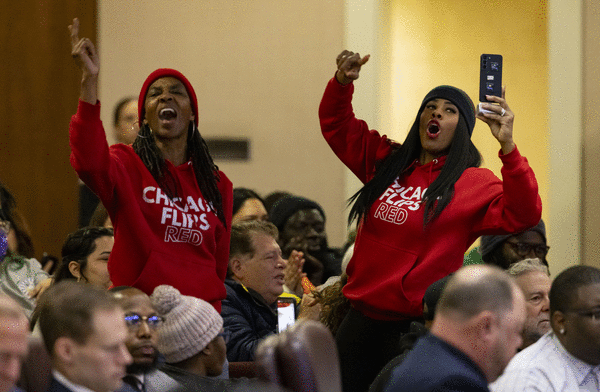
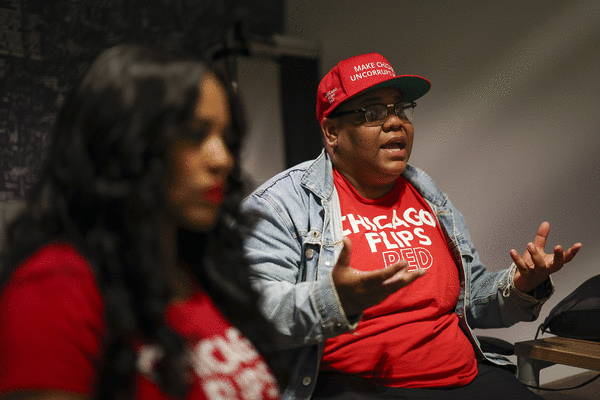
Decked out in red, the small group of mostly Black supporters of Republican President Donald Trump has been testifying before majority-Democratic city and county officials for months, railing against taxes and crime, and tying both to local sanctuary policies. Their near-constant activism has earned applause from as high up as the White House, they say. To detractors, they are disruptive gadflies at best, and at worst, attention-seekers or grifters whose speech could incite violence.
Some Chicago Flips Red members have been escorted out of City Council chambers and the county boardroom for violating rules of order — including shouting, interrupting or insulting other speakers or aldermen — and led some to consider or pursue orders of protection. Members of the group have fought some of that pushback in court as First Amendment violations.
Last August, Trump told reporters, in an apparent reference to the Chicago Flips Red protesters, “You have a force of Black women, Black women … they want Trump to come in. And you see them, they’re all over the place in Chicago.”
Democrats uniformly dismissed the president’s contention the group’s take reflected broader city sentiment.
The tension is especially acute in the close quarters of the Cook County Board room, where staff and commissioners, including Stamps, sit only a few feet away from public speakers, who at times raise their voices and address or disparage officials by name.
Her voice rising as the three-minute limit neared, Jackson turned to a typically nonplussed Daley and described him as “the lowest of the low.”
Stamps’ email later that day was a snapshot of the polarizing environment political figures find themselves in today, when invective and constant protest can steer away from decorum and, to some, edge closer to the line between harassment, stalking or worse. Politicians are also expected to roll with the punches of public criticism, but have broadly said they are subject to increased threats.
The line between protected speech and intimidation is a tricky one, the ACLU of Illinois’ Ed Yohnka told the Tribune. “What you want to make sure is that you are not, in any way, trying to punish a speaker for the content of their speech,” he said of government leaders. “You want people to be able to express what they feel as part of this policymaking process. I think that does put a higher responsibility and burden on the public official to accept and just sort of go with criticism, which can be uncomfortable, objectionable, and sometimes probably feels very personal, but that’s the nature of being in that arena for decision making.”
“Where this gets precarious is if you have an individual, a group of individuals, who are using tactics that suppress or chill others, either from offering their own public comment or policymakers from offering opinion out of fear that this opprobrium will be directed towards them. That really limits the discourse and sort of harms the ability to arrive at sound judgments about policy,” Yohnka said.
In a statement, Stamps said she should not have to “face harassment or intimidation simply for doing the work my community entrusted me to do,” and that groups like Chicago Flips Red cross “the line from civic engagement into conduct that is disruptive, disrespectful, and, at times, threatening. Especially in a moment where threats against elected officials have escalated — and in some cases have turned deadly — we must be clear: no one should have to serve under fear for their safety or their life.”
The situation involving Stamps is noteworthy in part because her mother, Marion Nzinga Stamps, was a passionate community activist at the Cabrini-Green public housing complex who was known to confront officials to press her case. Mayor Richard M. Daley once skipped his own news conference on job creation rather than face her.
“The First Amendment protects the right to speak and to disagree, but it does not protect threats, harassment, or intimidation. I remain committed to being present and accessible in the community, but that must be balanced with ensuring safety — for myself, for my colleagues, and for the residents we are elected to serve,” Stamps’ statement continued. “We cannot normalize this kind of behavior, and we must take it seriously. I fully support enhanced security measures to ensure elected officials can serve safely and effectively, both within government spaces and in the neighborhoods we are elected to represent.”
By March, Stamps’ staff had already asked the board’s secretary to preserve audio and video of targeted or threatening behavior to prepare a civil order of protection. Stamps separately drafted updates to the county’s public comment rules, according to emails obtained through the open records request. Her safety concerns were taken seriously by county leadership, records show, but one member of the same group that spurred the complaint had already sued the county for First Amendment violations.
According to communications received as part of the open records request, Stamps reported being followed to the county’s lobby by Chicago Flips Red members after a task force meeting on domestic violence. Members also showed up at the headquarters of the Chicago Teachers Union, social media videos show, where Stamps is administrator of new teacher development.
The group also counter-protested against the CTU at Friday’s May Day demonstrations at Union Park, yelling that some marchers were “evil,” railing against non-binary people, or saying children in attendance were “white racist liberals in the making.”
“The escalation from online activity to in-person harassment at a professional location is particularly troubling and may constitute targeted harassment,” Stamps’ chief of staff wrote in late January.
In an email, John Heiderscheidt, the attorney for three Chicago Flips Red members, said, “It is dangerous and crazy” to let the teachers union “silence political dissent under the guise of speech being ‘harassment.'”
“It is a precedent that can be unfairly turned against parents, and even the press, and absolutely will be when it becomes politically expedient,” Heiderscheidt said.
“Far more evidence” is needed to prove Chicago Flips Red members’ actions were threatening or approached stalking, Heiderscheidt said.
County court records do not show Stamps filed an order of protection. The county sheriff’s office said it offered Stamps an escort to and from her car when she was on county business.
In her staff’s request for help, they noted that a video Chicago Flips Red posted to social media received a comment from a woman that said she was “rooting for the hard working Chicago tax paying citizens!!! If you need help, I’m very well armed and I have a good aim!!! Fired expert in the military for almost 20 yrs!!! I have a rifle that I can fire effectively up to 400 mtrs!!! Assault rifle that is!!! Don’t unleash this!!!”
In late March, CTU filed an emergency workplace protection restraining order in Cook County Circuit Court against three members of the group.
In court documents, CTU lawyers allege the group’s protests outside union headquarters had grown increasingly threatening since January.
Chicago Flips Red members loudly yelled “that any and all CTU employees are ‘pedophiles,’ … ‘f—-g kid groomer[s],’ … and similar wholly false allegations that CTU employees are abusing children,” according to the court documents, an apparent reference to a recent report from Chicago Public Schools’ inspector general, which included 55 substantiated findings of sexual misconduct by CPS employees, including teachers.
Videos also show Chicago Flips Red members calling for the release of financial audits, which the union did publicize at the same time it turned over the documents to a congressional committee in January.
Chicago Flips Red members also took pictures of union members’ license plates, court records allege, as well as saying, “We need to start following them,” and yelling “rest in peace” and that “sacrifices have to be made.”
Multiple videos posted on Chicago Flips Red’s Facebook page show the group standing on the sidewalk outside the union’s headquarters — including one yelling at Stamps as she exited her car — blowing whistles, chanting through a bullhorn, and calling people entering the building “commies” and “hypocrites.”
CTU requested that three Chicago Flips Red members be barred from coming within 1,000 feet of CTU headquarters and using amplified sound within 3,000 feet.
Heiderscheidt said in a separate court filing on April 16 that CTU’s claims contained “false, misleading, and defamatory information,” and that members were engaged in “lawful, First Amendment speech” on public property, noting that the Chicago Police Department wouldn’t even arrest his clients on one of the protest days in question.
He declined to elaborate further, telling the Tribune in a text message: “I am in discussions on the case with opposing counsel now, and we are hoping to get it resolved quickly. I don’t have anything else to add at this time.”
Records show the president’s office took Stamps’ safety complaints to heart. Soon after her chief of staff reached out in January, Lechowicz Felicione contacted the sheriff and state’s attorney for guidance.
Sheriff spokesman Matthew Walberg told the Tribune the office “offered to escort her to and from official Board events, which she subsequently requested on several occasions” and offered to conduct premises checks at her home. They encouraged her “to contact her local police department to file a report.”
In addition to the two deputies stationed inside the board room during meetings, the sheriff’s office also scans bags and uses a magnetometer for visitors.
The state’s attorney’s office declined comment, citing client confidentiality, but records suggest they did advise Lechowicz Felicione on potential changes to board rules on public comment.
Some of Stamps’ suggestions were already in county code, but they could better define “certain terms or enforcement as proposed in your draft ordinance,” Lechowicz Felicione told her in an early February email.
In a later exchange, she noted the state had made clear that even insensitive, mean spirited personal attacks were protected if they pertained to matters of public concern.
County code bars “the use of vulgar, abusive, discriminatory, or otherwise profane language when addressing a board or committee,” limits public speakers to three minutes, and requires that people speak no louder than they would to a person sitting next to them.
Violators are supposed to get a warning before potential booting from the meeting, and two expulsions in a row can lead to a ban from proceedings.
The county had to tread carefully, though, Lechowicz Felicione added, because they were already facing a lawsuit “regarding alleged First Amendment violations for allegedly limiting public comment at a Cook County Board meeting.”
That suit was filed by Zoe Marsh-Leigh, one of the leaders of Chicago Flips Red, and included allegations of other violations on the city side of the building.
While attending a county board meeting in March of 2024, Marsh-Leigh criticized Preckwinkle for turning “a blind eye” when it came to issues of Black property ownership, according to court records. During that tirade, she referred to the board president by a slavery-era term that is now considered derogatory.
She was removed from that meeting, alleging she was detained for an hour and not called on to speak at the two later board meetings even though she signed up, a violation of her First Amendment rights.
The county’s rebuttal said Marsh-Leigh used “fighting words” intended to incite a breach of peace, records show. That kind of speech is not protected by the First Amendment.
While District Judge Matthew Kennelly found in late December the use of those words “vile and disgusting…abusive, insulting and completely inappropriate,” it was not enough to constitute fighting words, because it was not directed to produce “imminent lawless action” and was part of Marsh-Leigh’s argument about “Preckwinkle’s perceived alignment with institutional actors harming Black property owners.”
He allowed Marsh-Leigh to file an amended complaint based on “viewpoint discrimination and retaliation claims” against Preckwinkle. That case is pending.
©2026 Chicago Tribune. Visit at chicagotribune.com. Distributed by Tribune Content Agency, LLC.





Comments