Baltimore's proposed data center moratorium includes loophole for some projects
Published in News & Features
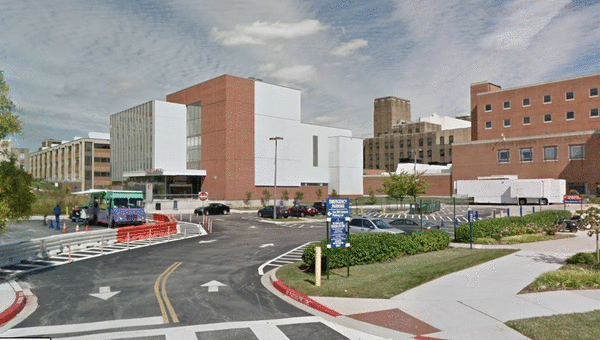
BALTIMORE — As Baltimore lawmakers debate whether to temporarily halt new data centers in the city, Johns Hopkins University is moving ahead with a $192 million expansion of its own computing infrastructure — aided by a loophole in the city’s proposed moratorium.
The Maryland Board of Public Works on Wednesday approved $9.04 million in state funding for a new 25,000-square-foot data center at Hopkins’ Bayview campus, according to board documents.
The project would expand computing capacity for the university’s Advanced Research Computing at Hopkins, or ARCH, program, formerly known as the Maryland Advanced Research Computing Center. The Bayview-based operation has supported research across Baltimore since opening in 2015, the university said.
The approval comes as the Baltimore City Council advances legislation that would place a temporary moratorium on new data center construction — while carving out exemptions for facilities under 10 megawatts and certain institutional projects, including those tied to universities like Hopkins.
Data center critics call for a freeze
Critics argued during a Land Use Committee hearing Thursday that the carveouts could undermine the entire purpose of the legislation, warning that data centers threaten Maryland’s climate goals, electrical grid and utility affordability.
“It’s clear that data center facilities are a threat to greenhouse gas emissions reduction goals, ratepayers, water resources, public health and the working class,” said Brittany Baker, Maryland director of the Chesapeake Climate Action Network.
Baker warned that Maryland lacks sufficient regulations to manage the rapid growth of energy-hungry data centers and argued allowing projects to move forward during a moratorium period would give developers “unwarranted political power to influence the regulatory process.”
Baltimore resident Raychel Gadson urged city leaders to take a broader look at the long-term impact of data centers on residents and infrastructure.
“Tech is outpacing regulation. It’s outpacing city, state and local government,” Gadson said. “It’s outpacing our power grids. It’s outpacing what we as people are prepared to understand and participate in as informed consumers.”
Gadson said Baltimore should comprehensively examine how large-scale data centers could affect energy costs and quality of life before allowing additional projects to move forward.
“The only way we regulate this to make sense for people, for cities, for our bills, which are outrageous, is by looking really comprehensively at the impact of data centers,” she said.
She also questioned whether data centers provide enough direct public benefit to justify their growing energy demands.
“When a company builds a center that is for computers and not for people, that only employs a small number of people or even almost no people, that’s not an investment in a city — that’s extortion,” Gadson said. “That’s them raising our bills and forcing us to pay for their profits.”
The moratorium is on par with what other counties are doing. Baltimore and Carroll counties both passed one-year moratoriums back in February. Montgomery County introduced a one-year moratorium on data centers this past week.
Hopkins provides details on data center plan
Hopkins defended the Bayview expansion Thursday, saying the project is designed to support growing research demands across multiple campuses, including life sciences and biomedical research in East Baltimore and the university’s new Data Science and Artificial Intelligence Institute in Remington.
“With support from the State of Maryland over the past two years, we will meet JHU’s current and future research needs,” a university spokesperson said in a statement.
The spokesperson said the facility would support “data-intensive” research in fields including public health, engineering, astronomy and artificial intelligence, while also incorporating advanced cooling technology intended to reduce energy waste.
Hopkins separately emphasized that its under-construction Data Science and Artificial Intelligence Institute in Remington is not a data center and is not expected to consume more electricity than a typical academic building.
The proposed moratorium legislation remains under consideration by the City Council.
_____
©2026 The Baltimore Sun. Visit at baltimoresun.com. Distributed by Tribune Content Agency, LLC.






Comments